
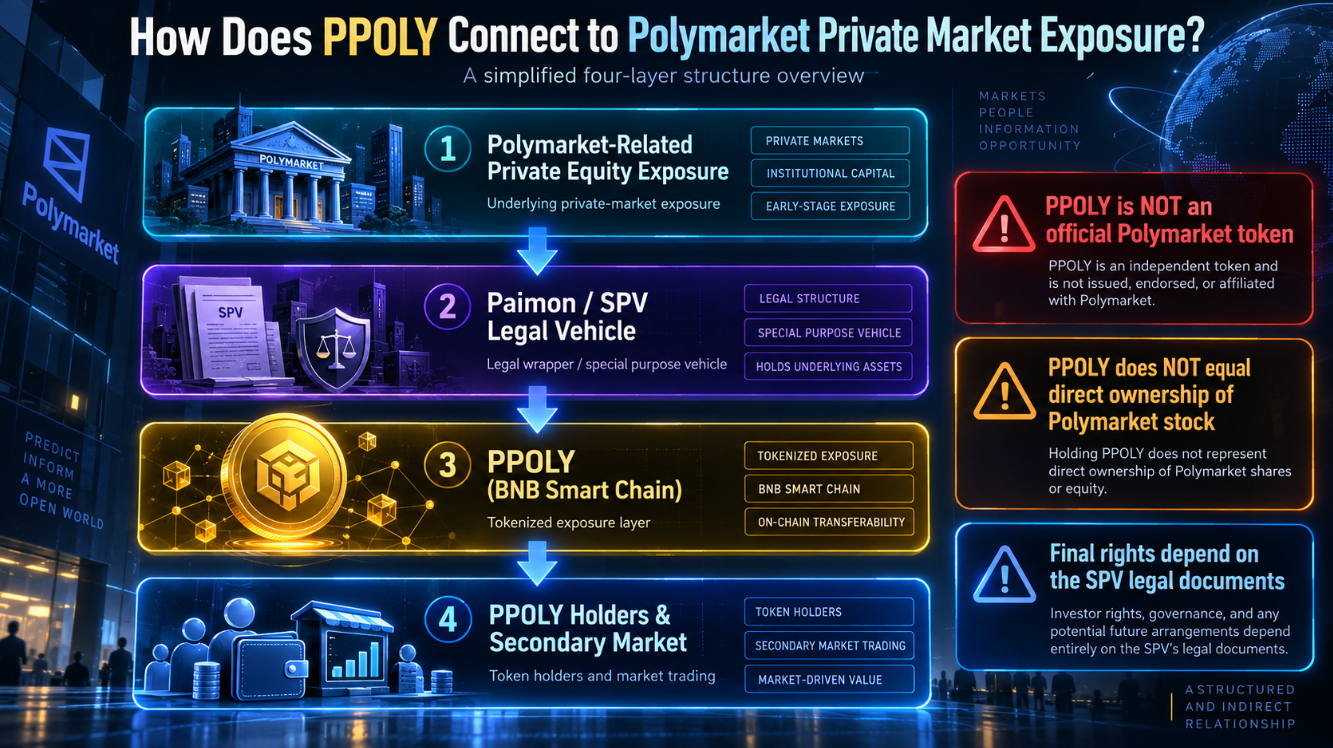
PPOLY is not Polymarket's official platform token, nor should it be simplistically understood as "Polymarket stock ported onto the blockchain." More precisely, it is a Pre-Access/SPV-related asset presented by Paimon Finance on BNB Smart Chain, attempting to give the market economic exposure linked to Polymarket's private equity.
This distinction determines how PPOLY should be valued. When analyzing ordinary crypto tokens, investors often look at tokenomics, protocol revenue, governance utility, and FDV; when analyzing tokenized public equities, one can reference public share prices and net asset value. But PPOLY's value chain has one or even several additional layers of intermediate structure:
Polymarket-related private equity → SPV → economic rights represented by PPOLY → exchange secondary market price
If any layer lacks reliable disclosure, the price cannot be directly equated with the underlying asset value.
As of October 8, 2026, Paimon's official website lists Paimon Polymarket SPV under Pre-Access products and uses pPOLY as the market reference ticker; MEXC uses PPOLY/USDT as the trading pair and opened trading on September 29, 2026. Paimon also explicitly warns that private market exposure may lack liquidity and be subject to transfer restrictions.
Risk Disclaimer: This article is intended for asset mechanism research and risk education and does not constitute investment, legal, or tax advice. PPOLY involves multiple layers of risk including private assets, SPVs, on-chain tokens, and exchange secondary markets, and may experience significant premiums or discounts, insufficient liquidity, rights that cannot be enforced, or total loss of principal. Prices, supply figures, and project disclosures may change; before trading, re-verify official documents, contracts, and order books.
Key Takeaways: 9 Things to Know Before Researching PPOLY
- PPOLY runs on BNB Smart Chain, with contract address
0x1D80392D12CAAaF9E333Bb0bb7f021eaCf297Fe6. - PPOLY is launched under Paimon Finance's Pre-Access/SPV product framework and should not be called Polymarket's official token.
- Holding PPOLY does not mean directly holding Polymarket shares on the shareholder register.
- Whether it carries dividends, sale proceeds, liquidation distributions, or other rights must be determined by the SPV and token legal documents.
- Paimon describes Pre-Access as a private market access product comprising Deal Room, Eligibility, Allocation, and Settlement.
- MEXC has listed PPOLY/USDT, but an exchange price does not mean the project has provided a verifiable real-time NAV.
- MEXC's listing announcement states a total supply of 1 billion tokens; CoinMarketCap showed on October 8, 2026, a max supply of 1 billion and total/circulating supply of approximately 322,600. The discrepancy between these two figures requires further explanation from the project team.
- Low float can amplify price and FDV, and also amplify future issuance, unlock, and premium compression risks.
- The most important factor in deciding whether PPOLY is worth investing in is not the candlestick chart, but whether the four answers—Underlying, Rights, NAV, and Exit—are clear.
I. What Is PPOLY? First Confirm the Asset Identity
PPOLY stands for Paimon Polymarket SPV Token. Paimon's official website currently lists it under "Paimon Polymarket SPV" with the ticker pPOLY; MEXC uses PPOLY as the trading ticker. Only when both point to the same contract can they be considered the same asset.
PPOLY's basic information includes:
- Network: BNB Smart Chain;
- Asset type: Pre-Access / SPV-related Token;
- Paimon page ticker: pPOLY;
- MEXC trading ticker: PPOLY;
- Trading pair: PPOLY/USDT;
- Contract:
0x1D80392D12CAAaF9E333Bb0bb7f021eaCf297Fe6; - MEXC announcement supply figure: 1,000,000,000 PPOLY.
"SPV-related Token" is the key phrase for understanding this asset. It is not a Polymarket market share predicting "whether something will happen," nor is it a utility token for paying Polymarket fees. What investors are trading is an on-chain wrapper tied to private market economic rights.
Why Is It Written as pPOLY and PPOLY Differently?
Paimon's official website uses pPOLY as the Market Reference, while MEXC uses PPOLY. In crypto markets, exchange tickers are not globally unique, and the same asset may use different capitalization or prefixes on product pages versus trading platforms.
Therefore, the verification sequence should be: network, full contract address, issuance page, legal documents, and finally the ticker. Looking only at the five letters "PPOLY" cannot rule out same-name tokens or counterfeit assets.
Is PPOLY Polymarket's Official Coin?
There is currently insufficient evidence to call PPOLY Polymarket's officially issued token.
Polymarket is a prediction market platform; Paimon Finance is a platform providing RWA, private market Pre-Access, and SPV tokenization products; PPOLY appears within Paimon's Pre-Access/SPV product system. These three cannot be conflated into one company or one protocol.
The brief project introduction in MEXC's announcement may easily lead readers to associate it with "launched by Polymarket," but Paimon's official website and documentation show that product issuance and on-chain structure come from the Paimon system. Unless Polymarket itself announces or a legally binding document explicitly confirms otherwise, the more prudent statement should be:
PPOLY attempts to provide Polymarket-related private market economic exposure, not Polymarket's official platform token.
Is PPOLY Polymarket Stock?
This also cannot be stated directly.
Directly holding company shares typically means the investor has a clear shareholder identity and related rights under applicable law and shareholder documents. Holding an SPV Token may only mean holding economic rights to a special purpose vehicle, and those rights are further constrained by the SPV's charter, subscription agreements, transfer restrictions, fee provisions, and distribution waterfall.
So "the underlying is related to Polymarket" and "Token Holders directly hold Polymarket stock" are two different things.
II. What Is an SPV? Why Private Assets Need This Layer
SPV stands for Special Purpose Vehicle. It is typically established to hold a specific asset, isolate liability, or organize multiple investors.
A simplified structure might be:
Investor funds → SPV purchases or holds private assets → SPV generates sale or distribution proceeds → distributes to rights holders per documented terms
In the context of PPOLY, the chain the market hopes to see is:
PPOLY holder → an enforceable SPV economic right → Polymarket-related private equity
But "hoping to see" does not equal "already fully proven." Complete due diligence must at minimum answer: the SPV's legal name, jurisdiction, manager, actual holdings, custody or registration evidence, purchase cost, current liabilities, fees, Token Holder rights, and exit distribution methods.
If these documents are not public, investors cannot accurately calculate how much net asset value one PPOLY represents, nor confirm whether final proceeds can legally flow through to Token Holders.
What Might Economic Interest Include?
Depending on the documents, economic rights may include:
- Net cash distributions after the SPV sells the underlying asset;
- Net proceeds after the underlying company is acquired;
- Proceeds from selling shares after an IPO;
- Residual asset distributions upon SPV liquidation;
- Token redemption or cash settlement under specified conditions.
But one cannot automatically assume PPOLY includes:
- Polymarket shareholder voting rights;
- Shares directly registered on Polymarket's shareholder register;
- Redemption at NAV at any time;
- Polymarket protocol governance rights;
- Polymarket platform revenue sharing;
- Automatic conversion to listed stock after an IPO.
The truly valid answers can only come from legal documents, not project names, exchange summaries, or social media slogans.
III. How Does Paimon Pre-Access Work?
Paimon's official website describes Pre-Access as a Deal Room for curated private market exposure and lists four stages: Deal Rooms, Eligibility, Allocation, and Settlement.
Deal Room: First Confirm the Transaction Itself
A Deal Room is not just a project introduction page. Mature private transaction materials typically need to include the underlying asset, SPV entity, transaction size, valuation, fees, subscription terms, risk factors, and exit arrangements.
For PPOLY, the most important question is not "how popular is Polymarket," but whether the Deal Room sufficiently proves what the SPV actually holds.
Eligibility: Having USDT Does Not Mean You Qualify
Private assets may involve jurisdictional restrictions, KYC, accredited investor requirements, sanctions screening, and transfer restrictions. A wallet being able to receive tokens does not mean the holder legally enjoys the same rights in all regions, nor does it mean anyone can participate in subscriptions, redemptions, or final distributions.
Paimon's official website explicitly warns that Private Market Exposure may lack liquidity and be subject to transfer restrictions. This shows that "free on-chain transferability" and "free transferability of underlying private equity rights" cannot be equated.
Allocation: Token Quantity Does Not Equal Underlying Share Quantity
Allocation must answer who receives how much, at what price, which tokens carry economic rights, and how unallocated amounts are handled. If 1 billion is merely the contract max supply while the number of tokens actually entitled to economic rights is defined differently, then directly calculating per-token NAV based on 1 billion would produce incorrect conclusions.
Settlement: Secondary Trading Does Not Mean Rights Have Been Settled
Settlement should explain when funds enter the SPV, when the SPV acquires the underlying asset, what evidence can verify this, and under what conditions Token Holders obtain enforceable rights. An exchange listing only proves that a market can trade a certain token; it cannot replace the legal settlement of private assets.
IV. How Much Polymarket Exposure Does 1 PPOLY Actually Represent?
As of the date of this article, this question cannot be reliably answered from public pages alone.
To calculate PPOLY's look-through NAV, at minimum you need:
- The number of Polymarket shares or economic rights held by the SPV;
- The per-share cost and valuation at which the SPV purchased;
- The latest financing round or reliable secondary market reference price;
- SPV cash, liabilities, management fees, carry, and tax costs;
- The number of PPOLY tokens that actually share in economic rights;
- Token issuance, burn, redemption, and conversion rules.
The theoretical formula can be written as:
PPOLY Look-through NAV = (Fair value of underlying rights held by SPV + other assets − liabilities − accrued expenses) ÷ PPOLY tokens entitled to economic rights
The denominator here is not automatically equal to 1 billion. If the project has not disclosed "the supply entitled to economic rights," one cannot divide Polymarket's company valuation by 1 billion to derive a reasonable PPOLY price.
This is not a small information gap—it is the most critical variable in the valuation model.
V. What Do 1 Billion Supply, 322,600 Circulating, and FDV Respectively Mean?
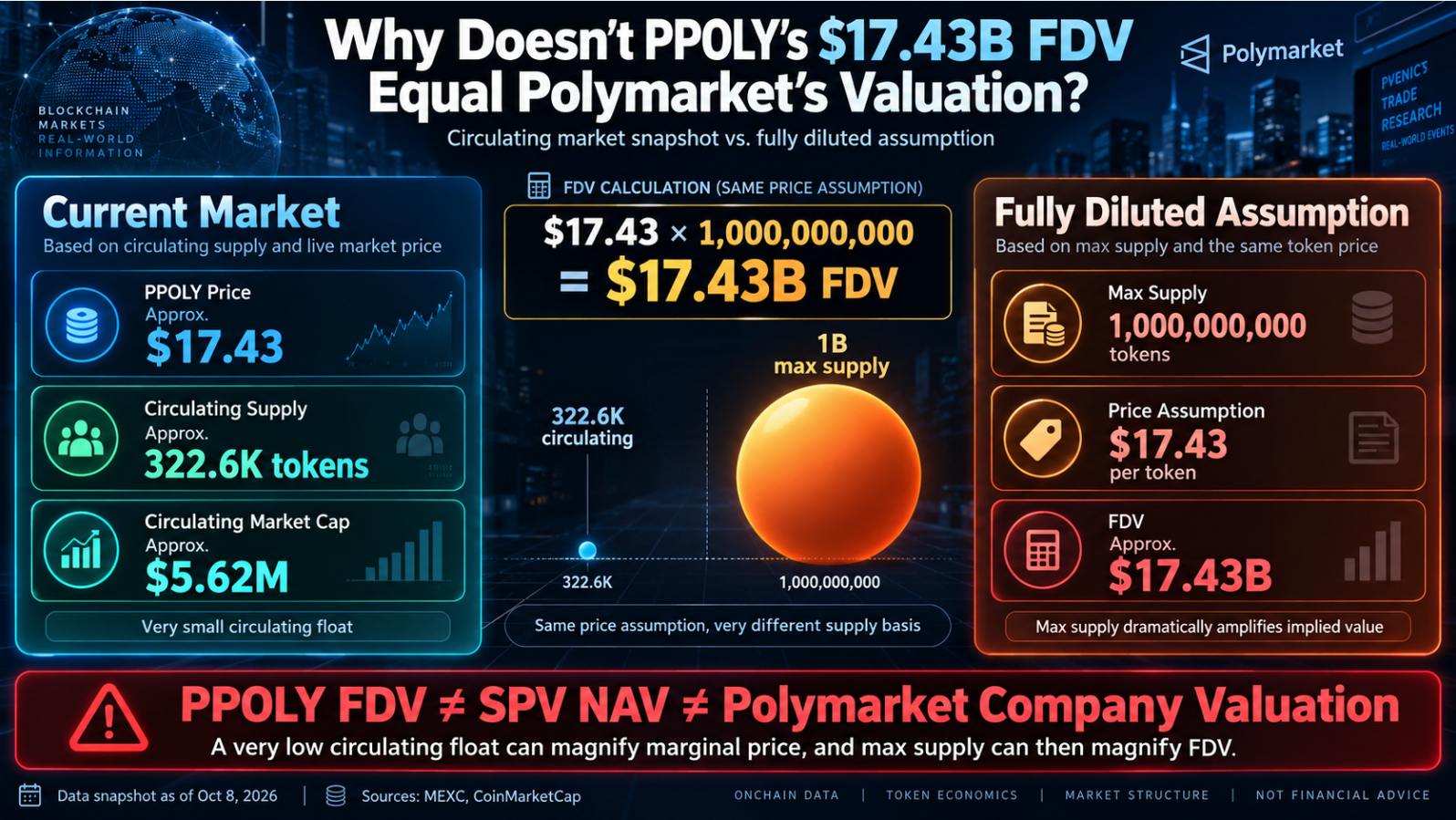
MEXC's listing announcement states Total Supply as 1 billion. CoinMarketCap's page on October 8, 2026, showed:
- Price approximately $17.43;
- Circulating market cap approximately $5.62 million;
- 24-hour trading volume approximately $95.76 million;
- Max supply 1 billion;
- Total supply and circulating supply approximately 322,600;
- Circulating ratio approximately 0.0323%;
- FDV based on max supply approximately $17.43 billion.
These figures will continue to change, but more importantly, there is a clear discrepancy between the two "total supply" figures. The 1 billion in MEXC's announcement may refer to the contract setting or max supply cap, while CMC's 322,600 is closer to the currently issued amount counted as total and circulating supply. Before formal investment, one must check the on-chain contract, minting authority, and project allocation documents to confirm how the two figures reconcile.
Why Is PPOLY's FDV Especially Misleading?
The mechanical calculation of FDV is:
Token price × Max supply
If PPOLY's price is $17.43 and max supply is 1 billion, FDV is approximately $17.43 billion. But this number only describes the mathematical result of "if all 1 billion tokens were valued at the current secondary market price." It does not represent:
- Polymarket's company valuation being $17.43 billion;
- The SPV holding $17.43 billion in assets;
- All 1 billion tokens corresponding to equal private equity rights;
- Future newly issued tokens continuing to trade at $17.43;
- The project having sufficient redemption assets to support the entire max supply.
Under extremely low float, a small amount of chips can create a very high marginal transaction price, and multiplying that price by a huge max supply produces an extremely exaggerated FDV. This "low Float × high price × large Max Supply" structure especially warrants caution.
Why Does Circulating Supply Affect Short-Term Prices More Than Max Supply?
The fewer tradable chips currently available, the easier the same buying pressure can push up the price; but equally, a small amount of selling pressure can also cause significant declines. If future circulating supply increases from 322,000 to 1 million, 10 million, or even higher, the capital required to maintain the same price rises rapidly.
Therefore, supply analysis cannot only ask "what is the total supply" but also:
- Who can mint new tokens?
- Why is there such a large gap between issued amount and max supply?
- How much do the team, SPV, market makers, and community each hold?
- Are there lock-ups, vesting periods, and unlock calendars?
- Do newly issued tokens automatically receive the same economic rights?
- Does burning or redemption correspondingly reduce supply?
If Vesting and Unlock are not adequately disclosed, "supply uncertainty" should be treated as a major risk, rather than explained away after prices fall.
VI. What Four Layers of Value Jointly Determine PPOLY's Price?
Layer 1: Polymarket Private Market Valuation
The underlying company's business growth, financing valuation, secondary private market trading prices, regulatory progress, and potential IPO expectations affect the theoretical value of Polymarket-related rights.
Layer 2: SPV Look-through NAV
Even if Polymarket's valuation rises, how much the SPV holds, at what cost, and whether there are liabilities and priority distributions still affect the value attributable to PPOLY.
Layer 3: Fees, Carry, and Taxes
Management fees, setup fees, administration fees, legal fees, custody fees, performance carry, exit fees, and tax costs all cause Gross Return to differ from the final return to Token Holders.
Layer 4: Secondary Market Premium or Discount
PPOLY's exchange price is also affected by low float, market-making depth, FOMO, crypto risk appetite, and listing events. In the short term, this layer may even completely overwhelm the first three layers.
From this, a very important conclusion follows:
Better Polymarket fundamentals do not guarantee PPOLY will rise; a PPOLY surge does not prove Polymarket's valuation has risen in tandem.
VII. The Most Important Metric for PPOLY: Premium/Discount to Look-through NAV
If reliable documents become available in the future, two metrics should be calculated for PPOLY.
PPOLY Look-through NAV
Net Polymarket exposure attributable to PPOLY from the SPV ÷ PPOLY tokens entitled to economic rights
This metric answers "how much underlying net asset value one PPOLY theoretically corresponds to."
PPOLY Access Premium
PPOLY market price ÷ PPOLY look-through NAV − 1
This metric answers "how much access premium investors are paying to gain early Polymarket private market exposure."
For example, if document-verified per-token look-through NAV is $10 and the market price is $17, the access premium is approximately 70%. At this point, investors are not just betting on Polymarket rising—they are also betting that future buyers will continue paying a high premium.
Conversely, a discount does not necessarily mean an arbitrage opportunity. If the token cannot be redeemed, the underlying asset cannot exit for years, or investors lack enforceable legal rights to distributions, the discount may persist long-term.
Why Can PPOLY Fall Even When the Underlying Rises?
Suppose Polymarket-related private market valuation rises 20%, but PPOLY previously traded at a 100% premium to NAV. If market enthusiasm fades and the premium compresses from 100% to 30%, PPOLY's price can still decline.
This is Premium Compression. For PPOLY, it may be more important than short-term changes in the underlying company.
Why Can PPOLY Surge Even When the Underlying Is Unchanged?
Low float, exchange listings, market-making capital, short-term FOMO, and the "Pre-IPO" narrative can all push up the token price. In this case, the rise primarily comes from secondary market premium, not SPV net asset value growth.
If the project does not simultaneously disclose new holdings, valuations, or exit information when the price rises, the move should be understood primarily as market repricing, not as underlying value having been proven to increase.
VIII. Exchange Liquidity and Private Asset Liquidity Are Two Different Things
PPOLY/USDT having trades only means the token can be bought and sold in a specific market. Whether the private equity held by the SPV can be sold, when it can be sold, and at what discount are a separate set of liquidity questions.
Token Liquidity
Observe:
- 1% and 2% order book depth;
- Bid-ask spread;
- 24-hour real volume;
- Market maker concentration;
- CEX vs. DEX price differences;
- Estimated slippage for large orders.
Underlying Liquidity
Observe:
- Whether private equity transfer is permitted;
- Whether the company has a right of first refusal;
- Whether the SPV can find qualified buyers;
- Whether transfer requires company or manager consent;
- Whether IPO, acquisition, or next financing round constitutes a liquidity event.
The token market can form prices 24 hours a day, but the underlying private asset may only see a reliable transaction once every several months or even years. Therefore, the MEXC order book price is not a real-time NAV—it is only the marginal price at which current traders are willing to buy or sell PPOLY.
As of October 8, 2026, CMC showed PPOLY's 24-hour trading volume far exceeding its circulating market cap. High turnover indicates very active short-term trading, but it does not prove the underlying asset is liquid, nor does it guarantee large holders can exit with low slippage.
IX. What Should Be Looked at in Polymarket's Fundamentals?
PPOLY's underlying narrative is related to Polymarket, so the prediction market business needs to be studied, but platform popularity cannot be directly equated with token NAV.
Trading Volume and Active Users
Trading volume can reflect participation, but one must also observe active traders, retention rates, number of markets, repeat trading ratio, and distribution across event categories. Elections or major breaking events may bring short-term peaks, while structural growth requires users to continue using the platform outside election cycles.
Open Interest and Market Depth
Open Interest, spreads, and executable depth better reflect market quality than cumulative Volume alone. If trading is concentrated in a few headline events, the platform's dependence on a single theme remains high.
Fees and Revenue
Polymarket's official fee page shows that fees do not simply cover all markets—some markets charge Taker Fees, and some trading activity generates no platform fees. Therefore:
Prediction market trading volume ≠ Company Revenue
Valuation models must further confirm Take Rate, market-making incentives, operating costs, compliance costs, and profitability. Multiplying annual trading volume by an imagined valuation multiple cannot yield a reliable company value.
Can Non-Election Markets Sustain Growth?
Whether election traffic can convert into structural usage is the core question for Polymarket's long-term valuation. Investors should observe the share of non-election categories such as Sports, Crypto, Macro, Companies, Culture, and Geopolitics.
If the platform can maintain active users and trading depth after elections end, the valuation logic becomes more robust; if activity is highly dependent on a few political events, private market valuation may be more cyclical.
Regulatory Access and U.S. Business
Regulation can both limit growth and open larger compliant markets. The CFTC's public directory shows QCX LLC operating as a Designated Contract Market under the name Polymarket US; Polymarket simultaneously distinguishes between its U.S. regulated platform and international on-chain platform.
For valuation, the key is not a slogan of "regulatory tailwind," but: whether serviceable regions expand, whether product scope increases, how high compliance costs are, and whether these changes can convert into revenue and retention.
X. If Polymarket IPOs in the Future, Will PPOLY Automatically Convert to Stock?
This cannot be assumed.
After the underlying company IPOs, the SPV may continue holding listed shares, may sell after the lock-up period, may distribute shares in kind to eligible investors, or may settle sale proceeds in cash per the distribution waterfall. Which path applies depends on the IPO, Conversion, Distribution-in-kind, Lock-up, Sale Mechanics, and Tax provisions in the SPV documents.
Therefore:
Polymarket IPO is not an automatic PPOLY redemption event.
If articles or community promotions only say "you can exchange for stock after IPO" without providing the corresponding legal provisions, such statements cannot serve as an investment basis.
XI. If Polymarket Is Acquired, What Happens to PPOLY?
An acquisition also does not mean the acquisition price will be passed through to Token Holders unchanged.
A possible path: the underlying company undergoes a Change of Control, the SPV receives cash or acquirer stock, then deducts taxes, management fees, carry, legal and administrative costs, and finally distributes per the Distribution Waterfall to eligible rights holders.
Investors need to confirm:
- Who decides whether to accept the acquisition or sale;
- Whether the SPV holds common stock, preferred stock, or other rights;
- Whether liquidation preferences exist;
- How fees and carry are calculated;
- Where PPOLY holders sit in the distribution waterfall;
- Whether settlement uses cash, stock, or other tokens;
- Which jurisdictions can receive distributions.
The real question should be "What is the Exit Waterfall," not just "Will Polymarket IPO or be acquired."
XII. What Fees Does PPOLY Charge?
Private SPVs may involve:
- Management Fee;
- SPV Administration Fee;
- Setup Fee;
- Legal and Audit Fee;
- Custody Fee;
- Performance Carry;
- Tax;
- Exit or Distribution Fee.
If the underlying asset rises 100%, PPOLY holders' final return is not necessarily also 100%. One should first deduct liabilities, fees, taxes, and carry from Gross Asset Value, then divide by the number of tokens with economic rights.
When fee disclosure is unclear, one should not assume "fees are zero" just to complete a valuation. The correct approach is to mark NAV as unverifiable and raise the risk rating.
XIII. PPOLY Price Prediction: Use Event Scenarios, Not False Precision
PPOLY is not suitable for predicting 2030 prices based solely on RSI, MACD, or moving averages. Its key variables are private market valuation rounds, SPV holdings, legal rights, supply changes, IPO or acquisition events, and secondary market premium/discount.
Bull Case: Underlying Value and Structural Transparency Both Improve
The optimistic scenario requires simultaneous occurrence of:
- Polymarket active users, market depth, and monetizable business continue growing;
- Regulatory access improves;
- New reliable financing or private market transactions raise underlying valuation;
- SPV holdings, costs, and rights are independently verified;
- The project continuously updates NAV;
- Unlock, redemption, and exit mechanisms are clear;
- PPOLY liquidity improves, with premium remaining within an explainable range.
A truly healthy Bull Case should come from Underlying Value rising, not just Token Premium expanding.
Base Case: Business Grows, But Token Remains Low-Transparency Private Market Exposure
The neutral scenario may be that Polymarket continues growing, but private market valuation updates slowly; PPOLY has some trading volume, but NAV, redemption, and exit timing remain unclear. Price fluctuates mainly between secondary market sentiment and occasional fundamental updates.
In this case, PPOLY is closer to high-risk, low-transparency, uncertain-duration Private Market Exposure.
Bear Case: Triple Pressure Simultaneously
The pessimistic scenario includes:
- Polymarket growth slows or regulatory risk increases;
- Private market valuation is marked down;
- SPV disclosure is insufficient or rights change adversely;
- PPOLY premium compresses rapidly;
- Circulating supply increases significantly;
- Trading depth declines;
- Exit timing extends;
- Fees continuously erode NAV.
The most dangerous combination is: Underlying markdown, Premium Compression, and Token Dilution occurring simultaneously.
XIV. Is PPOLY Worth Buying? Answer Five Questions First
1. What Does the SPV Actually Hold?
Need the underlying asset name, share count, share class, purchase cost, custody or registration evidence. Writing only "Polymarket Exposure" is not enough.
2. What Does 1 PPOLY Represent?
Need clarity on economic rights, distribution order, whether there is redemption rights, whether there is voting rights, and which tokens actually carry these rights.
3. What Is the Current NAV?
Need reliable private market valuation, SPV net assets, liabilities, and fees. If it cannot be calculated, acknowledge that NAV is unknown.
4. How Much More Expensive Is the Market Price Than NAV?
Without look-through NAV, one cannot judge whether $17, $10, or $5 is cheap or expensive. A low per-token price does not mean a low valuation.
5. How Do You Ultimately Exit?
Need to confirm the paths for exchange sale, token redemption, SPV sale, IPO distribution, or cash liquidation. A discount without a clear exit mechanism may persist long-term.
If any one of these answers is unclear, the risk level should automatically be raised.
XV. PPOLY Investment Strategy: Short-Term and Long-Term Must Be Separated
Short-Term Event Trading
Short-term traders focus on listings, new trading platforms, volume, order book depth, circulating supply changes, and market sentiment. Position size should be determined by maximum acceptable loss and actual depth, not by the story that "Polymarket might IPO in the future."
Innovation Zone assets may show high turnover but shallow order books. Before trading, check 1% and 2% depth, not just 24-hour volume; prioritize limit orders and include slippage in stop-loss costs.
Medium-Term Event-Driven Strategy
Medium-term investors should wait for verifiable catalysts: new SPV disclosures, underlying financing, regulatory progress, NAV updates, supply rules, or exit terms. Each catalyst must be judged on whether it actually changes Underlying, Rights, NAV, or only market sentiment.
Long-Term Private Market Exposure Strategy
Holding PPOLY long-term is essentially not simply betting that Polymarket will grow, but simultaneously believing:
- Polymarket's enterprise value rises long-term;
- The SPV genuinely holds the corresponding assets;
- PPOLY legally shares in net proceeds;
- Fees will not excessively erode returns;
- An enforceable exit mechanism exists in the future;
- The current price does not pay an excessive access premium.
If any one of these fails, "the company is good" and "the token return is good" can become disconnected.
Scaling In Cannot Replace Due Diligence
Scaling in can reduce entry-point errors, but it cannot solve the problems of the underlying asset not existing, legal rights being unclear, or the token being diluted. For PPOLY, position management can only control price risk, not structural risk.
XVI. When Should You Admit the Investment Thesis Has Failed?
The following signals warrant reassessment or even exit:
- Unable to verify the SPV's actual holdings;
- Key legal documents remain undisclosed for a long time;
- PPOLY rights description undergoes major adverse changes;
- Underlying private market valuation declines significantly;
- Circulating supply suddenly expands rapidly;
- Minting or unlock rules differ from original understanding;
- Market price remains far above verifiable NAV for an extended period;
- Exchange and on-chain liquidity continue declining;
- Polymarket's core business growth deteriorates;
- Exit, redemption, or settlement terms are extended or weakened.
One cannot always use "IPO might come later" to explain every price drawdown. The investment thesis must be built on verifiable conditions and should also have verifiable failure conditions.
XVII. How to Trade PPOLY/USDT on MEXC?
MEXC's announcement shows PPOLY/USDT opened trading on September 29, 2026, at 10:45 UTC in the Innovation Zone.
The basic process is:
- Register and log in to MEXC;
- Prepare USDT;
- Search for PPOLY/USDT;
- Verify the network and full contract address;
- Check the latest price, spread, 1%/2% depth, and 24-hour volume;
- Compare available SPV NAV information with the secondary market price;
- Choose limit or market orders;
- Continuously track supply and project disclosures after placing the order.
Steps five and six are more important than "clicking buy." Market orders in a thin order book can produce significant slippage; without reliable NAV, users also cannot judge whether they are buying underlying value or paying a high access premium.
XVIII. How Does PPOLY Differ from Other RWA Assets?
PPOLY vs. PYPLON: Private Market Exposure vs. Listed Stock Wrapper
What Is PYPLON/USDT corresponds to publicly listed PayPal stock-related assets. Public companies have continuous public share prices, financial reports, and market cap references, so the main question is whether the Token Wrapper can effectively track the public underlying.
PPOLY's underlying is private company-related SPV exposure with no continuous public share price. In addition to Wrapper Risk, it carries Private-Market Valuation Risk, SPV Risk, and Exit Risk.
PPOLY vs. XSMH: Public ETF NAV vs. Private Market NAV
What Is XSMH/USDT involves VanEck Semiconductor ETF-related assets, where the underlying ETF has public holdings, trading markets, and NAV references.
PPOLY's private assets have lower valuation update frequency, and holdings and fees require additional look-through. Tokenized Public Market Assets cannot use the same valuation confidence level as Tokenized Private Market Assets.
PPOLY vs. XSOXS: Different Sources of Complexity
What Is XSOXS has core risks from daily inverse 3x leverage, Daily Reset, and Volatility Decay; PPOLY does not have this intraday leverage reset structure, but faces private market valuation, SPV rights, liquidity, and premium/discount risks.
Both are complex products, but they cannot use the same risk model just because both are "complex."
PPOLY vs. EMBER: RWA Infrastructure vs. RWA Exposure
EMBER/USDT is closer to infrastructure or narrative using Tokenized Stocks as Launchpad quote assets; PPOLY's goal is to provide specific private market economic exposure through an SPV.
In one sentence: EMBER leans toward RWA Infrastructure, PPOLY leans toward RWA Asset Exposure.
XIX. Will BTC and ETH Market Conditions Affect PPOLY?
BTC Price Prediction can help observe overall crypto market risk appetite. BTC rising may increase stablecoin liquidity, BSC trading activity, and PPOLY's secondary market premium, but it will not directly increase the Polymarket shares held by the SPV.
Therefore, BTC is a Secondary Market Sentiment Variable, not an Underlying NAV Variable.
ETH Price Prediction is better suited for observing industry trends in RWA, Tokenized Equity, and on-chain capital markets. PPOLY is deployed on BNB Smart Chain and does not automatically appreciate just because ETH rises; ETH's influence mainly comes from industry capital preference and the competitive landscape of on-chain assets.
XX. HIBT PPOLY Ten-Factor Due Diligence Framework
Factor 1: Underlying Verification
What does the SPV actually hold? Is there verifiable evidence?
Factor 2: SPV Legal Rights
What rights do PPOLY holders legally have?
Factor 3: Entry Valuation
At what valuation and price did the SPV purchase the underlying asset?
Factor 4: Current Private NAV
What is the latest reliable private market valuation, and when is it updated?
Factor 5: Fee Waterfall
How much will management fees, carry, taxes, and exit costs deduct?
Factor 6: Eligible Supply
How many PPOLY tokens actually carry economic rights?
Factor 7: Unlock and Dilution
How will future supply increase, and do new tokens carry equal rights?
Factor 8: Redemption and Exit
Through what path will underlying value be realized for Token Holders?
Factor 9: Premium and Discount
How much higher or lower is the current market price relative to look-through NAV?
Factor 10: Market Liquidity
How much real buy/sell depth actually exists within 1% and 2% price ranges?
Ultimately, do not compress the framework into "8 points means buy." A more useful conclusion should separately evaluate Underlying Quality, Legal Clarity, Valuation, and Liquidity.
XXI. PPOLY's 16 Biggest Risks
- Private Market Risk: The underlying lacks continuous public pricing.
- SPV Risk: Investors depend on an intermediate legal entity and manager.
- Legal Rights Risk: Token rights may be weaker than direct shareholder rights.
- Disclosure Risk: Public information is less than that of listed companies or ETFs.
- Valuation Risk: Private market valuations may lag or come from sparse transactions.
- Premium Risk: The token may trade far above look-through NAV.
- Discount Risk: Without redemption arbitrage, discounts may persist long-term.
- Underlying Liquidity Risk: Private assets may be unable to exit for years.
- Token Liquidity Risk: High exchange volume does not mean the order book is deep enough.
- Supply Risk: The gap between 1 billion max supply and approximately 322,000 currently circulating is enormous.
- Unlock Risk: Full allocation and vesting information still requires disclosure.
- Eligibility Risk: Different regions and investor qualifications may affect rights.
- Transfer Restriction Risk: On-chain token transferability does not mean underlying rights are freely transferable.
- Counterparty and Custody Risk: Involves the SPV, manager, custodian, trading platforms, and other parties.
- Regulatory Risk: Tokenized private securities may be restricted in different jurisdictions.
- Exit Risk: IPO, acquisition, or financing does not automatically trigger PPOLY redemption.
XXII. 18-Point Checklist Before Investing in PPOLY
- PPOLY current price: What price is the secondary market willing to trade at?
- Circulating Supply: What is the current real Float?
- Total vs. Max Supply: How much potential dilution space is there?
- Holder Concentration: Are chips concentrated?
- MEXC Depth: Can large trades exit?
- DEX Liquidity: How deep are on-chain pools?
- SPV Name: Who legally holds the assets?
- SPV Jurisdiction: Under which jurisdiction's laws?
- Underlying Asset: What securities or contractual rights are actually held?
- Entry Valuation: What was the SPV's purchase cost?
- Ownership Percentage: What percentage does the SPV actually hold?
- PPOLY Rights: What enforceable rights do Token Holders have?
- NAV: What is the net asset value attributable to the token?
- Premium or Discount: How much more expensive or cheaper is the market price relative to NAV?
- Management Fees: What are the ongoing costs?
- Carry: How much profit must be shared?
- Transfer Rules: What restrictions apply to subscription, transfer, and redemption?
- Exit Waterfall: How are assets distributed after IPO, sale, or liquidation?
Looking at price should come after due diligence. For PPOLY, the four most important items are always Underlying, Rights, NAV, and Exit.
XXIII. FAQ: Common Questions About PPOLY
What is PPOLY?
PPOLY is a Polymarket-related Pre-Access/SPV Token presented by Paimon Finance on BNB Smart Chain, aiming to provide economic exposure related to Polymarket's private market.
What is Paimon Polymarket SPV Token?
It is an on-chain token that wraps private asset economic rights through an SPV structure. Its specific value depends on the SPV's actual holdings, legal rights, fees, and exit mechanisms.
Is PPOLY Polymarket's official coin?
There is currently insufficient evidence to define it as such. A more accurate description is a Polymarket-related SPV/Pre-Access asset launched by Paimon.
Is PPOLY Polymarket stock?
It is not Polymarket stock directly registered on the shareholder register. It may represent certain SPV economic rights, subject to legal documents.
What is the relationship between PPOLY and Polymarket?
PPOLY's underlying narrative and economic exposure are related to Polymarket, but the token issuance, trading, and rights structure come from the Paimon/SPV system, not the Polymarket prediction market itself.
What is Paimon Finance?
Paimon Finance is an on-chain platform deployed on BSC providing RWA, private market SPV Token, and yield products. Its official website lists Pre-Access and Paimon Prime as two product lines.
What is Pre-Access?
Paimon describes Pre-Access as a Deal Room for curated private market exposure, involving Eligibility, Allocation, and Settlement.
What is an SPV Token?
An SPV Token is an on-chain certificate linked to the assets or economic rights of a special purpose vehicle. It is not necessarily equivalent to underlying company stock.
Does PPOLY have real Polymarket equity backing?
The project name and product page express the goal of related private market exposure, but investors should still request the SPV name, holdings evidence, share class, holding quantity, and legal documents to verify the scope and quality of "backing."
How many Polymarket shares does 1 PPOLY represent?
As of the date of this article, public pages are insufficient for reliable calculation. One must know the SPV holdings and the number of PPOLY tokens entitled to economic rights.
Does PPOLY have voting rights?
One cannot automatically assume it has Polymarket shareholder voting rights. This should be based on SPV and Token terms.
Can PPOLY be converted to Polymarket stock?
Currently, this cannot be assumed. Whether redemption, in-kind distribution, or cash settlement is supported requires explicit terms.
What is PPOLY's total supply?
MEXC's listing announcement states 1 billion; CMC showed on October 8, 2026, a max supply of 1 billion, with total and circulating supply of approximately 322,600. The two statistical approaches need to be explained with reference to on-chain and project documents.
Why is PPOLY's max supply 1 billion but circulating only a few hundred thousand?
This may relate to actual minting, allocation, or statistical methodology, but without complete Mint, Allocation, and Unlock documents, one should not infer on their own.
Does PPOLY's $17.43 billion FDV represent Polymarket's valuation?
No. FDV is simply token price multiplied by max supply and cannot replace SPV holdings and underlying company valuation.
Why can PPOLY be traded on MEXC?
MEXC has listed PPOLY/USDT in the Innovation Zone. Exchange listing provides a secondary market entry point but does not guarantee the underlying private equity rights or NAV.
What does PPOLY's weekend price represent?
It represents the price formed by secondary market buyers and sellers at that time, potentially affected by crypto liquidity and sentiment, and does not equal a new official valuation of the underlying private asset over the weekend.
What happens to PPOLY after Polymarket IPO?
The SPV may continue holding shares, distribute cash after sale, distribute in kind, or use other methods, depending on IPO and exit terms. Automatic share conversion cannot be assumed.
Is PPOLY suitable for long-term investment?
Only when holdings, rights, NAV, fees, and exit mechanisms are sufficiently clear, and the market price has not paid an excessive premium, does it have an assessable long-term thesis. Otherwise, it is closer to high-risk event trading.
What is PPOLY's biggest risk?
The biggest risk is not daily volatility, but that the underlying asset, token legal rights, look-through NAV, and exit mechanisms cannot be adequately verified, while simultaneously being combined with extremely low float and enormous potential supply.
XXIV. Conclusion: PPOLY Is Not Simply "Polymarket Stock Ported On-Chain"
PPOLY's most imaginative aspect is its attempt to bring Polymarket-related private market exposure—difficult for traditional investors to access directly—onto BNB Smart Chain through Paimon's Pre-Access and SPV structure. Paimon's official website has listed pPOLY under related products, and MEXC has provided a secondary trading entry point for PPOLY/USDT.
But being tradeable on a secondary market does not mean the underlying rights are already sufficiently transparent. PPOLY's true value depends on four questions:
- What does the SPV actually hold?
- What rights do PPOLY holders legally have?
- How much net asset value does each PPOLY correspond to?
- Through what mechanism will underlying value ultimately be realized for Token Holders?
Especially given a max supply of 1 billion and current circulation of only approximately 322,000, Market Cap, FDV, and Polymarket's company valuation absolutely cannot be directly equated. Low Float can push prices up, and can also push unlock, dilution, and premium compression risks to extremes.
Therefore, whether PPOLY is worth investing in cannot be decided by the single sentence "Will Polymarket IPO?" The correct analytical sequence should be: first verify Underlying, then read Rights; first calculate NAV, then observe Premium; first understand Exit, and finally look at price.
PPOLY is a layer of economic rights structure built between a Private Company, an SPV, and a Token. For this type of asset, legal rights, look-through NAV, exit mechanisms, and secondary market premium are more important than candlestick charts and Pre-IPO narratives.
Sources and Update Notes
- Paimon Finance Pre-Access and Market Reference Page
- Paimon Finance Official Documentation
- MEXC PPOLY Listing Announcement
- CoinMarketCap PPOLY Price and Supply Page
- CFTC Designated Contract Markets Directory
- Polymarket Fee Description
Data in this article is updated as of October 8, 2026. Market prices, circulating supply, legal structures, and product terms may change; before formal trading, refer to the latest official pages, on-chain records, and legal documents.