
On February 12, 2026, the U.S. Commodity Futures Trading Commission (CFTC) published the member roster for its Innovation Advisory Committee (IAC), and Ripple CEO Brad Garlinghouse was named as one of the initial 35 members. The list also included heads of crypto companies such as Coinbase, Uniswap Labs, Robinhood, Solana Labs, Kraken, Gemini, Crypto.com, and Polymarket, as well as executives from traditional financial infrastructure institutions including Nasdaq, CME, Cboe, ICE, DTCC, and OCC. The committee later held its first meeting in Washington, D.C., on August 20.
But this news is easy to misinterpret.
Garlinghouse joining the CFTC advisory committee does not mean the CFTC has become an official partner of Ripple. It does not mean Ripple can determine U.S. crypto regulations. And it certainly does not mean XRP has received a U.S. government price endorsement. The IAC’s role is to provide industry experience and policy recommendations, not to vote laws into force or decide an asset’s legal status. The CFTC has also explicitly stated that views expressed by advisory committee members do not necessarily represent the views of the CFTC, its staff, or the U.S. government.
For XRP, a more direct regulatory fact than “Ripple’s CEO joined a committee” is that the SEC interpretation and CFTC guidance released in March 2026 already listed XRP as one of the examples of digital commodities. However, that still does not mean the U.S. Congress has established a permanent regulatory regime covering the crypto spot market. The CLARITY Act failed a Senate procedural vote on September 15, and the CFTC subsequently launched a request for comment on a new Crypto Asset Transactions regulatory framework on October 5.
So what this really represents is:
Ripple has obtained a formal seat in U.S. commodity and derivatives regulatory policy discussions. XRP’s regulatory status is clearer than before, but from policy participation to real incremental demand for XRP, there are still multiple transmission layers involving market structure, institutional products, capital inflows, and on-chain usage.
Risk disclosure: The data and regulatory developments in this article are updated as of October 9, 2026, and are intended only for policy research and market education. They do not constitute legal advice or investment advice. U.S. crypto regulation may still be affected by congressional legislation, executive rules, court rulings, and changes in government. Regulatory positives also cannot guarantee that the XRP price will rise.
Key Takeaways: 8 Things to Know Before Researching the Ripple CEO CFTC Crypto Panel
- Brad Garlinghouse is indeed one of the initial 35 members of the CFTC Innovation Advisory Committee.
- The IAC is an advisory committee, not a decision-making committee with independent legislative or approval power.
- What Ripple has gained is a policy discussion channel and institutional participation status, not regulatory privilege.
- The first meeting on August 20 discussed the evolution of crypto regulation, AI, and prediction markets. It was not an XRP-specific meeting.
- Garlinghouse joining the IAC will not by itself change XRP’s legal classification.
- The March 2026 SEC interpretation and CFTC guidance already listed XRP as an example of a digital commodity.
- The CLARITY Act failed to reach the 60 votes needed to advance in the Senate on September 15, meaning permanent U.S. crypto market structure legislation is still incomplete.
- Regulatory clarity can only reduce the uncertainty discount. Long-term price support is more likely only if it further brings institutional products, capital inflows, and actual XRP usage.
1. Did the Ripple CEO Really Join the CFTC Crypto Panel?
The answer is yes.
On February 12, 2026, the CFTC published the IAC member list. The 12th name on the official list was Ripple CEO Brad Garlinghouse. The initial roster had 35 members. The committee was initiated by CFTC Chairman Michael S. Selig, with Michael Passalacqua serving as Designated Federal Officer.
The CFTC’s official description of the IAC is that it helps the CFTC understand how artificial intelligence, blockchain, and other innovations are changing derivatives and commodities markets, so that regulatory decisions can be closer to how markets actually operate. On August 20, the committee held its first meeting in Washington, D.C., lasting three hours.
This answers the factual question behind searches such as “Is Ripple CEO on the CFTC crypto panel?” But it cannot be used to infer that “the CFTC approved Ripple” or that “XRP received special regulatory treatment.”
2. What Is the CFTC Innovation Advisory Committee?
The IAC is an external advisory mechanism for the CFTC, providing the commission with technical, market, legal, and policy advice. Its discussion scope includes:
- Crypto assets and blockchain markets;
- Trading, clearing, custody, and market surveillance;
- Artificial intelligence and agentic finance;
- Prediction markets and event contracts;
- How traditional financial infrastructure adapts to new asset types;
- How existing rules can be modernized.
It is not the U.S. Congress, not a court, and not an agency that can independently issue final regulatory rules. Committee members can share industry experience, point out problems in rule implementation, and make recommendations, but changes with actual legal force still need to go through congressional legislation, formal CFTC rulemaking, SEC rules, judicial rulings, or other statutory processes.
In one sentence:
The CFTC Innovation Advisory Committee is a policy advisory body, not an approval committee that determines the legal status of a crypto asset.
Can Garlinghouse Decide Whether XRP Is a Commodity?
No.
An asset’s legal classification depends on the law, the specific characteristics of the asset and the transaction, regulatory interpretations, and court rulings. It does not depend on whether a company’s CEO sits on an advisory committee. Even if Garlinghouse participates in discussions, he is only one of 35 members, and the CFTC has clearly stated that advisory committee members’ views do not necessarily represent the regulator’s position.
3. Why Did Garlinghouse Call It the “Olympic Roster of Crypto”?
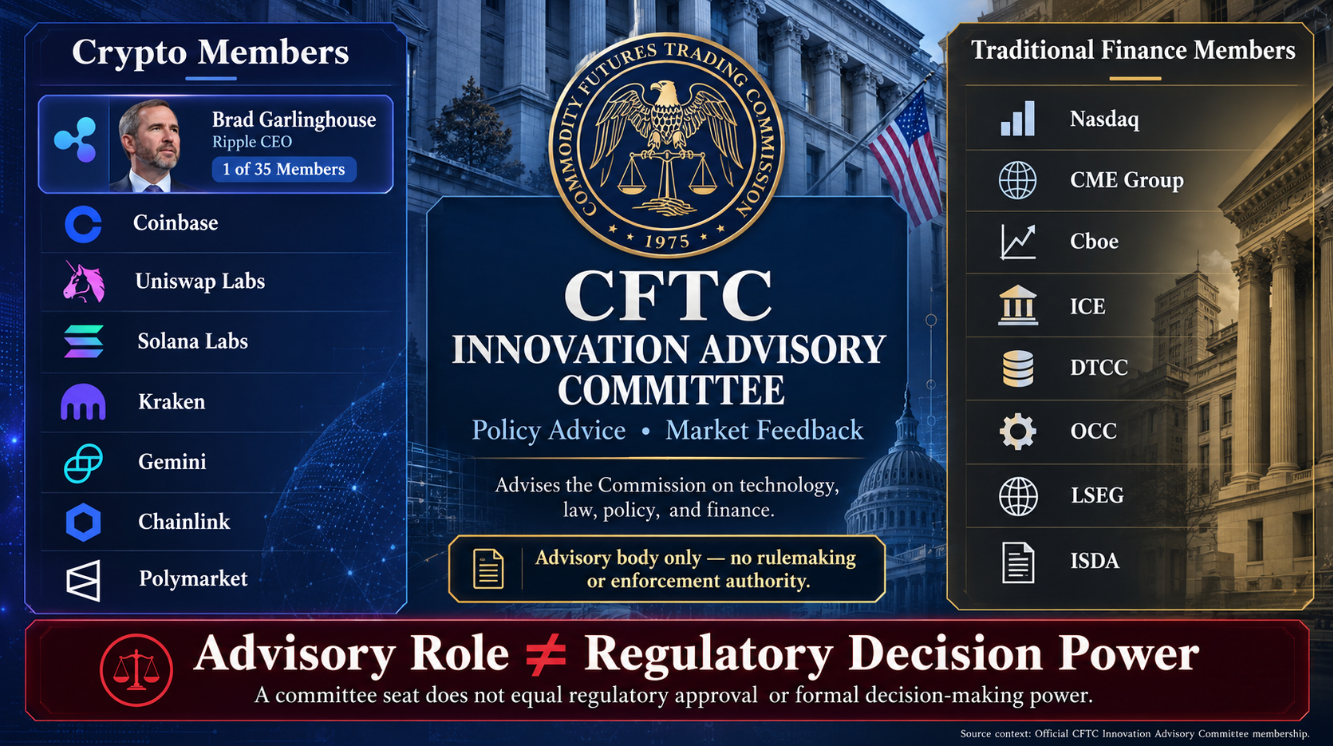
After the first meeting in August, Garlinghouse called the group “the Olympic roster of crypto.” The phrase spread not only because the list included several crypto CEOs, but also because crypto-native companies and traditional financial infrastructure players appeared together in the same advisory mechanism in a highly concentrated way for the first time.
Crypto-related members include:
- Ripple;
- Coinbase;
- Uniswap Labs;
- Solana Labs;
- Kraken;
- Gemini;
- Crypto.com;
- Chainlink Labs;
- Anchorage Digital;
- Polymarket;
- Kalshi;
- Grayscale.
Traditional finance and market infrastructure members include:
- Nasdaq;
- CME Group;
- Cboe Global Markets;
- Intercontinental Exchange;
- DTCC;
- Options Clearing Corporation;
- LSEG;
- ISDA;
- FIA.
This is not simply a crypto lobbying group. It is a group of participants covering trading venues, derivatives, clearing, custody, market infrastructure, and blockchain protocols.
The trend truly worth watching is this: the U.S. crypto policy question is gradually shifting from “whether crypto should be allowed to exist” to “who is responsible for trading, custody, clearing, surveillance, and consumer protection.”
4. Why Is TradFi and Crypto Appearing Together More Important Than Ripple Being Included Alone?
When Nasdaq, CME, Cboe, ICE, and DTCC discuss market rules alongside Coinbase, Ripple, Uniswap, and Solana Labs, it shows that crypto is being placed into a broader financial market infrastructure framework.
The future regulatory focus is not only whether a token is a security or a commodity. It also includes:
- Which types of institutions can operate crypto trading venues;
- How customer assets are segregated and custodied;
- Who regulates spot, futures, and perpetual futures respectively;
- How to prevent manipulation, insider trading, and wash trading;
- How stablecoins and tokenized assets enter traditional markets;
- How cross-platform clearing and risk management are implemented;
- How state licenses and federal regulation are coordinated.
Therefore, Garlinghouse’s inclusion is better understood under the framework of crypto institutionalization, not packaged as a regulatory benefit exclusively enjoyed by XRP.
5. What Was Discussed at the First IAC Meeting on August 20?
The CFTC’s official agenda was divided into three topics.
Crypto Regulation Moving from Uncertainty to Clarity
The first discussion was titled “Crypto’s Regulatory Evolution: From Uncertainty to Clarity.” It covered:
- Early approaches to regulating crypto markets;
- Fragmented requirements created by state licenses;
- The lack of a complete federal market structure framework in the United States;
- Overlapping jurisdiction and inconsistent regulatory interpretations;
- How existing statutory authority can be used to modernize rules;
- How future congressional legislation and agency rulemaking can complement each other.
AI and Intelligent Financial Markets
The second discussion covered AI applications in trading, compliance, market surveillance, and risk management. It also touched on autonomous agents capable of executing trades and managing portfolios.
Prediction Markets and Event Contracts
The third discussion covered prediction markets, federal and state regulatory authority, market surveillance, manipulation risk, and consumer protection.
The official agenda did not show that this was an XRP-specific meeting. Therefore, describing it as “Garlinghouse discussed XRP regulation at a CFTC meeting” is inaccurate. What can be confirmed is that he participated as a Ripple representative in broader crypto market structure discussions.
6. What Did Garlinghouse Actually Say After the Meeting?
The focus of Garlinghouse’s post-meeting remarks was not an XRP price target, but the idea that new financial markets cannot continue to rely only on rules designed for an older era. He also specifically noted the large presence of TradFi institutions at the meeting and again called for clearer U.S. crypto rules.
When analyzing these remarks, three layers should be distinguished:
Fact
Garlinghouse is an IAC member and attended the first meeting.
Opinion
He believes old rules are insufficient for new financial markets and that the United States still needs a clearer crypto regulatory framework.
Interpretation
Ripple has gained a formal channel for regulatory communication and industry policy discussion, but this does not mean its views will be automatically accepted by the CFTC.
News reports most easily upgrade Opinion and Interpretation into Fact. High-quality analysis must separate the three.
7. Does Garlinghouse’s Inclusion Mean the CFTC Officially Supports Ripple?
That cannot be inferred.
The CFTC’s official description of the first meeting states that the views, opinions, and information expressed by advisory committees belong only to the respective committee and do not necessarily reflect the views of the CFTC, its staff, or the U.S. government.
Therefore, the following statements are all overextensions:
- The CFTC has endorsed Ripple;
- Ripple has become an official U.S. government partner;
- Garlinghouse can make rules for XRP;
- The XRP price has received government support;
- Ripple will no longer face any U.S. regulatory risk.
A more accurate conclusion is:
Ripple has obtained a formal seat in the CFTC’s industry advisory mechanism, and its institutional visibility and policy communication capacity have improved.
Policy access does not equal regulatory privilege.
8. Is XRP Still Waiting for the CFTC to Declare It a Commodity?
As of 2026, continuing to use the phrase “XRP may one day be recognized as a commodity by the CFTC” is no longer accurate enough.
The SEC interpretation and CFTC guidance that took effect on March 23, 2026, listed assets including BTC, ETH, SOL, ADA, LINK, XLM, and XRP in its “Digital Commodities” section. The document explained that the value of these assets mainly comes from crypto systems already in operation and market supply and demand, rather than holders relying on a particular issuer to continuously fulfill management commitments.
It is important to note that this document is an SEC interpretation that includes CFTC guidance. It was not the result of Garlinghouse joining the IAC. XRP being listed as an example of a digital commodity and the Ripple CEO’s committee seat are two separate factual lines.
Does This Equal Permanent, Unchangeable Congressional Legislation?
No.
Regulatory interpretations have important practical significance, but they are still different from permanent market structure laws passed by Congress. Agency rules and interpretations may be subject to court review, subsequent government policy changes, or new laws.
Therefore, the most accurate formulation is:
Under the March 2026 SEC interpretation and CFTC guidance framework, XRP has been listed as an example of a digital commodity; however, the long-term statutory regulatory boundary for the U.S. crypto spot market has still not been fully resolved by Congress.
9. What Does It Mean for XRP to Be Treated as a Digital Commodity?
First, it means XRP itself does not automatically become a security simply because of ordinary secondary-market buying and selling. Regulatory analysis still needs to distinguish the asset itself from specific issuance, sales, investment contracts, or service arrangements.
Second, XRP-related derivatives can enter markets regulated by the CFTC. As of October 2026, the CFTC product database has listed multiple XRP products, including:
- CME XRP Futures;
- Coinbase XRP Futures;
- Bitnomial XRP Futures and Perpetual Futures;
- XRP price-based event contracts;
- Other certified XRP derivatives.
These products are more meaningful than a social media “regulatory positive” headline because they show that regulated market infrastructure is taking shape.
But digital commodity does not mean “completely unregulated.” The CFTC has direct regulatory authority over commodity derivatives and enforcement authority over fraud and manipulation in spot commodity markets. Trading platforms, custody, leveraged products, and specific sales arrangements may also be subject to other laws.
10. Does Digital Commodity Mean the CFTC Already Fully Regulates XRP Spot Trading?
No.
The CFTC’s existing authority and full congressional authorization for spot market oversight are not the same thing. U.S. regulation currently remains a multi-layered structure:
- The CFTC directly regulates commodity futures, options, and other derivatives;
- The CFTC can take enforcement action against fraud and manipulation in spot commodity markets;
- The SEC oversees securities and securities transactions;
- State regulators manage money transmission, consumer protection, and related matters;
- Banking, custody, and anti-money laundering also involve other agencies.
The market has long focused on the CLARITY Act precisely because the bill attempts to divide SEC and CFTC authority more systematically and provide a federal regime for crypto trading platforms, brokers, custodians, and customer asset protection.
To systematically understand the bill’s original design, you can read What Is the CLARITY Act? A Complete Guide to U.S. Crypto Regulation, SEC and CFTC Rules.
11. What Was the CLARITY Act Originally Meant to Solve?
The CLARITY Act is essentially market structure legislation, not a simple declaration that “crypto is legal.” It attempts to solve:
- How digital commodities are classified;
- How the SEC and CFTC divide responsibilities;
- How crypto trading platforms register;
- Which rules apply to brokers, dealers, and custodians;
- How customer assets are segregated;
- Market surveillance and anti-manipulation standards;
- How securities-like assets are distinguished from commodity-like assets;
- How federal rules and state regulation connect.
These questions determine whether U.S. crypto companies can build a stable long-term compliance model, and whether institutional investors can enter the market under a clear responsibility framework.
12. Did the CLARITY Act Pass in 2026?
As of October 9, 2026, no.
On September 15, the U.S. Senate held a procedural vote to advance the CLARITY Act. The result was 50 votes in favor and 49 against. Although more senators voted in favor, it did not reach the 60-vote threshold needed to advance most legislation. Four Republican senators joined Democratic senators in voting against it. Thom Tillis ultimately switched to oppose, while preserving the procedural space for a future motion to reconsider.
The bill’s blockage means:
- The United States still lacks a complete crypto spot market framework established by Congress;
- The SEC and CFTC will rely more on existing statutory authority to advance rules;
- New rules may face court challenges;
- Future changes in government may alter the regulatory direction;
- Companies still face a complex environment in which federal and state rules coexist.
So “U.S. crypto regulation is already completely clear” remains an overstatement. A more accurate state of play is this: the regulatory direction has clearly shifted, but permanent market structure legislation has not yet been completed.
13. What Can the CFTC Still Do After the CLARITY Act Stalled?
The CFTC has not stopped acting.
On October 5, 2026, the CFTC released an Advance Notice of Proposed Rulemaking, publicly seeking comments on how to regulate crypto asset transactions and crypto asset markets. The process focuses on retail commodity transactions involving crypto assets under Section 2(c)(2)(D) of the Commodity Exchange Act and explores establishing federal market rules better suited to crypto.
The areas open for comment include:
- How to prevent abuse and manipulation under a unified regime;
- Which industry best practices should be written into rules;
- How to provide crypto-specific disclosures to market participants;
- Whether to create a DCM registration subcategory called Crypto Asset Market;
- How to use the CFTC’s existing statutory authority to provide consumer protection.
This is not a final rule already in effect, but an early stage of the rulemaking process. The market cannot describe “request for comment” as “a new regulatory framework formally implemented.”
Currently, U.S. crypto regulation has two parallel paths:
Congressional legislation → establishing a more durable Market Structure Law
and:
SEC and CFTC rulemaking → filling regulatory gaps within existing authority
The former is more stable but politically difficult. The latter moves faster but is more vulnerable to litigation and changes in government.
14. What Is the Real Value of Ripple Joining the IAC?
Ripple cannot write regulations for itself, but an IAC seat still has practical value.
Policy Access
Ripple can explain the practical operational issues of payments, settlement, custody, stablecoins, and blockchain markets to regulators in a formal advisory environment.
Institutional Credibility
Participating alongside institutions such as Nasdaq, CME, Cboe, ICE, and DTCC raises Ripple’s institutional visibility as a financial infrastructure participant.
Information and Dialogue Channel
The advisory mechanism helps companies understand regulatory priorities and lets regulators hear implementation feedback from market operators.
Market Structure Influence
Ripple can make recommendations on future trading, custody, cross-border payments, and digital commodity rules, but whether they are adopted depends on CFTC statutory procedures and broader policy trade-offs.
Therefore, the value of an IAC seat is closer to “policy access, institutional credibility, and a communication channel,” not regulatory exemption.
15. Is This a Symbolic Shift for Ripple from Being Sued by the SEC to Sitting at the Regulatory Discussion Table?
From the perspective of institutional relationships and symbolism, it is a very clear change.
For many years, Ripple’s most important regulatory label in the United States was its litigation with the SEC over XRP sales and securities law issues. By 2026, Ripple’s CEO had entered the CFTC innovation advisory mechanism as an industry representative and was discussing future rules alongside heads of traditional market infrastructure.
This change shows that Ripple’s institutional identity in U.S. policy discussions has clearly improved. It also reflects a shift in the U.S. regulatory environment from “defining boundaries mainly through enforcement” to “building frameworks through interpretations, rules, and advisory mechanisms.”
But symbolic improvement cannot be written as full U.S. government endorsement of Ripple. The committee remains advisory in nature, and Ripple must still comply with applicable securities, commodities, payments, banking, anti-money laundering, and state-level rules.
16. Will the Ripple CEO Joining the IAC Directly Push Forward an XRP ETF?
Not directly.
Whether an ETF or another regulated investment product can launch mainly depends on:
- XRP’s legal classification;
- Spot and derivatives market depth;
- Market surveillance sharing;
- Qualified custody;
- Pricing and liquidity;
- Exchange filings;
- SEC and other regulatory procedures.
Garlinghouse joining the IAC is not an ETF approval condition, nor does it replace product filings and regulatory review.
A more reasonable indirect logic is:
A maturing regulatory environment → lower legal and operational uncertainty → more custody and derivatives infrastructure → institutional products become easier to develop
The IAC seat sits at the front end of this chain. There are still multiple conditions between it and actual ETF capital inflows.
17. Why Are CME XRP Futures More Worth Watching Than the Headline?
Regulatory stories ultimately land through market infrastructure.
The appearance of XRP futures or perpetual futures on markets such as CME, Coinbase, and Bitnomial shows that institutional trading, risk management, and price discovery tools are expanding. Futures markets may also bring:
- More standardized institutional exposure;
- Hedging tools;
- More transparent position and volume data;
- Demand for custody and clearing infrastructure;
- Arbitrage and price discovery between spot and derivatives.
Therefore, to judge whether XRP’s regulatory environment has truly improved, do not look only at what officials and executives say. Look at what products regulated markets actually allow to operate, and whether those products attract real trading volume and open interest.
18. Why Does Improved Ripple Regulatory Standing Not Mean XRP Must Rise?
It is essential to separate Ripple the company from XRP the asset.
Ripple’s policy influence, payments business, custody business, or stablecoin business growth may improve the XRP market narrative, but the XRP price is also affected by the following variables:
- XRP supply and holder structure;
- Trading platform demand;
- ETF and regulated product fund flows;
- XRP spot volume and derivatives open interest;
- XRPL activity and settlement volume;
- Whether payment institutions actually use XRP;
- The RLUSD development path;
- The BTC cycle and global liquidity.
The direct effect of regulatory clarity is to reduce legal uncertainty and institutional barriers to entry. It does not automatically create buy-side demand.
Regulatory clarity removes a discount; it does not automatically create demand.
If legal risk falls but XRP on-chain usage, payment demand, and institutional capital do not increase, the price may receive only a short-term sentiment boost without long-term fundamental support.
19. What Type of XRP Catalyst Is This News?
Short-Term Price Catalyst: Neutral to Slightly Bullish
The Ripple CEO joining a CFTC committee is highly newsworthy and may increase social discussion, regulatory optimism, and short-term trading activity.
Medium-Term Regulatory Catalyst: Slightly Bullish
Ripple’s ability to participate in policy communication and its institutional credibility improve, which helps the company express industry needs in future discussions on market structure, payments, and tokenization rules.
XRP Fundamental Demand Catalyst: Insufficient Evidence
The committee seat itself will not directly increase XRP trading volume, XRPL users, payment settlement demand, or institutional holdings.
Therefore, investors should not directly translate “policy participation” into “token demand growth.”
20. How Can You Verify Whether Regulatory Positives Have Transmitted into the XRP Price?
Eight groups of data can be continuously monitored:
- Net fund flows into XRP ETFs and other regulated products;
- XRP futures open interest on markets such as CME;
- XRP spot trading volume and market depth;
- The scope of institutional custody support;
- XRPL active addresses and settlement scale;
- RLUSD circulating supply and network distribution;
- Actual usage of Ripple Payments;
- XRP accessibility on U.S. regulated trading platforms.
Regulation is only one variable in a price model. XRP Price Prediction can serve as a market scenario reference, but it cannot replace fund flows, derivatives positioning, and on-chain adoption data.
21. What Is XRP’s True Long-Term Regulatory Bull Case?
The long-term bull case is not “Brad sitting on a committee.” It is a complete transmission chain:
Stable legal classification → Clear federal spot rules → Lower trading and custody barriers → Expanded institutional products → Capital inflows → Growth in actual XRP demand
This scenario requires:
- XRP’s digital commodity positioning remaining stable;
- A clearer federal Spot Market Framework;
- Crypto trading platforms obtaining a clear registration path;
- Continued expansion of institutional custody;
- Deepening futures and other derivatives markets;
- ETFs or regulated products attracting sustained capital;
- Banks and payment institutions having a clear compliance path;
- XRPL and Ripple products actually creating demand to use XRP.
Only when the final layer, “actual demand,” appears does a regulatory positive upgrade from Narrative to Fundamental Catalyst.
22. Under What Conditions Would the Regulatory Bull Case Fail?
Watch for the following signals:
- Federal market structure legislation remains stalled for a long time;
- CFTC or SEC rules are overturned by courts;
- The two regulators once again have a major jurisdictional conflict;
- XRP institutional product trading and fund flows remain insufficient;
- Custody support increases but investor demand does not;
- Ripple’s commercial growth does not lead to XRP usage;
- RLUSD growth mainly bypasses XRP;
- Real payment and settlement demand on XRPL stagnates;
- BTC enters Risk-Off and drains altcoin liquidity.
An investment thesis should have verifiable invalidation conditions, rather than explaining every price decline with “regulation will keep getting better.”
23. Could Ripple’s Success Actually Reduce the Need for XRP?
This is the question long-term investors most easily overlook.
Ripple can develop in multiple directions:
- RLUSD;
- Cross-border payments;
- Institutional custody;
- Tokenization;
- Enterprise blockchain services;
- Financial infrastructure.
Growth in these businesses may increase Ripple the company’s revenue and institutional standing, but investing in XRP still requires asking another question: do these businesses need to hold, use, or consume XRP?
If Ripple revenue rises while XRP usage does not increase, the following may occur:
Company Success ≠ Token Value Capture
This is also why Ripple gaining a policy seat is a company-level positive, but cannot automatically be counted equally into the XRP price.
24. Does RLUSD Growth Benefit or Replace XRP?
RLUSD and XRP may be complementary, or they may become substitutes in some scenarios.
Complementary Scenario
RLUSD enters XRPL, bringing more users, liquidity, transactions, and tokenized asset activity. Expansion of the XRPL ecosystem may indirectly increase XRP’s use and attention as a network asset.
Substitution Scenario
If institutions can directly complete settlement between USD, RLUSD, and USD without needing XRP as a bridge asset, then RLUSD business growth may have limited value capture for XRP.
Therefore, “RLUSD circulating supply increases equals XRP rises” cannot be mechanically derived. What really needs to be observed is the transaction path, liquidity routing, and XRP’s actual share in settlement.
25. Why Could BTC Override XRP’s Own Regulatory Positives?
XRP remains a high-beta crypto asset. When BTC enters a Risk-Off phase, market leverage, stablecoin liquidity, and altcoin risk appetite may all decline at the same time. Even if positive regulatory news appears for Ripple, XRP may still fall with the broader market.
Investors can use BTC Price Prediction to observe market cycles, but should not mistake BTC rallies for an improvement in XRP’s fundamentals.
A more reasonable model is:
XRP-specific Catalyst × Crypto Macro Cycle
Only when both regulatory catalysts and market liquidity are relatively strong is the price reaction more likely to be sustained.
26. Why Is ETH’s Regulatory Path Worth Comparing with XRP?
The 2026 SEC interpretation and CFTC guidance listed both ETH and XRP as examples of digital commodities, but the two assets have completely different sources of value.
For ETH, the main things to watch are:
- Gas demand;
- DeFi and stablecoin activity;
- Layer 2 ecosystem;
- Staking;
- Tokenization and on-chain settlement.
For XRP, the main things to watch are:
- Payments;
- Cross-border settlement;
- Liquidity bridging;
- XRPL usage;
- Ripple’s institutional ecosystem;
- Regulated XRP investment products.
Therefore, ETH Price Prediction can help compare market cycles and regulatory paths, but the same commodity framework does not mean the two assets should use the same valuation model.
27. HIBT XRP Regulatory Catalyst Score
Rather than simply labeling regulatory news as a “big positive,” it is better to judge it across five dimensions.
Legal Classification
Does the event truly change XRP’s legal classification? The current direction is Strengthening, but rule and court stability still need to be observed.
Market Structure
Does the event establish rules for trading, custody, brokerage, and customer protection? The CLARITY Act’s blockage shows that this layer remains Incomplete.
Institutional Products
Are futures, ETFs, custody, and regulated trading products growing? This layer should be verified using fund flows and open interest.
Ripple Policy Access
Does Ripple have a more formal regulatory communication channel? Garlinghouse joining the IAC clearly Strengthens this layer.
XRP Usage Conversion
Does regulatory improvement truly translate into payments, settlement, XRPL activity, and XRP demand? This still requires data verification.
In the end, do not compress all five into a single “regulatory positive score of 90.” A more professional conclusion is to judge each as Strengthening, Neutral, Weakening, or Incomplete.
28. What Links Are Needed from Regulatory News to the XRP Price?
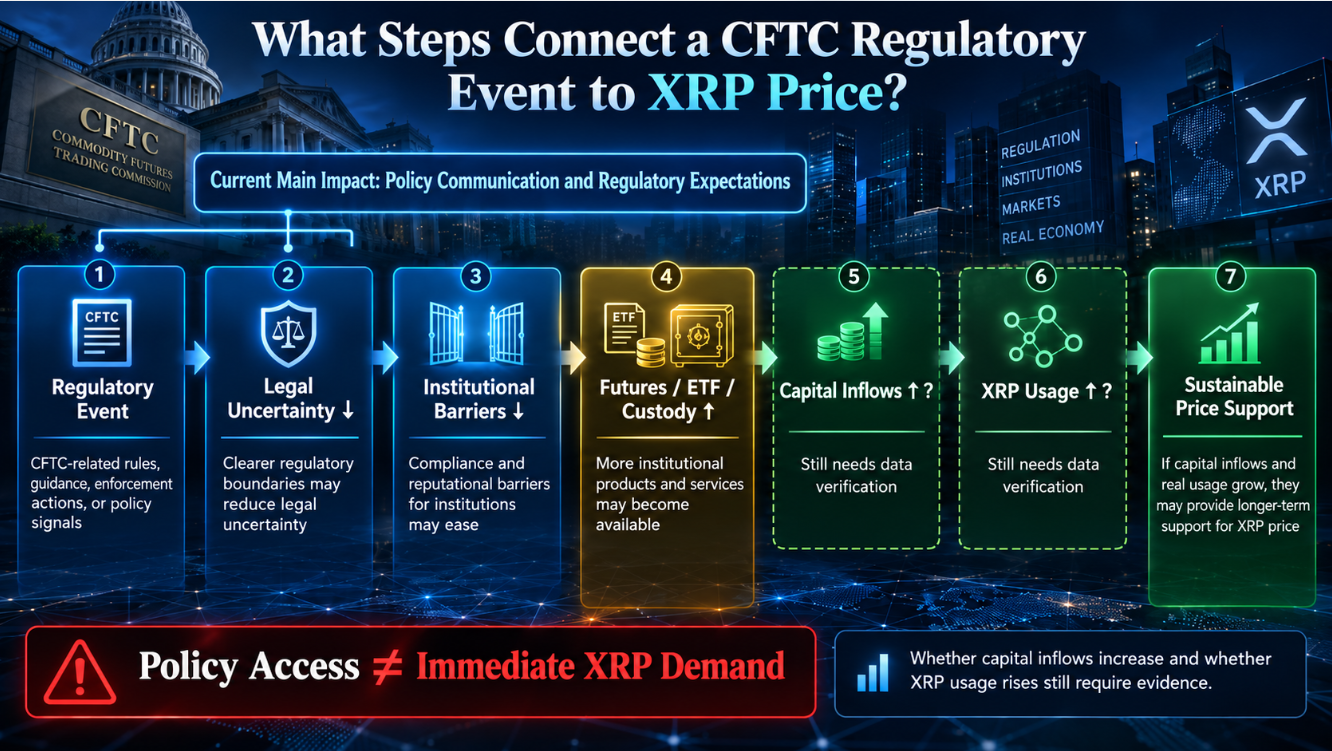
The complete price transmission model is:
Regulatory Event ↓ Legal Uncertainty declines ↓ Trading and institutional barriers decline ↓ Institutional Products increase ↓ Capital Inflows increase ↓ Actual XRP demand increases ↓ Price receives sustained support
Garlinghouse joining the IAC currently mainly occurs at the front end of the chain: it improves policy communication and the regulatory narrative, but it does not directly prove that capital inflows or XRP usage have already increased.
This also explains why, even if the price rises briefly after the news, the gain alone cannot prove that long-term value transmission has been completed.
29. How Do You Judge Whether the Next XRP Regulatory News Is Truly Significant?
Does It Change Legal Classification?
If it is only an executive expressing an opinion, without changing rules or court conclusions, its impact should be downgraded one level.
Does It Change Trading Eligibility?
New regulated trading markets, futures, custody, or institutional access are usually more important than advisory remarks.
Does It Create a Real Capital Entry Point?
ETFs, funds, bank custody, or major brokerage platforms can turn regulatory changes into capital entry points.
Does It Create Actual XRP Demand?
This is the most important layer. Even if the number of products increases, if fund flows, trading depth, and XRPL usage do not improve, the fundamental impact remains limited.
A truly long-term valuable regulatory catalyst should go as far as possible through:
Headline → Regulation → Capital → Usage
30. What Does This Mean for Ordinary XRP Investors?
Confirmed Facts
- The Ripple CEO is an initial member of the CFTC IAC;
- The IAC held its first meeting on August 20;
- XRP was listed as an example of a digital commodity in the 2026 regulatory interpretation;
- XRP-related futures and other derivatives infrastructure is expanding;
- The CFTC is using existing authority to explore crypto market rules.
Unconfirmed Inferences
- XRP will receive special rules;
- Ripple can control CFTC decisions;
- The IAC seat will directly lead to XRP ETF approval;
- Ripple business growth will necessarily create XRP demand;
- The XRP price will keep rising because of the committee seat.
For investors, this news should be viewed as a positive change in institutional identity and policy participation, not as an immediate all-in price signal.
31. Main Risks and Uncertainties of the Ripple CEO Joining the CFTC Committee
Advisory Power Being Exaggerated
The market may mistake an advisory seat for regulatory decision-making power, creating overly optimistic expectations.
Congressional Legislative Stagnation
The CLARITY Act’s blockage means regulators can only act within existing authority, and the stability of rules is weaker than formal legislation.
Court Challenges
Agencies expanding or reinterpreting authority may be sued by industry, state governments, or other parties.
Changes in Government
Different governments may change crypto policy direction, and administrative rules are not permanently fixed.
Company and Token Disconnect
Ripple’s improved institutional standing does not mean XRP automatically gains value capture.
Market Has Already Priced It In
If regulatory optimism is already reflected in the price, later news may trigger a “sell-the-news” reaction.
Macro Liquidity Risk
BTC declines, rising interest rates, or market deleveraging may override XRP-specific news.
32. FAQ: Ripple CEO CFTC Crypto Panel Common Questions
What is the Ripple CEO CFTC crypto panel?
It usually refers to Ripple CEO Brad Garlinghouse joining the CFTC Innovation Advisory Committee. The committee provides technical, financial, and policy advice to the CFTC and does not directly make laws.
Is Ripple CEO on the CFTC crypto panel?
Yes. Brad Garlinghouse is among the initial 35 IAC members announced by the CFTC on February 12, 2026.
Why did Brad Garlinghouse join the CFTC committee?
The CFTC wanted to absorb market experience from crypto, exchanges, clearing, custody, and traditional financial infrastructure. Garlinghouse participates in discussions as Ripple CEO representing the industry.
Can Brad Garlinghouse influence CFTC crypto regulation?
He can offer recommendations and feedback, but he does not have the power to individually make, approve, or veto regulations.
Is XRP officially a commodity?
The March 2026 SEC interpretation and CFTC guidance listed XRP as an example of a digital commodity. But this does not mean Congress has completed all crypto spot market legislation.
Did the CFTC declare XRP a commodity because Ripple joined the panel?
No. The XRP classification document and the IAC seat are separate regulatory events, and no direct causal relationship can be established.
Does Ripple joining the CFTC panel mean XRP is approved by the U.S. government?
No. Advisory committee members’ views do not represent the CFTC or the U.S. government, and there is no implication that the government endorses the XRP price.
Does the CFTC regulate XRP spot trading?
The CFTC can address fraud and manipulation in spot commodity markets, but there is currently no complete federal XRP spot trading regulatory framework established by Congress.
What does the CFTC panel mean for XRP price?
Short term, it may improve regulatory sentiment. Medium term, it benefits Ripple’s policy communication. But long-term price performance still needs verification through institutional capital, XRPL adoption, and actual XRP demand.
Will the CFTC panel help XRP ETF adoption?
It may indirectly improve the regulatory environment, but an IAC seat is not an ETF approval condition and cannot replace formal SEC and exchange procedures.
What did Garlinghouse mean by “Olympic roster of crypto”?
He was referring to the committee bringing together crypto company leaders and traditional financial infrastructure executives from Nasdaq, CME, Cboe, ICE, DTCC, and others.
What happened at the August 20 CFTC meeting?
The meeting discussed the evolution of crypto regulation, artificial intelligence, and prediction markets. It was not officially listed as an XRP-specific meeting.
Did the CLARITY Act pass in 2026?
No. The Senate vote on September 15 was 50 in favor and 49 against, short of the 60 votes needed to advance the bill.
What happens after the CLARITY Act failed in the Senate?
Permanent market structure legislation at the congressional level remains stalled, while the SEC and CFTC use existing authority to advance interpretations and rulemaking. However, these actions may face court and policy-change risks.
SEC vs CFTC: Who regulates XRP?
The CFTC mainly regulates XRP commodity derivatives and has enforcement authority over fraud and manipulation in the spot market. The SEC oversees securities and securities transactions. Which set of rules applies to a specific transaction or product requires analyzing its legal structure, not just looking at the token name.
Has XRP’s legal risk disappeared in 2026?
No. XRP’s classification is clearer than before, but market structure legislation, trading platform rules, institutional product approvals, and the stability of administrative rules still involve uncertainty.
33. Conclusion: This Is an Institutional Identity Positive, Not an XRP Price Pass
Brad Garlinghouse joining the CFTC Innovation Advisory Committee shows that Ripple has gradually moved from appearing in U.S. regulatory discussions mainly as a litigation party to entering a formal advisory mechanism as an industry infrastructure participant. This change is positive for Ripple’s institutional credibility, policy access, and industry influence.
But the IAC has no independent legislative power, and Garlinghouse cannot decide XRP’s legal classification. The truly more important regulatory development in 2026 is that the SEC interpretation and CFTC guidance listed XRP as an example of a digital commodity, and that the CFTC is using existing authority to explore new Crypto Asset Market rules.
At the same time, the CLARITY Act’s failure to advance in the Senate shows that U.S. crypto regulation is still far from a stable, complete, congressionally authorized market structure. Administrative rules can fill some gaps, but they may be affected by courts and future government policy changes.
For XRP investors, the most important conclusion is not “Ripple CEO joined a committee, so XRP must rise.” It is:
Ripple’s Policy Access is improving, XRP’s Legal Classification is strengthening, but whether the price can benefit long term still depends on Institutional Products, Capital Inflows, and XRP Usage Conversion.
When judging the next XRP regulatory news story, verify it in the order of “Headline → Regulation → Capital → Usage.” Only when a regulatory event ultimately creates a real capital entry point and actual XRP usage demand does it qualify as a Fundamental Catalyst capable of influencing long-term value.
Sources and Update Notes
- CFTC Announces Innovation Advisory Committee Members
- CFTC First IAC Meeting Announcement and Disclaimer
- CFTC August 20 IAC Meeting Agenda
- CFTC First IAC Meeting Recap
- SEC Interpretation and CFTC Guidance: Legal Classification of Crypto Assets
- CFTC Designated Contract Market Product Database
- CFTC Request for Comment on Crypto Asset Transactions Rules
- Reuters: U.S. Senate Fails to Advance CLARITY Act
This article is updated as of October 9, 2026. Laws, bill status, committee membership, and financial products may continue to change. Before making formal decisions, refer to the latest documents from the CFTC, SEC, U.S. Congress, and relevant markets.