
Quantum Inu (QI) is a new meme token running on Robinhood Chain. It is not a quantum computing company stock, nor is it an official network token issued by Robinhood. It has attracted attention partly because of the "quantum computing + Shiba Inu meme" narrative, and partly because the project's older pages proposed a QUBT stock token trading pair and a Quantum Vault experiment using Falcon post-quantum signatures.
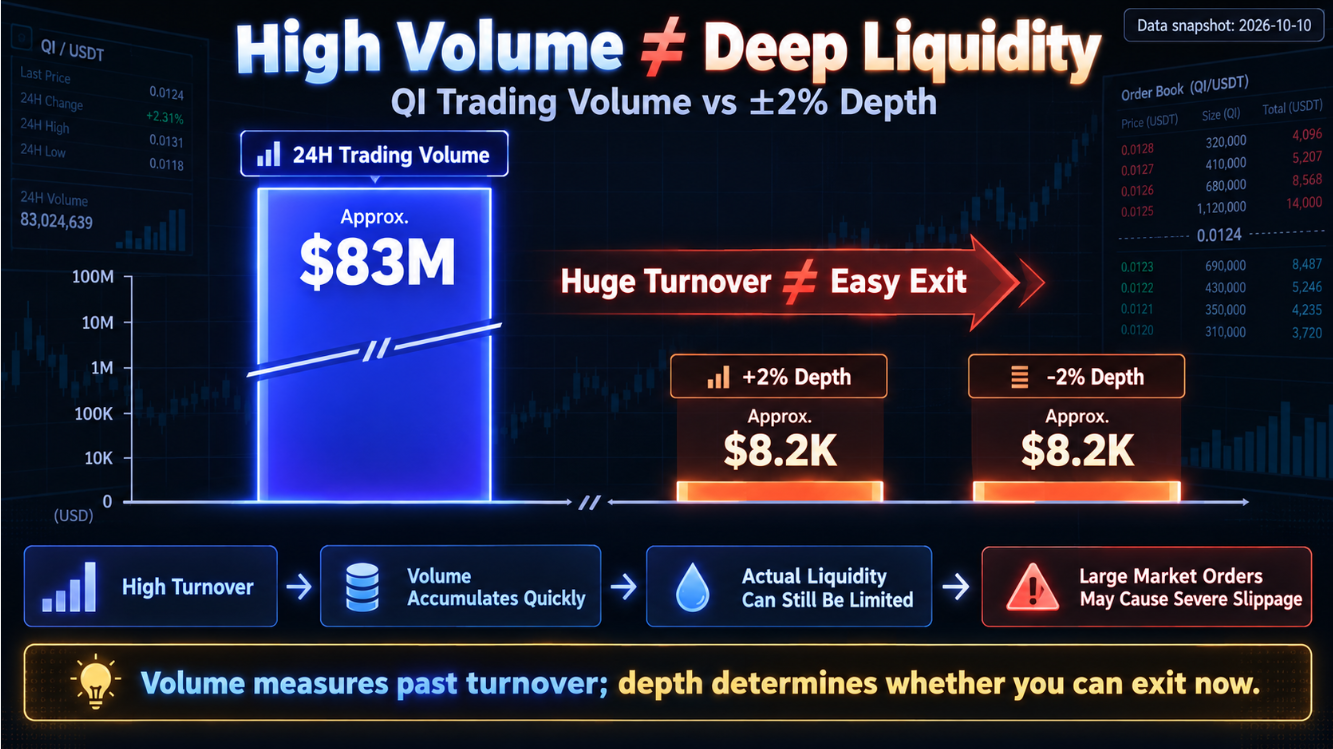
However, neither of these stories can directly lead to the conclusion that QI has stock asset backing or stable cash flow. What is more alarming is that, as of October 10, 2026, CoinGecko's Quantum Inu market page shows QI generating over $80 million in 24-hour trading volume, while the recorded QI/WETH market's ±2% order book depth is only about $8,000. In other words, high trading volume does not equal deep liquidity, and it certainly does not mean $80 million in long-term capital has entered QI.
There are also changes in project materials that investors need to actively verify: CoinGecko currently points to quantuminu.si, which describes QI as a Robinhood Chain Meme Coin; while detailed explanations involving the QUBT launch pair, Quantum Vault, and future fee mechanisms come from quantuminu.tech. The content and visual positioning of the two sets of pages differ, so one cannot simply assume that all old materials, contracts, and social accounts belong to the same continuously operating entity based solely on the name "Quantum Inu."
Risk Disclaimer: This article's data is updated as of October 10, 2026. New coin prices, trading volumes, contract information, and project pages may change rapidly. This article is for informational organization and risk education only and does not constitute investment advice, return promises, or trading recommendations.
9 Things to Know Before Investing in QI
- QI is a Meme Token on Robinhood Chain, not a stock token.
- The contract currently listed by CoinGecko is
0xb862389bf1ad271c70edbc2249bf1b0a6cd8783b. - Robinhood Chain mainnet Chain ID is 4663 and uses ETH to pay for Gas.
- "Deployed on Robinhood Chain" does not equal "issued or endorsed by Robinhood."
- QI forming a trading pair with QUBT does not mean QI holders have QUBT stock exposure.
- The Quantum Vault contract disclosed on the project's older pages can indeed serve as an on-chain technical clue, but "source code is viewable" does not equal "security audit has been completed."
- The same page also states that the Vault has not yet been connected to QI trading fees, and there are currently no quantum stock token assets.
- QI's maximum supply is approximately 1 billion tokens, but CoinGecko has not yet provided a reliable circulating supply, so FDV cannot be directly treated as circulating market cap.
- QI's most important observation variable right now is not "whether quantum computing is the future," but effective liquidity, independent traders, holder structure, and whether planned mechanisms can actually go live.
I. What Exactly Is Quantum Inu (QI)?
Quantum Inu can be understood as "a Robinhood Chain Meme asset wrapped in a quantum computing narrative." As of this article's update time, CoinGecko categorizes it under Meme and Robinhood Ecosystem, records both total supply and maximum supply at 1 billion tokens, and displays the following contract:
0xb862389bf1ad271c70edbc2249bf1b0a6cd8783b
Robinhood Chain's official connection documentation shows that Robinhood Chain is an Arbitrum Layer 2 built on Ethereum, with a mainnet Chain ID of 4663 and native Gas asset of ETH. Therefore, QI's on-chain transfers, Uniswap trades, and contract interactions all occur in the Robinhood Chain environment, not on Solana, BNB Chain, or Ethereum mainnet.
When first encountering QI, at least five pieces of information need to be verified:
- Name: Quantum Inu;
- Ticker: QI;
- Network: Robinhood Chain;
- Contract address;
- Current official website, social accounts, and block explorer records.
Searching and transferring based solely on the two letters "QI" is extremely dangerous. A ticker is not a unique identity—anyone can issue assets with the same name on different networks.
II. Is QI an Official Robinhood Coin?
No. What can be confirmed is that QI is deployed and traded on Robinhood Chain. This cannot be written as "Robinhood released Quantum Inu."
These two statements have completely different meanings:
- Built on Robinhood Chain: A third-party project deploys a contract on an open network;
- Issued by Robinhood: Created by Robinhood or an explicitly disclosed issuing entity that bears corresponding responsibility.
Robinhood Chain allows developers to deploy assets and applications. A token using this chain does not mean Robinhood has reviewed its team, economic model, or price, nor does it mean Robinhood provides value guarantees for it.
Robinhood's brand guidelines even explicitly require third parties to avoid creating mistaken impressions of official participation, endorsement, or sponsorship. Therefore, any promotion packaging QI as an "official Robinhood quantum coin" should be treated as high-risk information.
III. Why Is Quantum Inu Called "Quantum"? Three Layers of Narrative Cannot Be Conflated
QI's quantum story can be broken down into three layers.
The first layer is the Meme narrative. Quantum Inu combines Shiba Inu, the universe, superposition states, quantum leaps, and other visual symbols, essentially serving social propagation and short-term attention.
The second layer is the stock narrative. The project's older pages state that QI initially formed a Launch Pair with a QUBT stock token related to Quantum Computing Inc. on long.xyz, and planned to expand in the future to quantum computing stock tokens such as IONQ, RGTI, and QBTS.
The third layer is the technical experiment. The older pages disclosed a Quantum Vault using Falcon-512 signature verification, as well as an on-chain Falcon Verifier, hoping to require post-quantum signature authorization for operations on assets within the Vault.
These three layers are not equivalent. A project can have a quantum Meme without stock assets; can deploy a technical demonstration without protocol revenue; can form a trading pair with QUBT without giving QI holders any stock rights.
IV. What Is the Relationship Between QI and QUBT?
QUBT is the U.S. stock ticker for Quantum Computing Inc. The QUBT Token mentioned on the project's older pages is a Robinhood stock token that tracks the economic performance of the related stock.
The most common misunderstanding between QI and QUBT is: the two once formed a trading pair, so QI seems to have obtained QUBT asset backing. This inference does not hold.
A trading pair is merely a market pricing path. For example, BTC/USDT allows users to buy BTC with USDT, but it does not mean every BTC is 1:1 collateralized by equivalent USDT reserves. Similarly, QI/QUBT only indicates that two assets can be exchanged in the same pool. It does not mean:
- 1 QI can be redeemed for a fixed proportion of QUBT;
- QI holders are shareholders of Quantum Computing Inc.;
- QUBT rising will necessarily push QI up proportionally;
- QI has QUBT's NAV or liquidation value.
This is also an important difference between QI and truly stock-related assets. When researching assets like What Is BNC4/USDT, the core is issuance structure, underlying securities, and legal rights; when researching QI, the core remains Meme attention, trading liquidity, and the degree to which project mechanisms are delivered.
V. Why Does the Public Market Now Show QI/WETH Instead of QI/QUBT?
The launch trading pair and the current primary trading path are not the same thing.
The Launch Pair determines how the project completes initial price discovery when it first goes live; as the market develops, any participant can create new secondary liquidity pools. CoinGecko's primary market recorded as of October 10 is QI/WETH on Uniswap V3 (Robinhood), and currently visible trading is almost entirely concentrated in this market.
Therefore, one cannot write "initially paired with QUBT" as "every QI trade will permanently go through QUBT from now on." After QI/WETH becomes the primary path, QI's short-term price formation depends more directly on the WETH pool's liquidity, quoted range, and trading behavior.
VI. What Is Quantum Vault? Has It Been Built?
The project's older pages disclosed two contract addresses:
- Quantum Vault v2:
0x028C6928C025f0233EA2Db8156B788227B05A902; - Falcon Verifier:
0xE101Dad8034BeEB237fE476e111DE45fb8DcDa0E.
The design concept is: the Vault does not rely on ordinary EVM wallet private keys to directly authorize core operations, but instead requires instructions to carry Falcon signatures; ordinary wallets are only responsible for broadcasting transactions to the chain and paying Gas; the Verifier checks the signature, and only then does the Vault execute permitted actions.
The simplified process is:
Offline Falcon key signs instruction → Ordinary wallet broadcasts → On-chain Verifier verifies → Vault executes specified operation.
From the perspective of "whether a technical experiment exists," this adds a layer of verifiable content beyond an ordinary Meme that only uses quantum concept names. But it still cannot automatically become QI's value capture mechanism, because contract existence, capital entry, fee connection, stock purchases, token burns, and holder rights are six different issues.
VII. Does Falcon-512 Really Make QI "Quantum-Resistant"?
This cannot be summarized that way.
The NIST Post-Quantum Cryptography Standardization page shows that Falcon has been selected, but as of October 2026, the related FIPS 206 is still in development. A more accurate statement is: Falcon is a post-quantum signature scheme selected by NIST and planned for standardization, not "already proven to be forever uncrackable by quantum computing."
More importantly, ordinary QI holders still use conventional EVM wallets. Wallets, chains, bridges, trading platforms, and surrounding systems such as Robinhood stock tokens will not become entirely post-quantum systems just because a certain Vault uses Falcon.
Therefore, a distinction must be made:
- The Vault uses Falcon rules to protect its controlled assets;
- QI holder wallets receive quantum security guarantees.
The former is a narrowly defined technical experiment proposed by the project; the latter does not currently hold. The project's older pages also acknowledge that "Quantum Resistant" is a Meme expression rather than a security guarantee.
VIII. Does the Absence of a withdraw Function Mean Quantum Vault Is Absolutely Safe?
No.
Vault v2 is said to have no ordinary withdrawal function, which reduces one type of path for directly transferring assets away. But the older pages also disclose that the Falcon key holder is still responsible for signing Swap routing instructions. This means that the party controlling the key could theoretically still sign unfavorable swaps, incorrect routes, or destructive operations.
So "no withdraw" only indicates that the contract does not have a certain conventional exit—it does not mean the system is completely trustless. A more accurate conclusion is:
No withdraw function ≠ No control risk.
Additionally, the project pages explicitly state that the Vault and Falcon Checker have not yet undergone independent security audits. Source code being visible on a block explorer at most proves that the code can be externally viewed; it cannot replace professional audits, formal verification, and long-term operational records.
IX. Has QI's Fee Already Purchased Quantum Stocks?
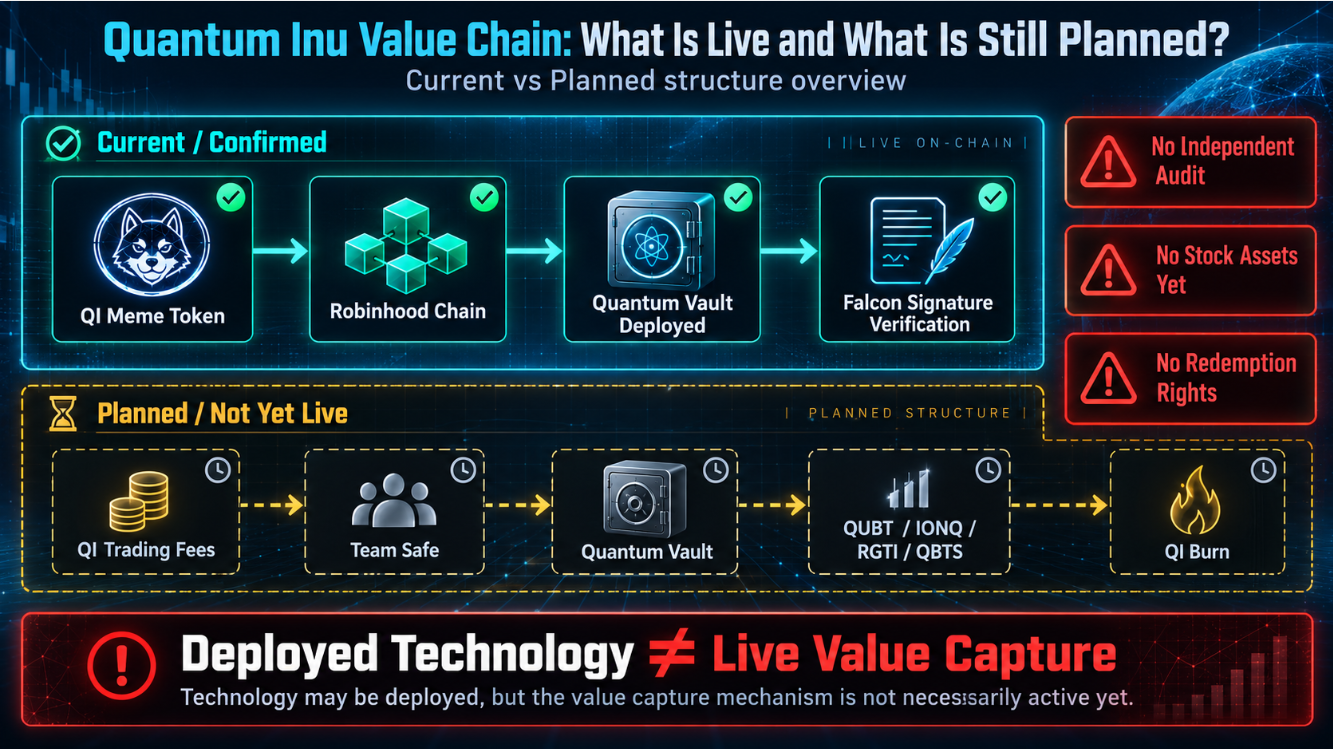
As of the latest disclosure on the project's older pages, no.
The statuses listed on the page include:
- The Vault has not yet been connected to QI trading fees;
- The Vault currently holds no QUBT, IONQ, RGTI, or QBTS stock tokens;
- Independent security audits have not yet been completed;
- Vault v2 has not yet executed formal asset swaps.
The future path proposed by the project is:
QI trading → Fees enter team Safe → Future connection to Quantum Vault → Buy quantum stock tokens or burn QI.
This path should currently be clearly labeled as: Planned, Not Live.
Before the mechanism actually goes live, "every QI trade's fees will buy quantum stocks" is an inaccurate statement. Investors also cannot count Vault assets that do not yet exist in QI's valuation.
X. If the Vault Holds Stock Tokens in the Future, Can It Form QI Asset Backing?
Still cannot be directly calculated that way.
The project pages state that QI holders do not have redemption rights to Vault assets. Even if the Vault holds $1 million in quantum stock tokens in the future, it does not mean QI holders can retrieve these assets proportionally based on their holdings.
Therefore, the Vault is closer to a Treasury controlled by the protocol or team, rather than redeemable collateral. The following formula has no legal or mechanical basis:
Vault NAV ÷ QI Supply = QI floor price
Stock assets may enhance the narrative, provide potential treasury value, or support burns, but whether they truly transmit to the token price depends on control, transparency, asset usage, revenue sustainability, and whether holders have enforceable rights.
This is also the difference between "RWA Exposure" and "RWA Narrative." Projects that truly involve SPVs, underlying rights, and exit arrangements can refer to What Is PPOLY; even if QI purchases stock tokens in the future, it still does not automatically become a redeemable tokenized stock.
XI. QI's Daily Trading Volume Exceeds $80 Million—What Does That Mean?
As of the CoinGecko snapshot on October 10, 2026, QI's price was approximately $0.016, 24-hour trading volume once exceeded $83 million, FDV was approximately $16.5 million, and both total supply and maximum supply were 1 billion tokens.
This set of data first shows that QI has gained extremely high short-term attention and turnover. But it cannot prove that $83 million in net capital has entered.
Trading volume is the cumulative total of all transaction amounts within a certain period. Suppose the same $100,000 in capital is exchanged back and forth 100 times among bots, arbitrageurs, and short-term traders—this could generate $10 million in trading volume, while the net new capital in the market is far lower than that number.
Therefore:
Trading Volume = Turnover, not Net Capital Inflow.
For newly launched Meme assets, trading volume may also be affected by market-making strategies, concentrated routing, high-frequency bots, and statistical methodologies. To judge the quality of market activity, Volume must be viewed together with Liquidity, Unique Traders, and Holder Growth.
XII. QI's Most Abnormal Signal Currently: Massive Volume, But Very Shallow Exit Depth
The same CoinGecko market snapshot shows that QI/WETH's 24-hour trading volume exceeds $83 million, but +2% and -2% order book depth are only about $8,180 and $8,160 respectively.
This means that within the liquidity range displayed on the page, only a relatively limited buy or sell size could push the quote 2% away from the current price. Large users cannot infer that "selling $50,000 or $100,000 won't affect the price" just because "daily volume is $80 million."
The truly important question is not how much was traded in the past 24 hours, but:
- If I sell $1,000 now, what is the slippage?
- Can I sell $10,000 within 1%?
- If I sell $50,000, how many price ranges will it cross?
- Is liquidity concentrated in a very narrow Uniswap V3 range?
- Can the current quote be maintained during market volatility?
This is High Volume ≠ Deep Exit Liquidity.
XIII. Using Three Metrics to Judge the "Quality" of QI's Trading Volume
1. Liquidity Turnover Ratio
Calculation method:
24H Volume ÷ Effective Liquidity
If trading volume is far higher than effective liquidity, it indicates that the same batch of capital may be turning over at high frequency within an extremely short period. An abnormally high ratio does not necessarily mean fabrication, but it means trading volume cannot be directly interpreted as long-term holding demand.
2. Exit Liquidity Ratio
Calculation method:
Value of QI that can be sold within 1% slippage ÷ Planned position size
If you plan to invest $50,000, but only $5,000 can be exited within the 1% slippage range, then there is a clear gap between the paper position and the actual exit value.
3. Volume Quality Ratio
This can combine independent trader volume, trader count, and average trades per address. Sustained participation by a large number of independent users is more indicative of demand diffusion than repeated trading by a few addresses.
For QI, what is most worth tracking is not whether it can spike again on a certain day, but whether 30-day trading volume, effective depth, and independent traders can grow in tandem.
XIV. How Should Holder Count and Top 10 Concentration Be Viewed?
After a new coin launches, different block explorers, aggregators, and project pages may index at different speeds. Holder addresses also do not equal truly independent users: one person can control multiple wallets, and liquidity pools, routers, and custodial addresses may also be counted as Holders.
When analyzing chip structure, one should first identify and exclude:
- Liquidity pool contracts;
- Burn addresses;
- Routers;
- Trading platform custodial wallets;
- Team or Treasury addresses;
- Known protocol contracts.
Then calculate the adjusted Top 10 holdings as a proportion of circulating supply. One cannot ignore the possibility of address association, team control, and new coin data labeling errors just because a third-party page shows "top ten ratio is low."
XV. How Does a 1 Billion Token Supply Affect QI Price Predictions?
If the maximum supply is 1 billion tokens, then the relationship between price and FDV is very intuitive:
- QI at $0.01 corresponds to approximately $10 million FDV;
- QI at $0.10 corresponds to approximately $100 million FDV;
- QI at $1 corresponds to approximately $1 billion FDV.
Therefore, "QI is only a few cents, it looks cheap" has no analytical value. The real question should be: can Quantum Inu's current community, effective liquidity, technical completion, and value capture support a $10 million, $100 million, or even $1 billion valuation?
CoinGecko currently does not provide a reliable Circulating Supply, so the FDV displayed on the page cannot be directly treated as circulating market cap. Before formally judging valuation, one still needs to verify total supply, actual circulation, LP, lockups, team wallets, and potential burn amounts.
XVI. QI's Bull, Base, and Bear Scenarios
Bull Case: From Quantum Meme to Verifiable Mechanism
The optimistic scenario requires multiple conditions to hold simultaneously: Robinhood Chain continues to expand, QI holder count and effective liquidity continue to grow, trading volume does not go to zero within days; Quantum Vault completes independent audits; fee routing officially goes live; the Vault begins transparently holding QUBT, IONQ, RGTI, or QBTS; QI burns can be verified on-chain; real trading demand emerges for stock token pools.
The true watershed is not the community releasing another Roadmap, but Planned Tokenomics becoming Live Tokenomics.
Base Case: A Highly Volatile Meme with Technical Experimentation
The neutral scenario is that the quantum narrative still has heat, the community continues to operate, the Vault contract exists, but asset scale, fees, and stock token trading demand are all very limited. In this case, QI can remain active but still mainly depends on attention and liquidity rather than stable cash flow.
Bear Case: Heat Fades, Mechanism Fails to Materialize Long-Term
The pessimistic scenario includes trading volume and independent traders rapidly declining, ±2% depth remaining shallow long-term, holder count stopping growth, the quantum computing narrative being replaced by new hotspots, fees never being connected, the Vault remaining empty long-term, audits not advancing, or the identity relationship between project websites and official channels remaining unclear.
Even if the technical demonstration is real, the token investment logic can still fail. Technical reality does not equal token value.
XVII. How Should QI Price Predictions Be Done?
For Meme Tokens with extremely short listing history, unclear circulating supply, and shallow depth, directly predicting "will rise to $1 by 2030" lacks a reliable basis. A more reasonable approach is to use a scenario model of "Target FDV + Effective Supply + Technical Stage."
Project completion can be divided into six stages:
- Stage 0: Meme only;
- Stage 1: Quantum Vault has been deployed;
- Stage 2: Independent audit completed;
- Stage 3: QI trading fees officially connected;
- Stage 4: Vault actually holds quantum stock tokens;
- Stage 5: Sustained fees, asset accumulation, or QI burns formed.
According to the older project pages' disclosure, QI can at most be confirmed to Stage 1; subsequent stages remain incomplete. Valuation models should not price in the full value of Stages 3 through 5 into the current price in advance.
XVIII. When Should One Admit QI's Investment Logic Has Failed?
Investors can set the following failure conditions in advance:
- 7-day and 30-day trading volume continues to shrink;
- Independent traders rapidly decrease;
- Liquidity does not increase with trading volume;
- Holders continue to net decrease;
- Major trading is concentrated in a few addresses;
- No real demand for stock token trading pairs such as QUBT;
- Fee routing has not gone live;
- The Vault has no assets long-term;
- Audits and development stop advancing;
- Websites, contracts, and official accounts cannot form a consistent identity chain;
- FDV remains high, but token value capture remains zero.
One cannot always use "quantum computing is the future" to explain all price changes. Between industry prospects and a certain Meme Token's value, there is still product, revenue, rights, and execution.
XIX. Will Quantum Computing Stocks Rising Drive QI?
QUBT, IONQ, RGTI, and QBTS rising may increase market attention to the Quantum Narrative and indirectly boost QI's search volume and trading activity. This is narrative correlation.
But these companies' revenue, patents, and earnings growth will not automatically flow to QI holders. Only when the fee mechanism officially operates, the Vault actually accumulates assets, and these assets form verifiable value transmission to QI can a stronger economic connection be discussed.
Therefore:
Narrative Correlation ≠ Economic Exposure.
XX. How Is QI Different from EMBER and PPOLY?
What Is EMBER/USDT corresponds to logic more oriented toward Solana Launchpad and fee routing infrastructure, with the focus on platform trading volume, protocol fees, Launch quality, and buyback burns.
QI, on the other hand, is a combination of Robinhood Chain Meme, quantum stock narrative, and post-quantum Vault experiment, with the focus on attention, effective liquidity, Vault assets, fee connection, and stock token trading demand.
PPOLY is yet another framework. It involves SPVs, private market exposure, legal rights, NAV, and exit mechanisms. QI holders do not have redemption rights to Vault stock assets, so it cannot be classified as the same RWA product as PPOLY just because the project mentions QUBT.
XXI. Why Do BTC and ETH Still Affect QI?
BTC rising typically improves overall crypto liquidity and risk appetite for small-cap assets, and capital may flow further into new chains and Meme Tokens. Investors can combine BTC Price Prediction to judge whether the market is in a Risk-On phase.
But BTC rising will not automatically give Quantum Vault stock assets, nor can it repair QI's overly shallow exit depth. It is only a market environment variable.
ETH's technical relationship with QI is more direct. Robinhood Chain is built on Ethereum and uses ETH to pay Gas, so ETH Price Prediction and overall Ethereum activity can help understand the underlying infrastructure environment.
However, ETH rising also does not equal QI rising. QI is ultimately still determined by its own attention, liquidity, chip structure, and mechanism delivery.
XXII. What 18 Items Should Be Checked Before Investing in QI?
Before placing an order, check in sequence:
- Correct contract address;
- Robinhood Chain network;
- Whether current official website and social accounts are consistent;
- Actual token supply;
- Circulating Supply;
- Whether FDV and circulating market cap are being conflated;
- Total DEX liquidity;
- ±1% and ±2% depth;
- Estimated slippage for large orders;
- 24-hour trading volume;
- 7-day and 30-day trading volume;
- Volume/Liquidity ratio;
- Number of independent traders;
- Holder growth;
- Adjusted Top 10 concentration;
- Quantum Vault and audit status;
- Whether Fee Routing is already Live;
- Whether Vault assets and QI burns can be verified on-chain.
For QI, price should be placed last on the checklist, not first.
XXIII. If You Plan to Trade QI, Why Are Limit Orders More Important Than Market Orders?
As of this article's update, CoinGecko's primary recorded market is still Uniswap V3 on Robinhood Chain, and it does not show an official HiBT QI/USDT market. Therefore, one cannot fabricate "open HiBT, search QI/USDT, and you can buy it."
Regardless of which platform is used for trading in the future, newcomers should first verify the Ticker, network, contract, trading pair, and order book. Especially in a market like QI where "trading volume is very high but visible depth is very shallow," large market orders may cross multiple quote ranges and produce slippage far higher than expected.
More prudent operational principles include:
- First use small amounts to test the network, trading, and withdrawals;
- Prioritize understanding limit orders;
- Determine position limits based on effective liquidity;
- Do not treat page trading volume as your own exit guarantee;
- Do not participate with funds you cannot afford to lose entirely.
XXIV. Quantum Inu's 16 Biggest Risks
- Meme risk: The project is first and foremost a Meme Token.
- Early-stage project risk: Historical data is extremely short, and price discovery is not yet sufficient.
- Same-name risk: QI and Quantum Inu may both have copycat versions.
- Identity continuity risk: The current CoinGecko website and older Vault pages present different public-facing information.
- Robinhood brand misinterpretation risk: Deployment on Robinhood Chain does not equal official issuance.
- Trading volume misinterpretation risk: A volume spike does not mean equivalent net inflow.
- Liquidity risk: ±2% depth is far lower than 24-hour trading volume.
- Slippage risk: Large orders may not be filled at the page price.
- Chip concentration risk: Multiple addresses may be controlled by the same entity.
- Quantum narrative risk: Industry heat may shift rapidly.
- Stock pairing misinterpretation risk: QI/QUBT does not equal stock Backing.
- Mechanism execution risk: Fee-funded stock purchases and burns have not yet gone live.
- Key holder risk: The Vault still depends on the Falcon key holder correctly signing operations.
- Audit risk: The Vault and Verifier have not yet completed independent audits.
- No redemption rights risk: QI holders cannot redeem Vault assets.
- Valuation risk: Short-term heat may cause the market to price in all unrealized plans in advance.
XXV. Frequently Asked Questions
What is Quantum Inu?
Quantum Inu is a Meme Token on Robinhood Chain that uses quantum computing, Shiba Inu, and post-quantum cryptography experiments as its narrative, but it is not a quantum computing company stock.
What is QI's correct contract address?
As of October 10, 2026, the Robinhood Chain contract listed by CoinGecko is 0xb862389bf1ad271c70edbc2249bf1b0a6cd8783b. Before transferring, one should still cross-check again through the current official website, block explorer, and market pages.
Is QI an official Robinhood coin?
No. QI runs on Robinhood Chain, but there is no evidence that it was issued by Robinhood or that Robinhood backs its price.
What is the relationship between QI and QUBT?
The project's older pages state that QI initially formed a trading pair with a QUBT stock token. A trading pair does not mean QI is collateralized by QUBT, nor does it grant QI holders QUBT or Quantum Computing Inc. stock rights.
Does holding QI equal investing in quantum computing stocks?
No. Quantum computing stocks rising may boost related narrative heat, but their corporate earnings will not automatically flow to QI holders.
What is Quantum Vault?
Quantum Vault is a Robinhood Chain contract experiment disclosed on the project's older pages, requiring operation instructions to pass Falcon post-quantum signature verification before execution.
Is Quantum Inu really quantum-resistant?
This cannot be summarized that way. Ordinary QI holders still use conventional EVM wallets; Falcon protects asset operations under specific Vault rules, and the Vault and Verifier have not yet completed independent security audits.
Is Falcon already an official NIST standard?
NIST has selected Falcon, but as of this article's update time, FIPS 206 is still in development.
Has QI's fee already purchased QUBT?
According to the project's older pages, not yet. Fee routing, stock token purchases, and QI burns remain planned mechanisms.
Why can QI have high trading volume but potentially low liquidity?
Trading volume counts cumulative turnover over a period, and the same batch of capital can trade repeatedly; depth measures the current order book's ability to absorb price impact. They are not the same concept.
Is QI suitable for long-term holding?
Currently, it is more suitable as a high-risk Meme and early-stage technical experiment observation. The long-term logic requires continuous verification of fees, Vault assets, audits, liquidity, and holder base.
What should QI price predictions focus on?
Focus on target FDV, effective supply, 30-day trading volume, ±2% depth, independent traders, Holder growth, audits, fee routing, and Vault assets, rather than directly extrapolating a fixed target price.
XXVI. Conclusion: QI's Real Watershed Is Not "Whether Quantum Computing Is the Future," But Whether Planned Can Become Live
Quantum Inu is currently first and foremost a Robinhood Chain Meme Token, not a quantum computing stock or redeemable Tokenized Equity. The QUBT launch pair and Falcon Quantum Vault disclosed on the project's older pages give QI an additional layer of technical story that can continue to be verified, beyond an ordinary quantum Meme with only a name and image.
But as of October 10, 2026, what can be confirmed is still mainly community narrative, extremely high short-term trading activity, and experimental contracts disclosed on project pages. Fees have not yet been connected to the Vault, the Vault has no quantum stock tokens, independent audits have not been completed, and QI holders have no redemption rights to future Vault assets.
More critically, the market structure: QI generated over $80 million in 24-hour trading volume in an extremely short time, while the ±2% depth of the market recorded by CoinGecko is only about $8,000. This contrast shows that investors cannot directly interpret high turnover as deep liquidity or long-term capital recognition.
To judge whether QI is worth continued research, what should truly be tracked is:
QI sustained trading volume → Effective liquidity → Independent traders and Holder growth → Fee launch → Quantum Vault accumulating assets → Verifiable QI burns or other value capture.
Only when this chain moves from Roadmap to real, sustained, auditable on-chain data does QI's valuation framework have reason to upgrade from "quantum Meme" to "experimental asset with value capture mechanism." Until then, the most accurate positioning remains: an early-stage Meme Token with post-quantum technical narrative enhancement but heavy dependence on attention and liquidity.