
Bordrless (BORDR) is not an ordinary Solana meme coin that trades only on community slogans. It is attempting to build a programmable token standard independent of SPL Token and Token-2022: when tokens are transferred, minted, burned, swapped, or when liquidity changes, Hooks can be called to adjust the amount received, allocate fees, burn part of the asset, or record holding status according to preset rules.
But "more technically complex" does not equal "the token must be more valuable." Whether BORDR can form long-term value ultimately depends on four verifiable questions: Are developers using it? Are projects continuously issuing on it? Is there real trading volume? Can protocol revenue be converted into sustained buyback demand?
As of October 13, 2026, Bordrless's official homepage shows 94 Launches, about $103,600 in 24-hour volume, cumulative Launch fees of 99.6 SOL, about 28.7 SOL paid to holders, and the market value of BORDR buyback holdings displayed on the page at about $9,350. This is real-time dashboard data from the project team, will change with price and on-chain activity, and cannot be treated as audited financial statements. In particular, note that "BORDR bought back" shows the current USD value of the bridged BORDR held by the Treasury; it is not the same as historical cumulative buyback cost.
Risk warning: This article was updated on October 13, 2026. It is for project research and investment education only and does not constitute investment advice, return promises, or trading recommendations. BORDR is a high-risk crypto asset that has launched recently and whose product is still rapidly iterating. It may experience liquidity declines, contract risk, permission risk, and significant price volatility.
Key Takeaways: 10 Things You Must Know Before Investing in BORDR
- Bordrless is the protocol and product system; BORDR is the project token. The two should not be conflated.
- Bordrless's core product is an independent token program, not a single feature plug-in on ordinary SPL Tokens.
- Programmable Hooks can execute rules during transfers, Mint, Burn, Swap, and other flows.
- The product system includes the token standard, DEX, Launchpad, SDK, and Bridge.
- Original BORDR is an SPL Token with 6 decimals and a fixed supply of 1 billion; the team says no further Minting will occur after issuance.
- BORDR can be bridged 1:1 into the Bordrless standard version, and the version held by the Treasury is the bridged version.
- Official rules allocate 50% of new protocol revenue to buybacks of BORDR and leave the other 50% in the Treasury to support protocol operations.
- Tokens acquired through buybacks are not burned; they enter the Treasury. So this is closer to inventory accumulation than permanently reducing total supply.
- Core mainnet programs currently still retain Upgrade Authority, so they should not be understood as immutable contracts.
- When judging BORDR's value, adoption, protocol revenue, buyback yield, and valuation matter more than the label "new token standard."
1. What Is BORDR? First, Separate the Token, Protocol, and Standard
To understand BORDR, you first need to distinguish three layers.
- Bordrless: The project and protocol system, including the token program, DEX, Launchpad, Bridge, SDK, and various Hooks.
- BORDR: The project token, used to capture the market demand created by protocol buybacks.
- Bordrless Token Standard: An independent token program running on Solana that lets tokens execute more complex Hook rules.
BORDR's official Mint address is:
6Mix12LiHrQFojaQEnfPUC65Qkwd6X4Y5Qg93oFbordr
Official Tokenomics show that original BORDR is an SPL Token under the Solana Token Program, with 6 decimals and a fixed supply of 1,000,000,000 tokens. There is no additional Mint mechanism after issuance, and the protocol will not burn this batch of BORDR.
There is a technical detail that is easy to overlook: BORDR itself was not originally a Bordrless new-standard token. Users can use the Bridge to convert original SPL BORDR into the Bordrless standard version at a 1:1 ratio. The version held by the official Treasury after buybacks is also this bridged version.
Therefore, "BORDR is a new token standard" is not accurate. A more accurate statement is:
BORDR is the fixed-supply token of the Bordrless protocol; Bordrless has a separate independent token standard, and BORDR can be bridged 1:1 into that standard.
To observe trading price, volume, and order book changes, you can check BORDR real-time quotes. However, early quotes for new assets may be affected by trading depth, and the latest price on a quote page does not necessarily represent the price at which large orders can actually be filled.
2. What Problem Does Bordrless Want to Solve? Why Is a New Token Standard Needed?
The most basic job of an ordinary token is to record supply, account balances, and transfer results. After a user initiates a transfer, the Token Program verifies permissions and updates both balances. This standardized design brings compatibility, but it makes it difficult for the token itself to express complex economic rules.
If a project wants to implement automatic trading fees, holder rewards, exit fees that change with holding time, buy/sell differentiated rules, or partial Burn, traditional approaches often require additional programs, external bots, Keepers, or centralized servers.
Bordrless's approach is to put rules into the token and the transaction path.
When an operation occurs, the token program or Bordrless DEX calls a Hook. The Hook reads the holder, balance, supply, signer, and transaction environment, then returns execution results. It does not just answer "allow or reject"; it can also answer: how much is actually transferred, how much goes to a specified account, how much is burned during a Swap, what fee rate this transaction should use, and what state needs to be saved in the position.
This lets a token behave more like a small application with built-in economic logic, rather than just a balance sheet.
The technical value is mainly reflected in three areas:
- Rules are bound to the token, reducing room for the project team to execute manually;
- The DEX can pass the full context of a Swap and liquidity change to the Hook;
- Each position can retain 64 bytes of state, used to record holding time, reward weight, or other logic.
However, greater capability also means integration difficulty, code complexity, and a potentially larger attack surface may be higher. A new standard must gain support from wallets, aggregators, market data tools, custodial services, and developers at the same time before it can move from "it can run" to "widely used."
3. What Are Programmable Token Hooks? Understand Them with an Example
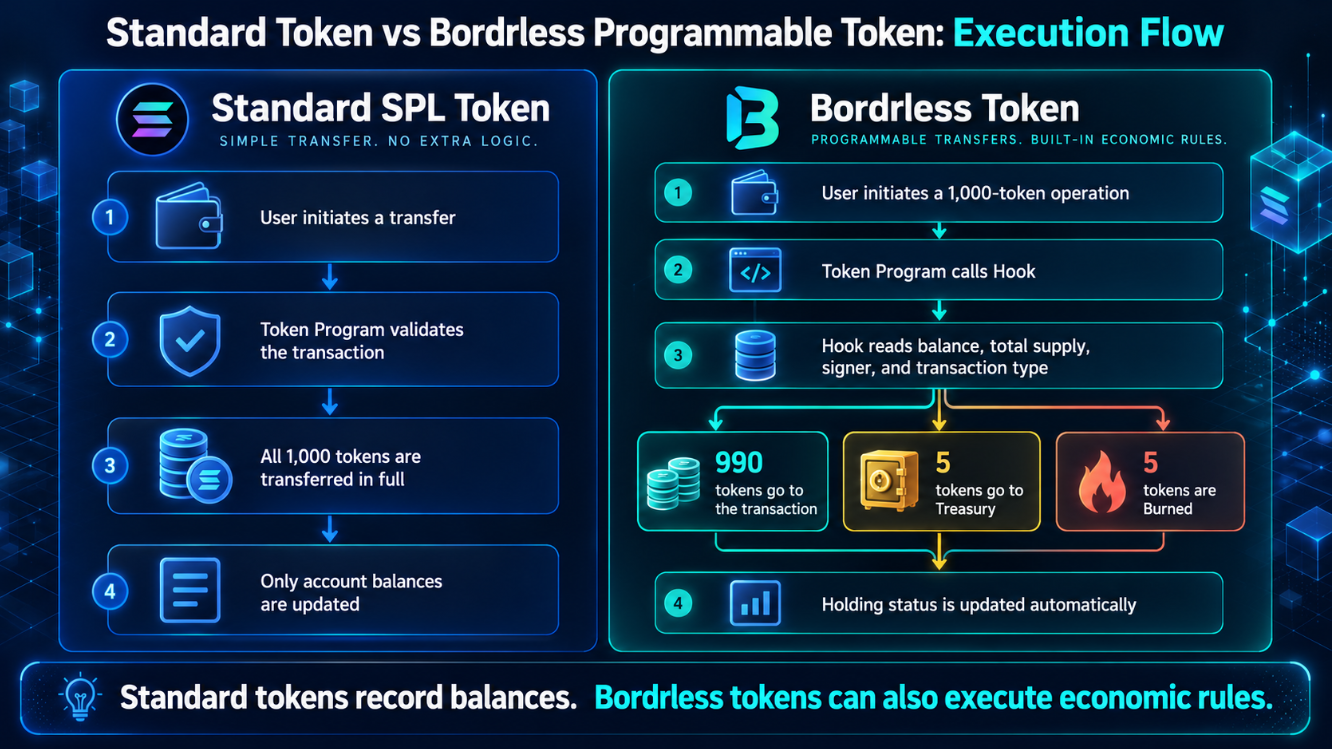
Suppose a project issues a token using the Bordrless standard and sets the following sell rule:
- A user sells 1,000 tokens;
- 990 tokens enter the Swap calculation;
- 5 tokens go to the project Treasury;
- 5 tokens are burned;
- The holding account simultaneously updates the average holding time of the remaining tokens.
Traditional Transfer Hooks are closer to a check of "can this transfer pass?" The Bordrless Hook can return multiple Cuts, burn during Swap, set the Swap fee rate for that transaction, and update position state. The token program and DEX are responsible for validating the Hook's return values to prevent the Hook from transferring more than the amount involved in the current operation.
The team also demonstrated a Half-Life rule: when tokens are first acquired, selling or transferring them out may incur a higher exit fee; the fee gradually decreases with holding time. It uses state saved within each position to track token age, enabling rules that ordinary static tax tokens find difficult to express.
The real significance of this capability is not that "all tokens should charge taxes," but that it lets developers design mechanisms that previously required multiple contracts and off-chain services.
At the same time, the other side must also be seen:
- Users need to understand the specific rules of the token they are buying;
- Different tokens may use completely different Hooks;
- Wallets and trading front ends must clearly display fees and restrictions;
- Custom Hooks themselves may contain vulnerabilities or malicious logic;
- Complex mechanisms may be packaged as marketing selling points to hide unreasonable high fees.
Therefore, Programmable Hooks are both an innovation space and a new due diligence responsibility.
4. What Is the Difference Between Bordrless and Solana Token-2022?
Solana's Token-2022 already supports Transfer Hook. According to Solana's official documentation, the Transfer Hook Extension can let a Mint execute custom instructions on every token transfer, for scenarios such as whitelists, blacklists, custom fees, or transfer events; however, the original transfer accounts are provided as read-only during the Hook call, and sender permissions do not automatically extend to the Hook program.
Bordrless chose another route: it is not a Token-2022 extension, nor an add-on module on standard SPL Token, but an independent token program built from scratch around Hooks.
The differences can be summarized as:
- Token-2022 Transfer Hook is mainly called during token transfers;
- Bordrless Hooks can be called before and after transfers, Mint, and Burn, as well as during DEX Swap and liquidity changes;
- Token-2022 Hooks can execute custom logic, but cannot directly modify the balances of read-only accounts in the original transfer;
- Bordrless allows Hooks to return results such as "actual amount received, Cut, Burn, Swap fee rate, and state updates";
- Bordrless also comes with a native DEX and Launchpad so the trading layer can understand these rules.
This should not be simplistically understood as "Bordrless is comprehensively better than Token-2022." Token-2022 is within Solana's official Token Extensions system and has a broader standardization base; while Bordrless gains greater rule expression capability, it also has to bear the compatibility and cold-start costs of an independent standard.
What investors should really watch is: whether the added programmable capability is enough to make developers accept new integration costs.
5. What Products Are in the Bordrless Ecosystem?
Token Standard
This is the protocol foundation, responsible for Mint, positions, transfers, and Hook callbacks. The token program calls the Hook during each relevant operation and validates its return results.
Bordrless DEX
The DEX not only handles Swaps and liquidity pools, but also calls the Pool Hook on every Swap or liquidity change. This lets the Hook recognize transaction context, rather than only seeing an ordinary wallet transfer.
Launchpad
The Launchpad allows creators to issue tokens with rules. The official interface provides presets such as Plain, Diamond Hands, Burn, Paid to Hold, and Half-Life, and also supports custom Hooks. After a Launch is created, the rules selected by the creator in the interface cannot be changed arbitrarily, but the underlying core programs are currently still upgradeable. These two layers cannot be conflated.
Bridge
The Bridge maps SOL, SPL Tokens, or Token-2022 assets 1:1 into the Bordrless standard and allows reverse conversion. The official page shows that the BORDR bridge ratio is 1:1 and currently charges no Bridge fee.
SDK and Workshop
The SDK provides developers with Hook, Mint, and Launch integration capabilities; Workshop is used to discover custom Hooks and configurations. They determine whether Bordrless can gradually become a platform adopted by external developers, rather than remaining only the project team's own product.
The number of products itself does not equal an ecosystem. More important is: whether each product has independent users, whether third-party developers continue to contribute, whether aggregators support it, and whether the project still has long-term trading after a single Launch.
6. What Value Does the BORDR Token Have? Where Is the Investment Logic?
BORDR's clearest current value capture path is not governance voting or deflationary burns, but protocol revenue buybacks.
According to current official Tokenomics, the protocol's main revenue includes:
- 0.3% LP fee on every Launch Pool trade;
- 0.01 SOL Launch fee when creating a token;
- 1% protocol fee on the quote side of every ordinary DEX Pool trade.
Official rules divide each round of new Treasury revenue into two parts:
- 50% remains in the Treasury for protocol operations such as development, deployment, and Keeper costs;
- 50% is sent to the Buyback Wallet, used to buy BORDR through Jupiter, then bridge it into the Bordrless standard version and deposit it in the Treasury.
The process can be summarized as:
Real usage → trading and issuance fees → protocol revenue → 50% used for market buybacks → bought-back BORDR enters the Treasury
This is more specific than simply promising "future token utility," because the revenue sources, Treasury, and Buyback Wallet can all be verified on-chain.
But it is not an automatic chain that guarantees appreciation. There are at least four variables in between:
- Whether the platform can continue generating revenue;
- Whether revenue scale is large enough relative to BORDR's market cap;
- Whether buybacks are continuously executed according to the rules;
- How the Treasury will manage or use already bought-back tokens in the future.
Only when adoption and revenue grow faster than market valuation can buybacks create meaningful value support.
7. Can the BORDR Buyback Mechanism Really Increase Value?
Buybacks have three potential positive effects.
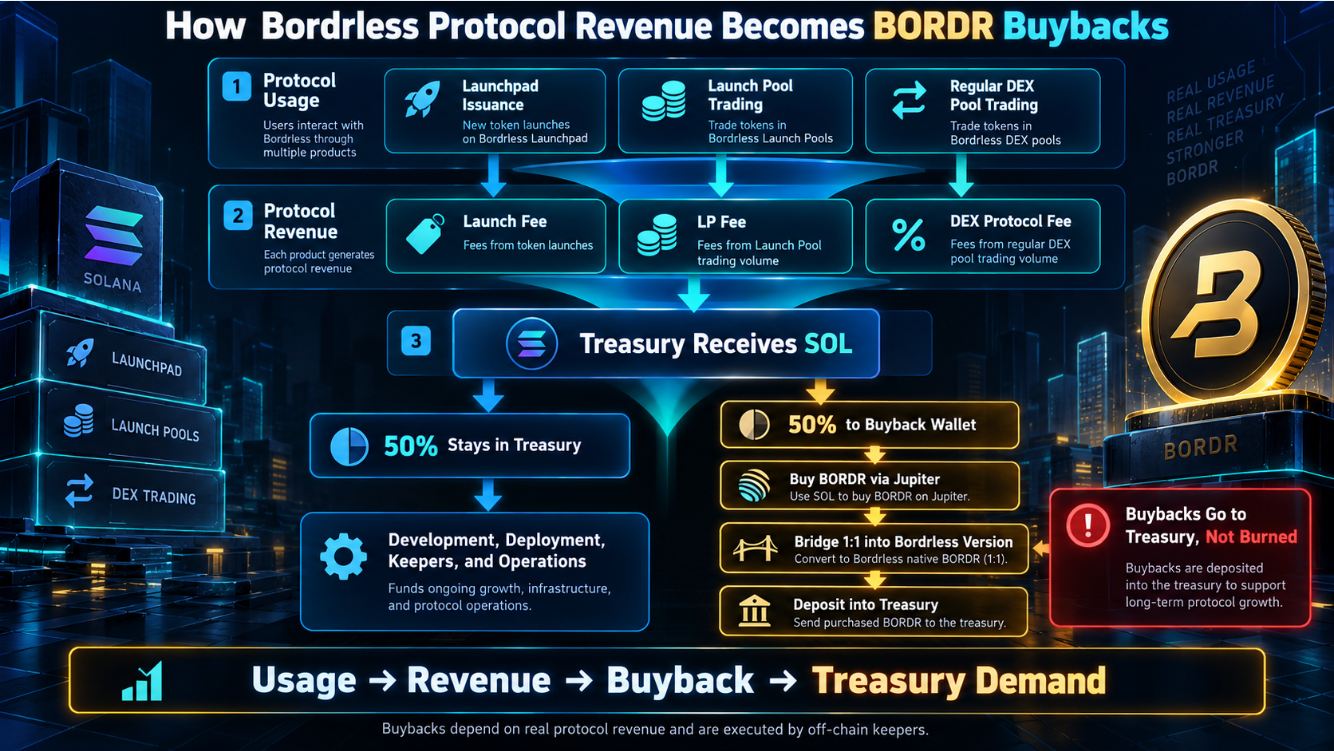
First, they convert protocol usage into actual buying pressure for BORDR. As long as revenue continues to be generated, the Buyback Wallet needs to buy BORDR in the market.
Second, buyback data is verifiable on-chain. Investors do not have to rely entirely on project announcements; they can track the Treasury, Buyback Wallet, and bridged holdings.
Third, buybacks provide a more quantifiable metric for valuation than "narrative heat," for example:
Annualized buyback amount ÷ BORDR circulating market cap = approximate buyback yield
But the current mechanism also has four limitations.
Buyback Does Not Equal Burn
Bought-back BORDR enters the Treasury, and the team explicitly says Nothing is burned. It reduces part of the immediate market circulation, but does not permanently reduce maximum supply. Whether and how Treasury tokens will be used in the future still affects actual supply expectations.
Buybacks Depend on an Off-Chain Keeper
The rule plans to process new revenue every 10 minutes, but the executor is an off-chain Keeper run by Bordrless. If the Keeper stops, revenue will remain in the Treasury waiting for a later run. This means buybacks are not completely automated by a permissionless on-chain program.
There Are Minimum Amounts and Per-Round Caps
When new revenue is below 0.02 SOL, it waits for the next round; each round processes at most 5 SOL, with any excess carried forward. During low-usage phases, both buyback frequency and scale may be limited.
USD Display Value Is Not Cumulative Spend
The homepage's "BORDR bought back" is calculated based on the Treasury's current holdings and real-time token price. When BORDR's price falls, this number may decline even if the number of tokens held has not decreased. Therefore, evaluating buybacks should look at both the number of tokens bought back, the actual SOL spent, and transaction signatures, not just the USD dashboard.
The most accurate conclusion is:
Buyback is not the source of value itself, but a distribution method for protocol revenue; the real source of value is still that people use it and are willing to pay.
8. Why Can't BORDR Be Simply Compared to BNB?
Seeing "platform revenue buys back tokens," many people naturally think of BNB. But this analogy can only be used to understand the mechanism, not to derive valuation.
Behind BNB is an already scaled trading platform, public chain, and multiple product revenue streams, with a business model and user base validated over years. BORDR, by contrast, is in the early stage of a new standard, new DEX, and new Launchpad, with adoption, revenue stability, and developer network still to be proven.
If you want to further understand the difference between BNB ecosystem narratives and new assets, you can read What Is BNC4/USDT. For BORDR, the key is not to replicate BNB's historical gains, but to verify whether it can build its own revenue scale.
The most fundamental difference between the two is:
- BNB's core question is how much more a mature ecosystem can grow;
- BORDR's core question is whether an independent token standard can cross the cold-start phase.
Therefore, just because both have a "revenue—buyback" logic, BORDR cannot be assigned the same valuation multiples as BNB.
9. What Is the Difference Between BORDR and GSTOCK? Why Can't They Be Valued the Same Way?
BORDR is a crypto-native infrastructure token, and its value mainly comes from protocol adoption, revenue, and buybacks. If GSTOCK-type assets are stocks or real-world asset mappings, more attention should be paid to underlying asset net value, issuance and custody structure, price peg, and redemption mechanisms.
To understand another asset analysis framework, you can read What Is GSTOCK/USDT. Even if both types of assets trade in USDT, they cannot be compared only by price gains.
When analyzing BORDR, focus on:
- DEX trading volume;
- Number of Launches and survival rate;
- Protocol revenue;
- Number of tokens bought back;
- Third-party developer adoption;
- Relationship between market cap and revenue.
When analyzing Tokenized Assets, focus more on:
- Underlying Asset;
- NAV;
- Custody and redemption;
- Premium or Discount;
- Legal and regional restrictions.
In one sentence: BORDR depends on protocol operating results, while Tokenized Assets depend on underlying asset value and mapping quality.
10. What Are BORDR's Four Biggest Opportunities Right Now?
Solana's Issuance Ecosystem Continues to Grow
Solana has active token issuance and trading users. If the market is no longer satisfied with homogeneous tokens that only have a name, image, and fixed supply, programmable issuance tools may gain more demand.
Launchpad Competition Shifts Toward Mechanism Innovation
Traditional Launchpads mainly compete on issuance speed, liquidity curves, and traffic. Bordrless wants to push competition to the token rule layer: holder rewards, dynamic exit fees, Burn, wallet restrictions, and composable game mechanics can all become issuance templates.
Programmable Tokens Become a New Category
If developers begin to view tokens as programmable financial objects rather than merely transferable assets, Hook standards may develop network effects. More Hooks attract more projects, more projects bring more trading, and more trading attracts wallet and aggregator integrations.
Revenue Buybacks Create Verifiable Demand
When protocol revenue grows, using 50% of revenue for buybacks can give BORDR market demand tied to usage. This gives the token an additional value capture path beyond pure market sentiment.
However, the four items above are opportunities, not completed results. The current 94 Launches and ten-thousand-dollar-level 24-hour volume prove the product is running, but not enough to prove it has become Solana's general infrastructure.
11. What Are BORDR's Biggest Risks?
Technical Adoption Risk
Developers already have SPL Token, Token-2022, and mature Launchpads available. Bordrless must prove that its added capabilities are enough to offset migration, learning, auditing, and integration costs.
Ecosystem Cold-Start Risk
A Launchpad needs projects, projects need traders, traders need liquidity, and liquidity needs sustained attention. If any link is insufficient, revenue and buybacks may fall quickly.
Independent Standard Compatibility Risk
Wallets, aggregators, custodial platforms, and analytics tools may not immediately recognize all Bordrless rules. An asset may exist on-chain, yet not have the same accessibility as an ordinary SPL Token.
Upgrade Authority Risk
The official Programs page shows that Token Standard, DEX, Launchpad, Rules Kit, and Bridge are currently Upgradeable. The official open-source repository further warns that before Upgrade Authority is migrated to a multisig with a timelock, these programs should be treated as upgradeable by a single key, not immutable programs.
This does not mean the project will definitely maliciously upgrade, but it means investors need to pay extra attention to:
- Whether Upgrade Authority is migrated;
- Whether multisig is adopted;
- Whether a public timelock is set;
- Whether each program upgrade is publicly explained;
- Whether the on-chain binary matches the open-source code.
Smart Contract and Custom Hook Risk
Core protocol security does not equal third-party Hook security. Each custom Hook may introduce independent vulnerabilities, abnormal fees, or malicious rules. Before trading, you must read the specific token's rules, not just look at the Bordrless brand.
Buyback Execution and Treasury Risk
The buyback Keeper runs off-chain, and Treasury-held buyback tokens are not burned. Keeper availability, wallet permissions, and Treasury management policy all affect the credibility of value capture.
Revenue Concentration Risk
If volume mainly comes from a few popular Launches, short-term revenue may be very high but unsustainable. One-off hits should be distinguished from diversified, stable ecosystem activity.
Valuation and Liquidity Risk
Early tokens often see prices rise faster than revenue. Low liquidity amplifies both upside and exit slippage. A low market cap does not equal a cheap valuation; it must be compared with sustainable revenue and buyback scale.
12. What Conditions Are Needed for BORDR's Price to Rise?
BORDR's rise can come from short-term narrative or fundamentals. The two need to be separated.
Short-term catalysts may include:
- New trading platform listings;
- Solana ecosystem Risk-On;
- Popular Launches bringing volume;
- New Hooks or game mechanics gaining attention;
- The market repricing the "programmable token" narrative.
Long-term upside requires stricter conditions:
- Monthly Launch count continues to grow, rather than relying only on concentrated releases soon after launch;
- Tokens launched on the platform can graduate and maintain trading;
- Ordinary DEX Pool volume increases and revenue sources become more diversified;
- Protocol revenue and the number of tokens bought back continue to grow;
- External developers begin writing Hooks, rather than all being provided by the team;
- Wallets, aggregators, and analytics tools expand support;
- Upgrade Authority gradually shifts to multisig, timelock, or immutable structure;
- BORDR's valuation does not run far ahead of revenue.
Price rising does not mean these conditions have been met. New assets may rise first and look for fundamentals later, or they may draw down during product growth because the overall market falls.
13. What Should BORDR Price Predictions Look At?
You can use BORDR price prediction to observe market trends and different scenarios, but fixed target prices cannot replace protocol data.
A more suitable valuation framework for BORDR includes the following five groups of metrics.
Trading Metrics
- 24-hour and 30-day DEX trading volume;
- Unique trading addresses;
- Share of trading between ordinary Pools and Launch Pools;
- Liquidity and large-order slippage.
Adoption Metrics
- Number of new Launches;
- Launch graduation rate and 30-day survival rate;
- Number of independent Hook developers;
- SDK downloads and third-party integrations.
Revenue Metrics
- LP fee;
- Launch fee;
- DEX protocol fee;
- Whether revenue is concentrated in a few projects.
Value Capture Metrics
- SOL spent on buybacks per cycle;
- Number of BORDR bought back;
- Ratio of annualized buyback amount to circulating market cap;
- Treasury balance and buyback token management policy.
Valuation Metrics
- Price;
- Circulating Market Cap;
- FDV;
- Market cap to protocol revenue ratio;
- Potential supply pressure from unlocks or Treasury.
The team confirms maximum supply of 1 billion tokens, but maximum supply does not equal circulating supply. Before formal valuation, you should still verify circulating supply, team and Treasury holdings, lockup arrangements, and whale concentration. Judging "cheap" by unit price alone is meaningless.
14. Why Do BTC and ETH Cycles Still Affect BORDR?
BORDR runs in the Solana ecosystem, but it is still a high-beta crypto risk asset.
BTC price prediction can help observe whether the overall market is in a Risk-On phase. When BTC rises, stablecoin liquidity increases, and traders are willing to take more risk, capital can more easily flow into Solana new assets and infrastructure tokens. When BTC enters a rapid decline or deleveraging phase, small-cap tokens usually suffer higher drawdowns.
ETH price prediction can be used to observe the overall valuation environment for DeFi and on-chain infrastructure. ETH is not Bordrless's underlying asset, but when the market is willing to pay higher valuations for DEXs, Launchpads, Hooks, and on-chain revenue, related narratives may transmit across multiple chains.
You should also monitor SOL, because Bordrless's fees, user funds, and developer activity happen directly on Solana. The absence of bad news from the project does not mean BORDR will not fall because BTC, ETH, or SOL weaken.
15. If Buying BORDR, How Should You Analyze It Before Trading?
Step 1: Confirm Asset Identity
Verify the token name, Solana network, and official Mint address. Do not buy based only on the ticker. Popular new tokens are very likely to have same-name copycats.
Step 2: Check Market Quality
After opening the quote page, do not just look at price change. Also check:
- 24-hour volume;
- Bid-ask spread;
- Order book depth;
- Estimated slippage for large trades;
- Whether there are obvious price gaps between different markets.
Step 3: Check On-Chain and Protocol Data
Compare the official dashboard, Treasury, and Buyback Wallet to confirm whether volume, revenue, and buybacks are growing together. If price rises while protocol data stalls, the market may be driven mainly by sentiment.
Step 4: Estimate How Much Future Growth Is Already Priced In
Do not first ask "can it go up 10x"; first ask: how much annual revenue, trading volume, and buyback amount does the current market cap require to be supported?
Step 5: Set a Loss Budget
Early infrastructure tokens are better managed with small positions, scaling in, and clear invalidation conditions. Position size should be based on acceptable loss and liquidity, not on the project story.
16. BORDR Investment Strategy: Short, Medium, and Long Term Look at Different Indicators
Short-Term Event Traders
Short-term traders focus on volume, liquidity, platform listings, popular Launches, SOL price action, and social attention. The core risk is mistaking short-term momentum for long-term adoption.
Suitable disciplines include:
- Do not chase solely based on gain leaderboards;
- Set a maximum loss in advance;
- Keep position size within what market depth can absorb;
- Reassess when volume and liquidity decline together.
Medium-Term Narrative Investors
Medium-term investors focus on whether "Programmable Tokens" form an independent sector and whether Bordrless can become a representative platform. At minimum, check Launch, volume, revenue, buyback, and developer data monthly.
Long-Term Fundamental Investors
Long-term investors are really betting on whether Bordrless can become token infrastructure that Solana developers are willing to rely on for the long term.
Signals that the long-term thesis is failing include:
- Launch count grows but survival rate declines;
- Revenue depends on a single project for a long time;
- External developers do not adopt the SDK;
- Buybacks remain insignificant relative to market cap;
- Core program permissions do not improve for a long time;
- Mainstream tools are unwilling to integrate the standard.
17. HIBT BORDR Six-Dimension Scoring Model
To avoid judging solely by narrative, BORDR can be tracked continuously across six dimensions.
1. Technology: Does the technology truly add capability?
Observe whether Hooks can reliably implement mechanisms that traditional tokens find difficult, whether the code is open source, whether mainnet deployment is verifiable, and whether security issues are disclosed promptly.
2. Adoption: Who is using it?
Observe Launch count, active projects, independent developers, and wallet and aggregator integrations. Team-built demos cannot replace third-party adoption.
3. Revenue: Is sustainable revenue being generated?
Observe 30-day and 90-day revenue trends, revenue source distribution, and trading volume quality. One-off popular projects cannot represent recurring revenue.
4. Buyback: Is value returning to the token?
Observe actual SOL spent, number of tokens bought back, execution frequency, Treasury holdings, and buyback yield, not just the homepage USD figure.
5. Liquidity: Can you actually get in and out?
Observe DEX and CEX depth, spreads, slippage, and cross-market arbitrage. Paper market cap does not equal exitable liquidity.
6. Valuation: Is the price already pricing in the future?
Compare market cap growth with revenue, buybacks, users, and developer growth. If the token price rises much faster than all fundamental indicators, risk-reward deteriorates.
Investors can set each dimension to red, yellow, or green rather than forcing a seemingly precise total score. A project with green technology and red adoption still cannot be considered a mature investment target.
18. BORDR's Bull, Base, and Bear Scenarios
Bull Case: The Standard Forms Network Effects
The optimistic scenario requires several things at once:
- Solana on-chain issuance and trading remain active;
- Bordrless Launch count and survival rate both improve;
- External developers continue launching new Hooks;
- DEX volume and protocol revenue grow;
- Buyback scale gradually rises relative to market cap;
- Mainstream wallets, aggregators, and data platforms complete integrations;
- Core permissions shift toward more credible multisig and timelock structures.
In this case, the market may reprice BORDR from a "new Launchpad token" to a "programmable token infrastructure asset."
Base Case: The Product Runs, but Adoption Grows Slowly
The neutral scenario may be:
- The platform continues shipping features;
- Popular Launches appear occasionally;
- Volume and revenue are volatile;
- Developer adoption is limited;
- Buybacks exist but are small;
- The token trades in a wide range between narrative catalysts and insufficient data.
This is the most common path for many early infrastructure projects.
Bear Case: Technology Does Not Convert Into Demand
The pessimistic scenario includes:
- Developers continue choosing SPL or Token-2022;
- Launch count and volume decline;
- Liquidity concentrates in a few short-lived tokens;
- Protocol revenue and buybacks decrease;
- Security incidents occur in Hooks, Bridge, or core programs;
- Upgrade Authority or Treasury management raises trust issues;
- The Solana new-token market enters Risk-Off.
In this case, the "new token standard" may remain a technical experiment and fail to support BORDR's valuation.
19. BORDR FAQ
What coin is BORDR?
BORDR is the fixed-supply token of the Bordrless protocol in the Solana ecosystem. It is not an ordinary meme coin, but it is still a high-risk crypto asset. The protocol builds a programmable token ecosystem through its token standard, DEX, Launchpad, and Bridge.
What is Bordrless?
Bordrless is a Solana token infrastructure system independent of SPL Token and Token-2022. Its Hooks can execute custom rules during transfers, Mint, Burn, Swap, and liquidity changes.
What is BORDR's maximum supply?
Official Tokenomics show a maximum supply of 1 billion tokens, with 6 decimals and no further Minting after issuance. For valuation, current circulating supply and holding structure still need to be verified separately.
Will BORDR be burned by the protocol?
No. The team explicitly states that tokens bought back by the protocol enter the Treasury and are not burned. Some other tokens issued by Bordrless can set Burn rules, but that does not mean BORDR itself uses buyback-and-burn.
How does the BORDR buyback work?
Official rules send 50% of new Treasury protocol revenue to the Buyback Wallet, which buys BORDR through Jupiter, bridges it into the Bordrless standard version, and deposits it back into the Treasury. Execution depends on an off-chain Keeper run by the project team.
What is the difference between Bordrless and Token-2022?
Token-2022 Transfer Hook mainly executes custom logic during transfers; Bordrless is designed around Hooks at the token program and DEX levels, and can return results such as Cut, Swap Burn, dynamic fee rates, and position state, but it also requires independent ecosystem integrations.
Is BORDR worth buying?
It cannot be judged only by a technical concept. You should also check developer adoption, Launch survival rate, DEX volume, protocol revenue, buyback yield, liquidity, program permissions, and current valuation. At this stage, it is closer to an early high-risk infrastructure investment than a mature blue-chip asset.
What should BORDR price predictions look at?
Focus on Market Cap, FDV, DEX Volume, Protocol Revenue, Buyback, active projects, developer adoption, and the SOL market environment. For early tokens, precise long-term target prices are usually unreliable.
How do you buy BORDR?
Before trading, verify the Solana network and official Mint address, then check quotes, spreads, depth, and slippage. When using a centralized platform, confirm the correct BORDR/USDT trading pair; when using on-chain markets, also confirm contract and wallet security.
Are Bordrless programs non-upgradeable?
No. The official Programs page shows that core programs currently still retain Upgrade Authority. The project repository recommends treating them as single-key upgradeable programs until permissions are migrated to a multisig with a timelock.
20. Conclusion: Is BORDR Worth Buying? The Key Is Not Whether the "Standard" Is New
What is most noteworthy about Bordrless is that it does not stop at token Hooks approving or rejecting transfers. Instead, it tries to make tokens, DEXs, and Launchpads jointly understand and execute more complex rules. This architecture may indeed expand the design space for Solana tokens.
But from an investment perspective, technical innovation is only the starting point.
The value chain BORDR really needs to complete is:
More developers adopt → more effective Launches → more real trading → more protocol revenue → more BORDR buybacks → stronger token demand
The current official dashboard already shows real Launches, trading, fees, and buyback holdings, indicating the product is not only in a whitepaper; but the current scale is still early and cannot prove the business model is mature.
In addition, investors must correctly understand two limitations: bought-back BORDR enters the Treasury rather than being burned; core programs still retain upgrade permissions, and protocol buybacks depend on an off-chain Keeper. These do not mean the project has no value, but they do mean BORDR cannot be treated as a low-risk asset simply because of "fixed supply + revenue buyback."
Therefore, a more responsible answer to "Is BORDR worth buying?" is:
BORDR is a high-risk, high-potential early Solana infrastructure investment. Whether it is worth participating depends on whether investors are willing to continuously verify adoption, revenue, buybacks, permissions, and valuation, rather than simply believing the "new token standard" narrative.
Ultimately, what matters most is not what the code can do, but whether the market truly needs it:
Are there real developers → are there real projects → is there real trading → is there real revenue → is there sufficiently large sustained token demand.
Data updated October 13, 2026. Technical mechanisms and Tokenomics are mainly based on the Bordrless official website, official Tokenomics, official Programs page, Bordrless open-source repository, and Solana Transfer Hook documentation. On-chain and homepage dynamic data will continue to change and should be rechecked before trading.