
Hookr.fun is not just an ordinary memecoin launchpad that only handles token issuance. It is deployed on Robinhood Chain and attempts to package Uniswap v4’s Hooks capabilities—originally aimed at developers—into trading infrastructure that projects, liquidity providers, and applications can directly compose and use.
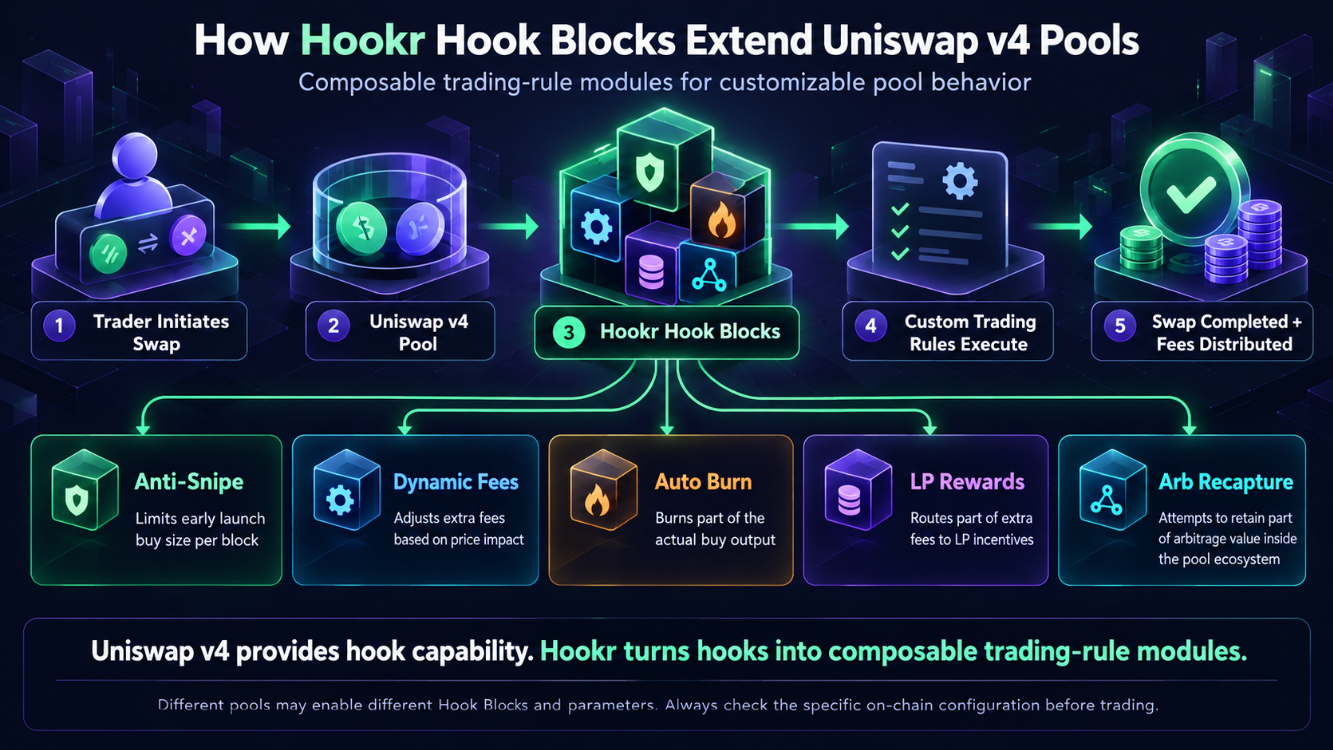
Through Hook Blocks, a Uniswap v4 liquidity pool can add rules such as Anti-Snipe, Dynamic Fees, Auto Burn, LP Rewards, and Arbitrage Recapture. HOOKR is the protocol’s token. The main value-capture path officially designed for it is: hook add-on fees and other protocol revenue flow into the Treasury, which is then used to buy back HOOKR and send it to the Dead Address.
This gives HOOKR a verifiable value chain that new coins relying solely on social attention lack, but it does not mean the price must rise. What ultimately determines HOOKR’s long-term value is not the “Uniswap v4 Hooks” label, but whether Hookr can attract real pools, developers, trading volume, and protocol revenue.
Risk Disclosure: This article was updated on October 14, 2026. It is intended only for project information organization and investment education and does not constitute investment advice, a guarantee of returns, or a trading recommendation. Hookr officially discloses that its contracts have not yet undergone an independent external audit. HOOKR is an early-stage, highly volatile crypto asset and may experience severe drawdowns due to insufficient ecosystem adoption, smart contract vulnerabilities, declining liquidity, or market risk-off.
Key Takeaways: 10 Things You Must Know Before Investing in HOOKR
- Hookr.fun is Uniswap v4 Hooks infrastructure, not just a memecoin token launchpad.
- Hook Blocks are like composable trading pool plug-ins that give pools custom rules.
- Hookr currently runs on Robinhood Chain, with Chain ID 4663.
- The project supports both launching new tokens and creating new Hook Pools for existing assets.
- The HOOKR contract address is
0x18E674231A58c239Dc7DaeDcffE15Ec3A24cff5c. - HOOKR has an initial supply of 1 billion tokens. The team treats tokens sent to the Dead Address as permanently burned.
- Hookr does not take the Base LP Fee; pools that only enable the base fee generate no Hookr protocol revenue.
- New Pools by default allocate 20% of hook add-on fees to the protocol. The protocol share cap for future new Pools is 50%.
- Protocol revenue received by the Treasury is used to buy back HOOKR and burn it, but the scale of that revenue still depends on real trading activity.
- The biggest current risk is not that the technical concept is not novel enough, but that contracts are unaudited, the ecosystem is still early, and revenue may not support valuation.
1. What Is HOOKR? First Understand the Difference Between Hookr.fun and the HOOKR Token
Hookr.fun and HOOKR are not the same concept.
- Hookr.fun: The protocol and product suite responsible for Hook discovery, composition, deployment, Pool creation, Launch, and SDK integration.
- HOOKR: The project token, which mainly captures ecosystem value through protocol revenue buybacks and burns.
- Hook Blocks: Functional modules that can be composed into Uniswap v4 Pools, such as anti-sniping, dynamic fees, auto burn, and LP rewards.
The team defines Hookr.fun as modular infrastructure for discovering, composing, and integrating custom Uniswap Hooks. Projects can compose Hook Blocks, deploy custom Hooks, and initialize new Uniswap v4 Pools for new or existing tokens.
HOOKR runs on Robinhood Chain. The officially listed token contract is:
0x18E674231A58c239Dc7DaeDcffE15Ec3A24cff5c
Public on-chain and market data show that HOOKR has a supply of 1 billion tokens. Note that “burn” mainly means sending tokens to an unusable Dead Address. The economically available supply decreases, but the ERC-20 contract’s totalSupply() does not necessarily decline in sync. Therefore, when assessing HOOKR supply, you should look at:
- contract total supply;
- Dead Address balance;
- actual unburned supply;
- liquidity pools and exchange wallets;
- large holder concentration.
Users can check the latest quote, volume, and price action through real-time HOOKR market data, but the latest traded price of a new token is not the price at which large amounts of capital can actually enter and exit. You still need to check market depth, bid-ask spread, and slippage.
2. What Problem Does Hookr.fun Solve? Why Does Uniswap v4 Need Hooks?
Traditional AMM Pool trading logic is relatively fixed: users input assets, the Pool calculates price and fees according to a preset curve, and the swap is completed. If a project needs anti-sniping, dynamic fees, rewards for liquidity providers, or additional burns, it usually needs to develop complex contracts separately or add services outside the trading system.
Uniswap v4 introduced Hooks, opening key points in the Pool lifecycle to external smart contracts.
According to Uniswap’s official documentation, each v4 Pool can bind to one Hook at creation. The Hook can be called before and after actions such as Pool initialization, adding or removing liquidity, swaps, and Donate. For example:
beforeInitializeandafterInitialize;beforeAddLiquidityandafterAddLiquidity;beforeRemoveLiquidityandafterRemoveLiquidity;beforeSwapandafterSwap;beforeDonateandafterDonate.
This means Pools no longer only execute uniform AMM logic; custom rules can be inserted into the trading lifecycle.
Hookr targets not “whether Hooks can be developed,” but “whether ordinary projects can more easily discover, understand, compose, and use Hooks.”
It hopes to turn functions that originally required professional Solidity development, deployment, and integration into configurable Hook Blocks. Projects do not need to develop an entire Hook from scratch every time, and they can see rules, fees, and distribution methods in the same interface in advance.
Therefore, Hookr’s potential value comes from lowering three thresholds:
- development threshold: reducing repetitive coding of basic Hook logic;
- product threshold: turning technical parameters into selectable functional modules;
- distribution threshold: enabling wallets, launchpads, and applications to access the Hookr marketplace through the SDK.
However, modularity does not eliminate security risks. Multiple Blocks combined may create new interactions; if a creator chooses the wrong parameters, a Pool may be permanently locked into an unreasonable fee or restriction structure.
3. What Is a Uniswap v4 Hook? Understand It Through One Trade
A swap in an ordinary Pool can be simplified as:
User submits transaction → Pool calculates price and base fee → Asset exchange completes
A Pool bound to a Hook may look like this:
User submits transaction → Before Swap Hook checks transaction → Adjusts dynamic fees or limits → Pool executes swap → After Swap Hook completes rewards, records, or other actions
Assume a user uses 1000 USDC to buy a token using Hookr rules. The Pool may execute according to settings fixed at creation:
- check whether it is in the Launch Guard Window;
- limit the maximum quote asset allowed to enter per block;
- adjust dynamic fees based on price movement caused by the trade;
- allocate part of the quote asset to LPs;
- deduct a certain percentage from the actual buy output and send it to the Dead Address;
- record the protocol’s share in the Treasury ledger.
This example only explains how a Hook works. It does not mean all Hookr Pools enable the same features and fees. Each Pool’s Block combination, fees, receiving addresses, and protection period may differ. Investors must read the specific Pool’s on-chain configuration before trading.
Uniswap v4 requires a Pool to bind to one Hook contract at creation. Hookr’s key approach is to allow multiple Blocks to be composed within the same Hook framework, so one Pool can have multiple trading rules at the same time.
4. What Are Hook Blocks? Why Are They Like a “Trading Rule Plug-In Marketplace”?
Hook Blocks can be understood as plug-ins for DeFi trading pools. Different Blocks solve different problems, and creators combine them into a Pool’s operating rules.
Anti-Snipe
Used to limit front-running and sniping early in a launch. It can limit the amount of quote asset allowed to buy within one block and increase fees during the initial launch period.
But Anti-Snipe is not “absolute bot prevention.” Official documentation states that the limit applies to the entire block, not each address. It raises the cost of rapid liquidity sweeping, but cannot prevent capital from trading across blocks or using multiple addresses.
Dynamic Fees
Adjusts add-on fees based on how much a swap moves the price. Large trades or stronger price impact may incur higher fees, raising the cost of manipulation and some MEV strategies.
Dynamic fees also carry user-experience risk. Especially in Exact-Output trades, the system may use a preset dynamic fee cap rather than calculating progressively based on input size, so the actual fee on small trades may be higher than intuitively expected.
Auto Burn
Deducts a portion of tokens from the actual Buy Output and sends them to the Dead Address. It can create a burn mechanism tied to trading activity for new tokens.
Here it is essential to distinguish two types of Burn:
- Pool Token Auto Burn: a project’s token is burned on buys according to Pool rules;
- HOOKR Buyback & Burn: the Hookr Treasury uses protocol revenue to buy HOOKR and then burn it.
They are not the same fee, nor the same value path.
LP Rewards
Extracts an additional portion from trades and distributes it to liquidity providers within the current active price range. It aims to improve market-making incentives, but returns still depend on trading volume, price range, impermanent loss, and Pool parameters.
Arbitrage Recapture
Attempts to leave arbitrage value that appears between the Pool and external markets with ecosystem participants, rather than handing it all to external MEV bots. In new Pools, partner executors can run arbitrage capture, and profits are then distributed according to preset ratios to Hookr, partners, traders, or LPs.
The team also discloses that if partner executors cannot run, transactions can still complete without executing Recapture. This shows that Arbitrage Recapture is an enhancement mechanism, not revenue that necessarily arises from every trade.
More Extension Blocks
Hookr also shows modules such as Buy/Sell Block, Market Guard, Recovery Reserve, Tax + Conversion, Creator Royalty, Revenue Router, Swap Reward Mint, and Limit Orders. This shows the project is expanding from “five basic Blocks” to a broader programmable market framework.
Investors should distinguish between features “already deployed and generating usage” and features “shown on product pages or soon to be deployed.” Do not treat every module on the roadmap as an existing revenue source.
5. What Products Does Hookr.fun Have? It Is More Than a Token Launchpad
New Token Launch
Creators can issue a fixed-supply ERC-20 and create up to 8 Pools in one transaction, each using different quote assets and Hook configurations. Creators can choose ETH, USDG, HOOKR, or other eligible ERC-20s as quote assets.
Existing Token Market
Existing tokens can also create new Hookr Pools. Creating a new Pool does not give control over the original token and does not change other markets that already exist for that token.
This capability is very important because it means Hookr’s market may come not only from new token issuance, but also from existing crypto or tokenized assets creating new programmable trading pools.
Hook Builder
Builder allows developers to compose Hook Blocks, save configurations, or deploy their own Hooks. Over the long term, this may form a plug-in marketplace where “developers publish modules — projects adopt modules — modules generate usage fees.”
HookrScan and Discover
HookrScan is used to analyze Hook addresses, permissions, and behavior; Discover is used to view Pools, Hooks, tokens, fees, and trading data. For a complex Hook market, readability itself is a form of infrastructure.
SDK and Integrator
The SDK lets wallets, launchpads, trading applications, and Agents read Pool rules, request quotes, initiate swaps, create markets, and claim revenue. What ultimately determines whether Hookr can expand is not only traffic to its own website, but whether external products are willing to integrate Hookr into their underlying trading paths.
6. What Value Does the HOOKR Token Have? Where Is the Investment Thesis?
HOOKR’s clearest current value-capture path is protocol revenue buybacks and permanent burns.
But “Hookr takes a cut from every trade” is inaccurate. The new mechanism clearly distinguishes Base LP Fee from hook add-on revenue.
Base LP Fee Is Not Protocol Revenue
The base LP fee paid on every swap goes 100% to liquidity providers in the active range. Hookr does not take a cut from the Base LP Fee.
Protocol Revenue Mainly Comes from Hook Add-Ons
New Pools by default allocate enabled add-on revenue streams 80/20, with 80% going to LPs, creators, or corresponding functions, and 20% becoming Hookr’s protocol share. Main sources include:
- the portion of Dynamic Fee above the Base Fee;
- Snipe Tax during Launch Guard;
- LP Rewards Cut;
- quote-side protocol share related to Auto Burn;
- certain Router-related rewards or pot mechanisms;
- Integrator share from Partner Launchers;
- Arbitrage Recapture profit share;
- certain fixed fees retained in earlier versions.
Hookr’s default protocol share is 20%, determined by the creator or Integrator Tier when creating a new Pool and frozen into the Pool configuration. The current structure allows future Pools’ protocol share to reach up to 50%, but the share of already-created Pools does not change when the default is later modified.
How Does Protocol Revenue Flow to HOOKR?
The official token page gives this chain:
Hook add-on revenue and protocol share → Treasury → buy HOOKR on the market → HOOKR sent to Dead Address
This is a more direct value-capture logic than governance voting alone. The more ecosystem usage, the higher protocol revenue in theory; the higher protocol revenue, the more funds available to buy back and burn HOOKR.
Hookr also shows Hook Blocks Market: when developers publish modules, they may use HOOKR as a Bond and earn usage fees from Pools that install the module. This can expand functional demand for HOOKR, but investors should still verify actual deployment, Bond size, and the number of third-party developers rather than pricing solely based on product descriptions.
7. Is HOOKR’s Buyback Burn Mechanism Reliable?
From a design perspective, Buyback & Burn has three advantages.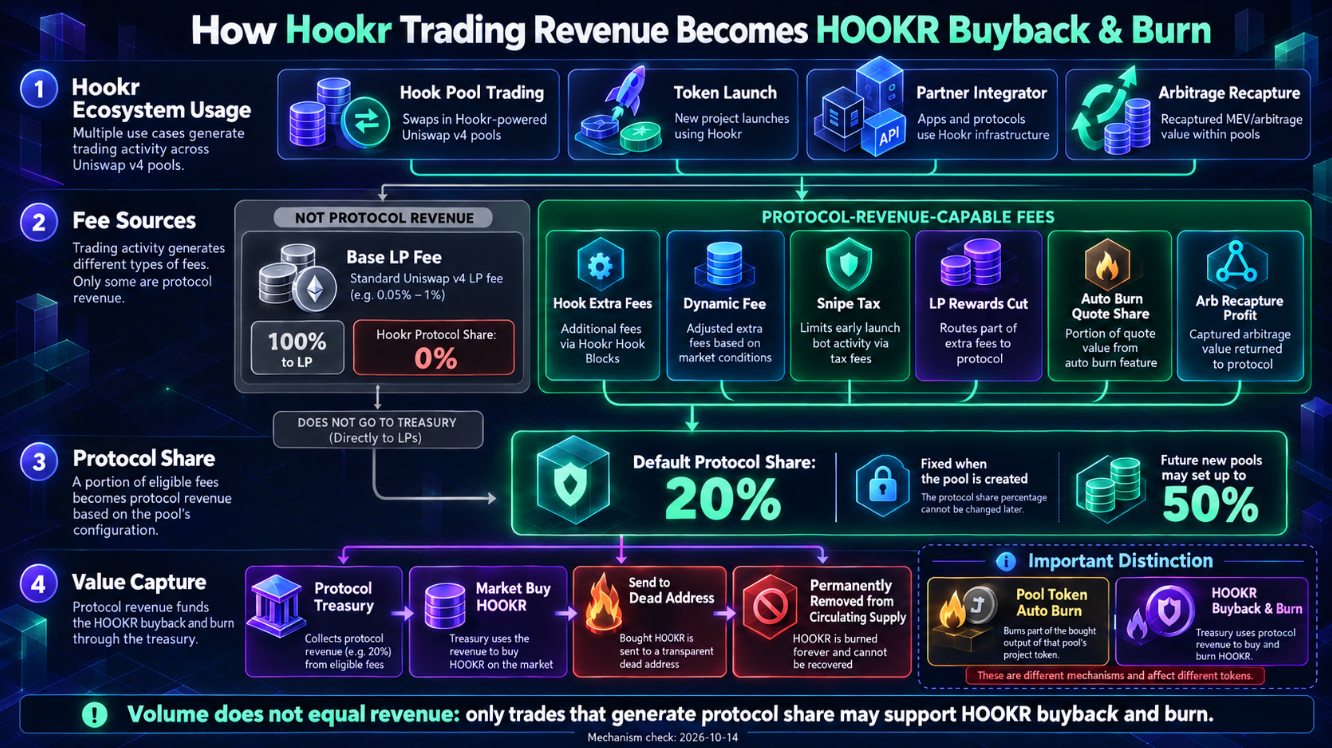
First, value capture is linked to real protocol revenue. Only when Pools generate add-on fees, Integrator revenue, or arbitrage capture shares does the Treasury have more assets to use for buybacks.
Second, burn results are verifiable. The team counts HOOKR sent to the Dead Address as permanently burned, and investors can verify the balance through the on-chain address.
Third, buybacks provide a quantifiable metric. You can calculate:
Annualized HOOKR buyback amount ÷ HOOKR circulating market cap = approximate buyback yield
But this mechanism has at least five limitations.
Not Every Trade Generates Protocol Revenue
Base LP Fees all go to LPs. A Pool that only enables the base fee and has no Dynamic Fee, Anti-Snipe, Auto Burn, LP Rewards, or other add-ons may never generate protocol revenue for Hookr throughout its life.
Exact-Output Sells May Have No Protocol Share
The team has listed “Exact-Output Sells Are Free of Protocol Take” as a known limitation. If the market heavily uses such paths, trading volume may look high, but protocol revenue may be significantly lower than a simple Volume × fee estimate.
Protocol Share Is Not Protocol Net Profit
Revenue may also involve distributions to Integrators, partner executors, and other participants. When evaluating Buyback, you must look at the quote assets actually received by the Treasury, not treat all add-on fees as Hookr revenue.
Buyback Burn Is Executed by the Treasury
Protocol share can be transferred from modules to the Treasury Forwarder via Permissionless Collect, but swapping Treasury revenue into HOOKR and burning it is still an asset management action executed by the Treasury. It cannot be described as a fully automated buyback completed on every swap.
Burn Numbers May Include Other Sources
The team states that Total HOOKR Burned reads the Dead Address balance, which may include permanent burns from sources other than the Treasury. Therefore, “new Dead Address balance” is not necessarily all from protocol revenue buybacks.
The most accurate judgment is:
Buyback & Burn is a value distribution mechanism, not value creation itself. Real value still comes from whether Hookr generates enough sustained protocol revenue.
8. What Is the Difference Between HOOKR and BORDR?
HOOKR and BORDR are both early infrastructure tokens and both try to transmit technology usage into token demand, but they solve different problems.
To learn more about another programmable asset design, read What Is BORDR / Bordrless.
The core differences are:
- BORDR runs on Solana and focuses on a programmable Token Standard;
- HOOKR runs on Robinhood Chain and focuses on Uniswap v4 trading pool Hooks;
- BORDR solves “how the token itself executes rules”;
- HOOKR solves “how the token trades after entering a liquidity pool”;
- BORDR currently buys back tokens into the Treasury and does not directly burn;
- HOOKR’s official mechanism uses protocol revenue to buy back HOOKR and send it to the Dead Address.
Neither can be judged only by “advanced technology.” BORDR must verify Token standard adoption; HOOKR must verify Hook Pools, trading volume, and protocol revenue.
9. What Is the Difference Between HOOKR and BNC4? Why Can’t They Be Valued the Same Way?
HOOKR is a DeFi Infrastructure Token. Its core metrics are Pools, Volume, Protocol Revenue, Buyback, and Burn. Other tokens that mainly rely on community narrative, market supply and demand, or different asset structures cannot directly use revenue multiple valuation.
Through What Is BNC4/USDT, investors can compare different token value sources. Seeing the same USDT trading pair does not mean the underlying logic is the same.
Analyzing HOOKR is better done by asking:
- How many active Hook Pools are there?
- Is monthly trading volume growing?
- Which Blocks actually generate fees?
- What is the Treasury’s actual revenue?
- What percentage of market cap is buyback burn?
If an infrastructure token only has price and community hype but no verifiable usage and revenue, it should not receive a high valuation just because of the “Infrastructure” label.
10. What Is HOOKR’s Biggest Bull Case?
Robinhood Chain Ecosystem Growth
Hookr depends heavily on Robinhood Chain. If more crypto assets, tokenized stocks, RWAs, and new projects enter the chain, they may need Pool creation, liquidity management, and differentiated trading rules.
Uniswap v4 Hooks Become an Industry Standard Component
Uniswap v4 gives Pools greater programmability. If more applications use Hooks for dynamic fees, launch protection, rewards, and order-like functions, Hookr may become the discovery, composition, and distribution layer for Hooks.
Launchpad Upgrades from “Token Issuance Tool” to “Market Design Tool”
Traditional launchpads mainly handle token creation and initial liquidity. Hookr allows creators to simultaneously design trading rules, multiple Pools, quote assets, and fee distribution, potentially attracting projects that want differentiated markets.
Existing Tokens and Tokenized Assets Expand the Market
Hookr serves not only new tokens but can also create new Pools for existing assets. If Robinhood Chain stock tokens are used as quote assets or subject assets, this could further expand use cases for programmable Pools.
Revenue Buybacks Create Token Demand
When Volume, add-on fees, and Arbitrage Recapture grow together, the Treasury receives more revenue, and Buyback & Burn scale may also increase, forming:
Pools → Volume → Protocol Revenue → HOOKR Buyback → Permanent Burn
This chain is HOOKR’s most important fundamental logic, but if any link breaks, the valuation model weakens.
11. What Is HOOKR’s Biggest Risk?
Contracts Have Not Completed an Independent Audit
This is the most important trust information at present. Hookr’s official FAQ and security documentation explicitly state that the contracts have undergone adversarial review but have not completed an independent external audit. Verified source code is not equivalent to a security audit.
Hooks are on the critical path of swaps and liquidity operations. If there is an accounting, permission, fee, or claim vulnerability, it could directly affect Pool assets.
Robinhood Chain Ecosystem Dependency
Hookr is currently deployed on Robinhood Chain. If the chain’s users, stablecoins, DEX liquidity, or developer growth fall short of expectations, Hookr may lack sufficient market even if the technology is complete.
Technology Adoption Risk
Developers can write Uniswap v4 Hooks directly or use other launchpads or modular platforms. Hookr must prove that its SDK, module composition, readability, and distribution capabilities can significantly reduce costs.
Competition Risk
Potential competition comes not only from other Robinhood Chain launchpads, but also from the native Uniswap Hook ecosystem, cross-chain Hook platforms, general DEX Builders, and large wallets’ own liquidity products.
Permanent Parameter Error Risk
After a new Pool is created, there is no per-Pool Kill Switch, fee override, or parameter modification path. If a creator configures it incorrectly, the Pool may remain under incorrect rules for a long time. This is the cost of immutability, not just an advantage.
Anti-Snipe Capability Is Limited
Guard limits by block, not by address; creators are still the only LP early in the launch and can recover most of the Snipe Tax they paid. It raises the cost of sniping but cannot guarantee a fair launch.
Revenue and Volume Decoupling Risk
Base-Fee-Only Pools do not generate protocol revenue, and Exact-Output Sells may also have no protocol share. Looking only at total Volume will overestimate HOOKR’s value capture.
Treasury and Management Permission Risk
The Hookr Owner can set default protocol share and Creator Tier for future Pools, pause new market creation, register or retire future modules, and adjust the Treasury Forwarder’s Payout Target. Although the Owner cannot modify already-opened Pools, future protocol revenue destination addresses still include governance and operational trust assumptions.
Liquidity and Valuation Risk
HOOKR is an early-stage token. Price may first reflect the “Robinhood Chain + Uniswap v4” narrative while revenue, developers, and Pool scale have not caught up. Market cap in a low-depth environment cannot be equated with exit liquidity of the same size.
12. What Conditions Does HOOKR Need for Price to Rise?
Short-term price can be driven by exchange listings, narrative spread, Robinhood Chain hotspots, and low float depth; long-term upside requires verifiable data.
More credible fundamental conditions include:
- Active Hook Pool count continues to grow;
- Beyond new Pools, 30-day trading volume of existing Pools is still growing;
- Third-party launchpads, wallets, or trading apps begin integrating the SDK;
- Hook Blocks Market sees external developers and real usage fees;
- Protocol Revenue grows, not just Base LP Volume;
- The Treasury continuously discloses or executes on-chain Buyback & Burn;
- An independent security audit is completed, and critical issues are fixed;
- Overall Robinhood Chain liquidity and user growth;
- HOOKR valuation growth does not exceed revenue and Burn growth for a prolonged period.
If price hits new highs but Pools, revenue, buybacks, and developer count stagnate, the rally is more likely valuation expansion than fundamental improvement.
13. What Should HOOKR Price Prediction Focus On?
Users can refer to HOOKR price prediction to observe trends and different market scenarios, but should not treat a single target price as an investment basis.
Suitable HOOKR analysis metrics are divided into five groups.
Market Metrics
- Price;
- Circulating Market Cap;
- FDV;
- CEX and DEX volume;
- bid-ask spread, depth, and slippage.
Product Metrics
- Number of Hooks;
- Active Pool count;
- Existing Token Pool share;
- SDK calls and third-party integrations;
- Number of independent Hook Builders.
Trading Metrics
- Total Volume;
- Volume corresponding to hook add-on fees;
- Trading share by different Routers;
- Exact-Input vs Exact-Output structure;
- Actual Arb Recapture profit.
Revenue Metrics
- Protocol share received by the Treasury by Quote Asset;
- How much is contributed by Dynamic Fee, Snipe Tax, LP Rewards, and Auto Burn respectively;
- Net revenue after Integrator split;
- Monthly revenue concentration and sustainability.
Token Value Capture Metrics
- HOOKR bought back per month;
- Burn amount per month;
- Dead Address balance changes;
- Buyback Yield;
- Market cap to annualized protocol revenue ratio.
The most dangerous valuation method for HOOKR is seeing a low unit price and judging it “cheap.” With 1 billion supply, each $0.01 increase in price corresponds to about $10 million change in fully diluted valuation. What matters is total valuation, not unit price.
14. Why Do BTC and ETH Cycles Still Affect HOOKR?
HOOKR is deployed on Robinhood Chain but still a high-beta crypto risk asset.
BTC price prediction can help judge overall market risk appetite. When BTC is strong and stablecoin liquidity expands, capital more easily flows to new chains, DeFi infrastructure, and small-cap tokens. When BTC falls rapidly or the market deleverages, HOOKR may see larger drawdowns without project-specific bad news.
ETH price prediction is more directly related to HOOKR. Uniswap v4 belongs to the Ethereum/EVM DeFi technology stack; ETH and DeFi market valuations affect how much valuation premium investors are willing to pay for DEXs, liquidity infrastructure, and Hooks.
But BTC and ETH rising will not automatically increase Hookr protocol revenue. They provide the market environment; Hookr’s own Pools and Volume determine fundamentals.
15. Using HIBT as an Example: How to Judge Whether HOOKR Is Worth Buying?
Step 1: Confirm Token Identity
Check the ticker, Robinhood Chain network, and full contract address. Do not just search “HOOKR” and buy directly, because anyone can create a same-name token.
Step 2: Check Market Quality
On the quote page, focus on:
- current price and 24-hour change;
- spot volume;
- bid-ask spread;
- order book depth;
- slippage on large orders;
- abnormal price gaps between CEX and on-chain Pools.
Step 3: Verify Product Data
Visit Hookr Discover and an on-chain explorer to check active Pools, Hook Blocks, TVL, 30-day Volume, and new Pool creation.
Step 4: Verify Revenue and Burn
Do not use total Volume to directly estimate revenue. Confirm whether trades enabled Add-ons that generate protocol share, and check quote assets received by the Treasury, buyback transactions, and Dead Address balance.
Step 5: Judge Whether Valuation Is Overextended
Ask yourself: Is the current market cap already pricing in “Hookr becomes the main Hooks infrastructure on Robinhood Chain”? If the market has already priced in success while data is still in early validation, risk-reward may not be attractive.
Step 6: Set a Loss Budget
Early infrastructure tokens are better suited to scaling in, small position sizes, and clear conditions for thesis invalidation. Do not ignore smart contract and liquidity risks just because the project has a real product.
16. What Type of Investors Is HOOKR Suitable For?
Long-Term Infrastructure Investors
Suitable for those willing to continuously track Uniswap v4 adoption, the Robinhood Chain ecosystem, protocol revenue, and developer growth. The premise for long-term holding is not that price has not fallen, but that the fundamental chain is still strengthening.
Medium-Term Narrative Investors
Focus on whether Robinhood Chain, RWA, Uniswap v4 Hooks, and modular DeFi become market themes, while requiring Pool and Volume data to validate the narrative.
Swing Traders
Mainly focus on volume, market depth, exchange listings, on-chain hotspots, and BTC/ETH risk cycles. They need to avoid turning event trades into long-term positions without exit criteria.
Less Suitable Users
- Do not understand Uniswap and AMMs;
- Cannot judge liquidity and slippage;
- See “Infrastructure” and assume lower risk;
- Cannot withstand large drawdowns;
- Are unwilling to continuously track on-chain revenue and security changes.
17. HIBT HOOKR Six-Dimension Scoring Model
Technology Score
Evaluate whether Hook Blocks provide real new capabilities, whether module composition is stable, and whether code and deployment are verifiable. Source-code Full Match is a plus, but cannot replace an Audit.
Adoption Score
Observe active Pools, independent projects, existing token integrations, Integrator and SDK usage. Demos created by the team itself cannot fully represent third-party adoption.
Revenue Score
Observe actual Treasury revenue, not just Volume. Especially distinguish Base LP Fee from protocol share truly belonging to Hookr.
Token Value Capture
Observe buyback amount, new HOOKR in the Dead Address, Buyback Yield, and whether Burn is mainly supported by protocol revenue.
Liquidity Score
Check HOOKR depth on DEX and CEX, spread, slippage, and trading concentration. High volume but low depth still means high exit risk.
Valuation Score
Compare Market Cap, FDV, annualized revenue, buyback scale, and ecosystem growth rate. Good technology does not mean any price is worth buying.
It is recommended to set each dimension to red, yellow, or green and keep evidence sources. A project with Technology green, Audit red, and Revenue red can still only be considered a high-risk early-stage asset.
18. HOOKR’s Bull, Base, and Bear Scenarios
Bull Case: Hookr Becomes the Hooks Distribution Layer
This requires the following to occur simultaneously:
- Robinhood Chain users and liquidity grow rapidly;
- Hookr becomes the main entry point for new Pools and Existing Token Pools;
- Third-party Builders continuously publish Blocks;
- Wallets, launchpads, and trading apps integrate the SDK;
- Hook add-on fees and Arb Recapture revenue grow;
- Buyback & Burn scale expands significantly;
- An independent security audit is completed.
In this scenario, the market may reprice HOOKR from “new chain launchpad token” to “Uniswap v4 Hooks infrastructure token.”
Base Case: Product Continues Running, Ecosystem Expands Slowly
This may look like:
- Pool count continues to increase;
- Trading volume is concentrated in a few hot projects;
- External integrations are limited;
- Revenue and Burn exist but at small scale;
- HOOKR trades in a wide range between product progress and market cycles.
This is usually a more realistic neutral path for early infrastructure projects.
Bear Case: Technology Does Not Convert into Market Share
Risk conditions include:
- Robinhood Chain growth falls short of expectations;
- Projects choose other launchpads or build Hooks themselves;
- Pool trading volume and TVL decline;
- A high share of Base-Fee-Only trading leads to insufficient protocol revenue;
- Buyback & Burn cannot form meaningful demand;
- A contract security incident occurs;
- Competing platforms gain stronger liquidity and developers;
- HOOKR valuation expands rapidly ahead of fundamentals.
19. What Is the Biggest Difference Between HOOKR and Traditional DeFi Governance Tokens?
Traditional DeFi tokens often base value on Governance: holders vote on parameters, the Treasury, or protocol upgrades. But whether governance rights create economic value depends on whether voting controls real cash flows and whether the token has irreplaceable demand.
HOOKR’s current clearer logic is:
Pool adopts Hook Blocks → generates add-on fees and protocol share → Treasury receives Quote assets → buys back HOOKR → sends to Dead Address
This is easier to quantify than just writing “future governance,” but it still is not equivalent to equity or profit sharing. HOOKR holders do not automatically own Treasury assets, protocol legal rights, or fixed income.
What truly needs verification is: Has Hookr become trading infrastructure, and is protocol revenue large enough relative to HOOKR valuation?
20. HOOKR FAQ
What is Hookr.fun?
Hookr.fun is Uniswap v4 Hooks infrastructure on Robinhood Chain for discovering, composing, deploying, and integrating Hooks, and for creating programmable trading Pools for new or existing tokens.
What is HOOKR?
HOOKR is Hookr.fun’s Utility Token. Its main value-capture path is protocol revenue buybacks and sending tokens to the Dead Address. It is not Robinhood’s official platform token and does not represent Uniswap equity.
What chain is HOOKR on?
HOOKR runs on Robinhood Chain, Chain ID 4663. Before trading, verify the full contract address rather than just the ticker.
What is the relationship between Hookr and Uniswap v4?
Hookr uses Uniswap v4 Pool and Hooks architecture to build modular trading rules, but Hookr is an independent project. Using Uniswap infrastructure does not mean it is issued or guaranteed by Uniswap.
What are Hook Blocks?
Hook Blocks are composable trading function modules for Pools, such as Anti-Snipe, Dynamic Fees, Auto Burn, LP Rewards, and Arbitrage Recapture.
What is HOOKR’s supply?
Public on-chain data show HOOKR has an initial supply of 1 billion tokens. Tokens sent to the Dead Address are treated as permanently burned. When analyzing, look at both total supply and unburned supply.
Does HOOKR have real revenue?
Hookr can earn protocol share from enabled hook add-on fees, Integrator, and Arbitrage Recapture. But Base LP Fee does not belong to Hookr; Base-Fee-Only Pools generate no protocol revenue.
Is HOOKR buyback burn automatic?
Protocol share can enter the Treasury Forwarder via Permissionless Collect, but converting revenue into HOOKR and burning it is executed by the Treasury. It cannot simply be described as automatic buyback and burn on every swap.
Has Hookr been security audited?
As of the update date of this article, the team explicitly states that the contracts have undergone adversarial review but have not completed an independent external audit.
Is HOOKR worth buying?
You should combine Pool count, hook add-on volume, protocol revenue, buyback burn, independent audit, Robinhood Chain growth, liquidity, and current valuation. It is closer to an early-stage high-risk infrastructure investment than a mature blue-chip token.
How should HOOKR price prediction be viewed?
Fixed long-term target prices have low reliability. It is better to build Bull, Base, and Bear scenarios based on Market Cap, FDV, Volume, Protocol Revenue, Burn Rate, and Ecosystem Growth.
What is the difference between HOOKR and BORDR?
BORDR leans toward Solana programmable Token Standard, while HOOKR leans toward Uniswap v4 trading pool Hooks on Robinhood Chain. The former focuses on how the token itself runs; the latter focuses on how the Pool executes trading rules.
21. Conclusion: Is HOOKR Worth Buying? Focus on Revenue, Not the Hook Concept
The most notable thing about Hookr.fun is that it attempts to turn Uniswap v4 Hooks from a professional developer tool into modular infrastructure that projects, launchpads, wallets, and trading applications can directly use.
Compared with new coins that depend entirely on market sentiment, HOOKR at least has a verifiable value path:
User and project growth → Hook Pool growth → add-on trading volume growth → protocol revenue growth → HOOKR buyback → permanent Burn
But at this stage, this path still cannot be treated as a mature business model.
Base LP Fee is not protocol revenue; some trading paths do not generate protocol share; buyback burn is executed by the Treasury; Dead Address increases may include other sources; and the contracts have not completed an independent external audit. These limitations mean HOOKR remains a high-risk early-stage infrastructure asset.
Therefore, a more responsible answer to “Is HOOKR worth buying?” is:
If investors are bullish on Robinhood Chain and Uniswap v4 Hooks and are willing to continuously track Pools, Volume, Revenue, Burn, and security audits, HOOKR can be treated as an early-stage infrastructure watchlist asset. If they chase it merely because “Hooks are the next generation of DEX technology,” they have not completed the most basic valuation verification.
What truly matters is not how big the technology story can be, but whether this chain can hold over the long term:
Real projects → Real Pools → Real trading → Real protocol revenue → Verifiable Buyback & Burn → Enough to support current valuation.
Data updated: October 14, 2026. Technical mechanisms are mainly based on the Hookr.fun official website, Hookr developer docs, HOOKR Token page, Hookr security limitations, and Uniswap v4 Hooks official docs. Protocol data, burn amounts, and market prices change continuously; re-verify before trading.