
Author: HiBT Research Institute | 5+ Years in Crypto Asset Research Last updated: October 15, 2026 Risk warning: This article is for information organization and methodology sharing only. It does not constitute investment advice. Crypto asset prices are highly volatile; make independent decisions based on your own risk tolerance.
If you've searched for "UPRH," you've probably run into this confusion: very few search results, incomplete information on major data sites, and you may not even be sure whether what you found is the same thing. This article tackles three core questions: What exactly is UPRH, where are its real risks, and if you decide to get involved, what discipline should you use?
One thing to note upfront: UPRH is a classic micro-cap, low-liquidity token with very limited public information. This article will not avoid that fact—on the contrary, "information scarcity" is itself one of the most important risk signals when evaluating this type of asset. If this is your first time dealing with small-cap tokens, we suggest bookmarking the UPRH/USDT Live Market page and reading alongside the data.
1. What Is UPRH? First, Understand What You're Buying
The first mistake beginners make with small-cap tokens isn't overpaying; it's buying the wrong asset.
UPRH's basic identity: UPRH is a digital asset token that trades in the UPRH/USDT pair on HiBT. HiBT is a digital asset exchange registered in Canada in 2021, holds MSB (Money Services Business) licenses in Canada and the US, and is headquartered in Dubai.
Is it "Upfire (UPR)" or "UpRock (UPT)"? No. Crypto is full of similarly named micro-cap tokens, and beginners often buy the wrong one because of name confusion. The only reliable way to confirm you're buying the intended token is to verify the token contract address (via a block explorer), not whether the name sounds right.
Why can't major data sites find it? Platforms like CoinMarketCap and CoinGecko have liquidity and information transparency thresholds for listings. If a token can't be found, it usually means one or more of the following: the project team has not submitted complete information, daily volume is too low, or the community is too small. That doesn't automatically mean it's a scam, but it clearly means it sits on the fringes of market attention.
Chapter takeaway: For now, UPRH can only be confirmed as a tradable asset based on limited exchange-side information; there is not enough public information about its project background, team, or tokenomics. Keep this in mind—it is the starting point for every risk judgment that follows.
2. UPRH Due Diligence: A 5-Step Self-Check for Small-Cap Tokens
When dealing with an information-scarce token like UPRH, instead of asking "what do others think," it's better to learn a due diligence process you can reuse. The five steps below apply to any micro-cap token.
Step 1: Check the website and whitepaper. Legitimate projects at least have a website, whitepaper, and clear roadmap. When you search for UPRH, you'll find that this basic material is currently hard to find—and that itself is part of the due diligence conclusion: lack of transparency = higher risk.
Step 2: Check tokenomics. What's the total supply? What percentage is circulating? Is there a team allocation and unlock schedule? If 90% of a token's supply hasn't unlocked yet, the "10x" story can be ended at any time by unlock-driven selling pressure. Verify this on a block explorer, not through community rumors.
Step 3: Check holder distribution. Use a block explorer to check the holder rankings. If the top 10 addresses (excluding exchanges and burn addresses) hold more than 50% of circulating supply, a handful of people can dump at any time, and price action is basically not determined by the market.
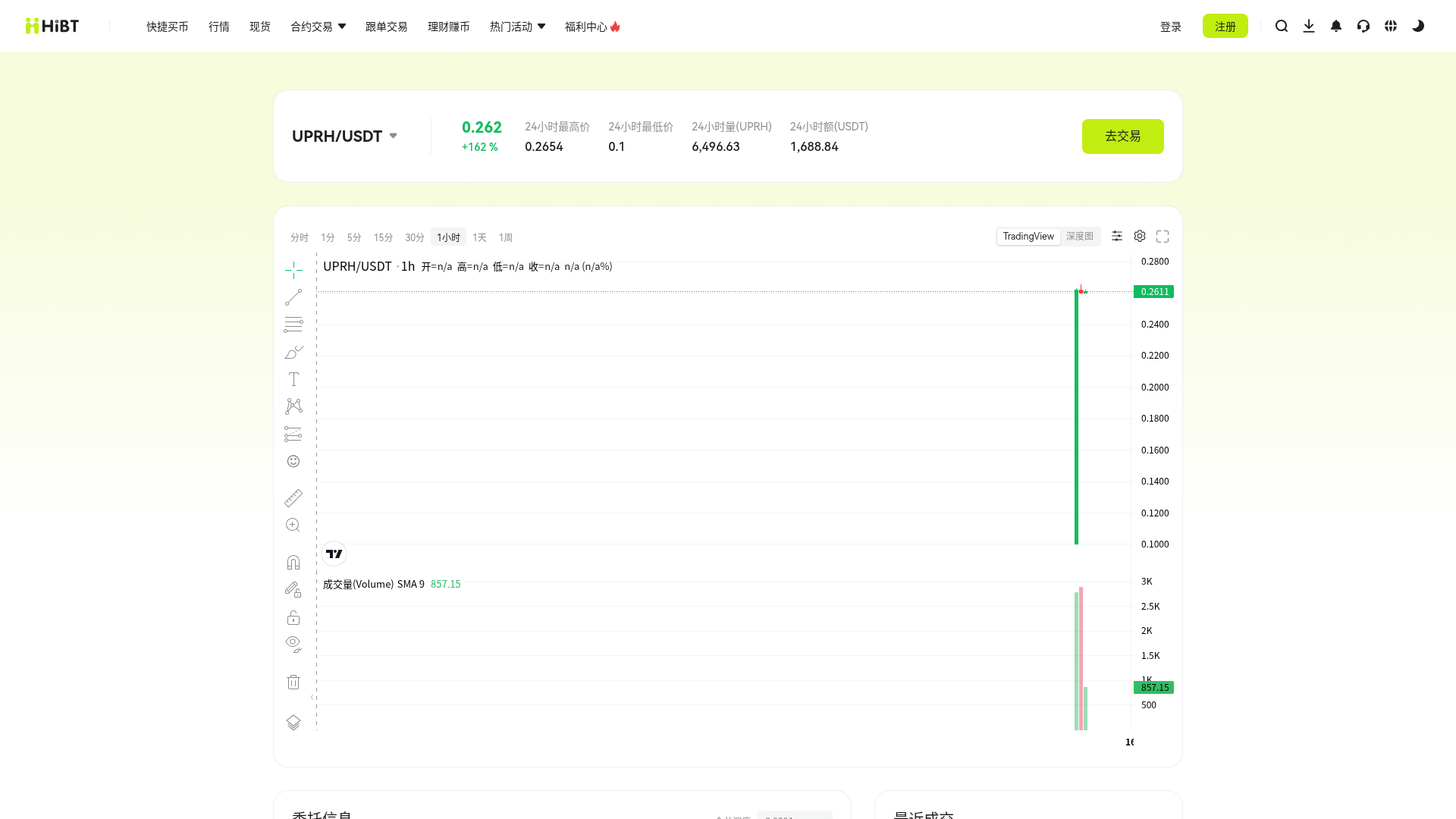
Step 4: Check liquidity. This is the issue UPRH most needs to confront right now. Open UPRH Price and Chart, and you'll see that its 24-hour volume and turnover have long been close to zero. What low liquidity actually means:
- When you want to buy, there may not be enough supply; try to buy a little more and you'll push the price up yourself (slippage);
- When you want to sell, there may be no counterparty, and paper gains can't be turned into real money;
- Even a slightly larger order can cause violent price swings, making candlestick patterns nearly useless as a reference.
Step 5: Check community authenticity. Having Twitter and Telegram doesn't mean having a community. Look at the quality of engagement: if posts are flooded with generic "To the moon" comments, they're likely bot-generated volume, not real holders discussing the project.
Chapter takeaway: Run UPRH through these five steps, and the answer to most questions is "can't find it" or "not good." This isn't meant to scare you off; it's meant to help you enter the next chapter with the right risk expectations.
3. How to Read UPRH Market Data: Don't Just Stare at Price
When beginners open UPRH's market page, they tend to look only at "what's the price right now." Experienced traders look at three other sets of data.
First group: 24-hour high/low and volume. The price range tells you the magnitude of volatility; volume tells you how much substance that volatility has. UPRH's volume is currently close to zero, meaning any price move may be caused by just a few scattered trades and cannot be used to judge a trend.
Second group: the depth chart. The depth chart shows the current distribution of bids and asks. For low-liquidity tokens, the depth chart is more important than the candlestick chart—it directly tells you how much you'll push the price down if you sell now.
Third group: recent trades. Look at trade frequency and average trade size. If there are only a handful of trades a day, you need to recognize clearly: what you're facing is more like an over-the-counter market than a fully traded public market.
Chapter takeaway: The core feature of UPRH's current market data is low liquidity. For live data, go to UPRH/USDT Live Price and Depth Chart. All data should be based on the page as of the day you check it.
4. Three Things You Must Know About "UPRH Price Predictions"
When you search for UPRH, you'll likely see price prediction pages listing target prices for 2027, 2030, or even 2050. Before believing those numbers, understand three things.
1. How are predictions generated? HiBT's price prediction page clearly states that "all price predictions are generated based on user feedback." In other words, these numbers reflect community sentiment and expectations, not institutional research, quantitative models, or fundamental valuation.
2. Why are predictions for low-liquidity tokens inherently unreliable? Price predictions are only meaningful when there is a sufficiently traded market. When volume is close to zero, the price itself lacks a basis for consensus, and any extrapolated "future price" is just a numbers game.
3. What's the right way to use them? Use the prediction page as a sentiment indicator, not a reason to buy: if community expectations are extremely bullish while liquidity hasn't improved at all, that's actually a warning sign. You can see the current community expectation range on the UPRH 2026–2030 Price Prediction page (e.g., about ¥1.81 for 2027 and about ¥2.14 for 2030, based on the user-feedback predictions shown on the page), but remember the disclaimer at the bottom: for reference only, not investment advice.
⚠️ Warning: Any price prediction that "guarantees returns," whether from a platform, influencer, or community admin, is a red flag.
5. The Broader Market Determines the Fate of Small-Cap Tokens: Watch BTC and ETH First
A common beginner mistake is studying a small-cap token in isolation while ignoring the broader environment that determines its fate.
Why does the broader market set the direction for small caps? Crypto capital flows top-down: when risk appetite rises, money moves from BTC to ETH and then spills over into small- and mid-cap tokens; when risk appetite falls, capital retreats in reverse order, and small caps often fall hardest and recover slowest. That's why micro-cap tokens are called "high-beta assets"—more upside in rallies and deeper losses in selloffs.
What should you watch now? Before making a judgment on UPRH, check BTC Price Prediction and ETH Price Prediction to see community expectations for the broader market, then combine that with sentiment indicators such as the Fear & Greed Index to assess where we are in the cycle.
A practical framework:
- BTC in an uptrend + improving market sentiment → small caps have a chance to perform, but each still needs individual due diligence;
- BTC in a downtrend or sideways low-volume "dead zone" → low-liquidity small caps will likely keep grinding lower, and buying assets like UPRH at that point has a significantly lower win rate.
Chapter takeaway: Buying UPRH essentially adds a layer of high-leverage-like high-risk exposure on top of the broader market direction. Get the direction wrong, and even a tiny position loses.
6. Peer Comparison: How UPRH Differs From and Resembles Small-Cap Tokens Like HOOKR and BORDR
Looking at UPRH in isolation can create the illusion that "it's special." Put it alongside similar assets, and its risk profile becomes much clearer.
HOOKR and BORDR are also early-stage tokens listed on HiBT with similarly low market caps and liquidity. Compare all three using the same due diligence framework from Chapter 2, and you'll find they share a set of typical traits:
Dimension
Shared profile of UPRH / HOOKR / BORDR
Information transparency
Public information is limited; project details are hard to verify independently
Liquidity
Low volume, thin bid/ask depth, high slippage
Price volatility
A single trade can cause violent swings; candlestick charts have little reference value
Core risks
Liquidity drying up, information asymmetry, project shutdown, exchange delisting
Potential upside
Small market-cap base; if the project is validated, upside elasticity can be large
Chapter takeaway: UPRH is not a special case; it belongs to the asset class of "low-cap new tokens." The real decision isn't "Is UPRH good or bad?" but "Do I want to allocate a spot in my portfolio to this type of high-risk asset, and how much?" To learn more about similar assets, read the project breakdowns for What Is HOOKR and What Is BORDR.
7. Is UPRH Worth Buying? The Balance of Opportunity and Risk
Now let's answer the question in the title directly. The responsible answer is: there is no one-size-fits-all "worth it" or "not worth it"—only a decision that matches or doesn't match your risk tolerance. Here are both sides of the scale.
Opportunity side:
- Small market-cap base: if the project is later validated (whitepaper released, community gains traction, liquidity improves), early participants do have more upside elasticity than with mature coins;
- During bull-market sentiment spillover, low-cap tokens can see sharp short-term rallies.
Risk side (each has played out repeatedly in reality):
- Liquidity risk: You can buy in but can't sell out; paper gains can't be realized—this is UPRH's most real risk right now;
- Information asymmetry: The project team knows far more than you do; scarce public information means you're piecing things together blind;
- Project team risk: Small projects shutting down, teams disappearing, and soft rug pulls are not rare in this industry;
- Delisting risk: Tokens with no volume for long periods may be delisted by exchanges, at which point liquidity can go to zero.
Three self-check questions before deciding:
- If I lose all this money, will it affect my life? (Yes → don't buy)
- Can I explain UPRH's value proposition to someone else in three sentences? (No → research first, don't buy)
- Do I know under what conditions I will sell after buying? (No → make an exit plan first)
Chapter takeaway: For the vast majority of beginners, UPRH's current risk-reward ratio is not favorable; if you still want to participate, it should only be a small "money you can afford to lose entirely" trial position. You can check community expectations on UPRH Future Price Trend Prediction, but just remember it is only a sentiment reference.
8. If You Decide to Buy: An Actionable UPRH Strategy for Beginners
Suppose you passed the self-check in the previous chapter and decide to participate with a small amount. Here is a set of rules you can follow directly.
Rule 1: Position sizing. Capital allocated to high-volatility small caps like UPRH should be no more than 1%–5% of your total crypto portfolio, and no more than a small fraction of your total investable assets. The test is simple: if this position goes to zero, you can still sleep normally that night.
Rule 2: How to buy. For low-liquidity tokens, always use limit orders—do not sweep the book with market orders. In a thin order book, a market order can raise your cost basis by several or even dozens of percentage points. If funds allow, split purchases into 2–3 batches to reduce timing risk.
Rule 3: Stop-loss and take-profit. Decide before buying, not after a drop:
- Stop-loss: e.g., exit unconditionally at -30%. With low-liquidity tokens, there is no averaging down, because there may be no bottom;
- Take-profit: e.g., at +100%, sell half to recover principal, then use a trailing stop on the rest to capture further upside.
Rule 4: Execution path. Register and complete identity verification on HiBT → deposit USDT → search for the UPRH/USDT trading pair → place a limit buy order. HiBT holds MSB licenses in Canada and the US; choosing a licensed, compliant platform is one of the few safety variables you can control in small-cap trading.
Rule 5: Asset security. If you plan to hold rather than trade short-term, consider withdrawing to a self-custody wallet; always verify the contract address, test with a small amount first, and beware of any "support" asking for your seed phrase.
Chapter takeaway: In small-cap investing, 80% of success comes from discipline; only 20% comes from picking the token. Check the live depth for Trade UPRH on HiBT now. Watching the order book for a few days before deciding whether to act is never too late.
9. FAQ
Q1: What is UPRH? UPRH is a low-cap digital asset token that trades in the UPRH/USDT pair on HiBT. Public information about its project background, team, and tokenomics is currently limited, making it an early-stage asset with low transparency.
Q2: Where can I buy UPRH? It can currently be bought on HiBT via the UPRH/USDT trading pair. HiBT is a Canada-registered exchange that holds MSB licenses in Canada and the US.
Q3: What is UPRH's price now? Prices change in real time, and the token has low volume, so a single trade can cause noticeable swings. Please refer to the live data on the UPRH/USDT market page.
Q4: How high can UPRH go? Are predictions reliable? Market price predictions are mostly based on user feedback or simple model extrapolation, which have limited value for low-liquidity tokens and should not be used as a basis for buying. Any claim that guarantees specific returns is not credible.
Q5: What is the biggest risk of investing in small-cap tokens? Liquidity risk—it may look like it's up a lot, but when you want to sell, there aren't enough buyers, so profits can't be realized. Next are information asymmetry and project shutdown risk.
Conclusion
Back to the three original questions: What is UPRH—an early-stage token with scarce information and extremely low liquidity; Is it worth buying—for most beginners, risk outweighs opportunity; If you must buy—use a position you can afford to lose entirely, limit orders, and preset stop-loss and take-profit levels. Treat it as a small experiment, not a chance to turn your life around.
In crypto, surviving long matters more than making money fast.
Disclaimer: This content is for informational reference only and does not constitute investment advice, an offer, or a solicitation. Crypto asset prices are highly volatile, and past performance does not guarantee future results. Do your own research (DYOR) before making decisions and consult a licensed professional if necessary. Data in this article is as of October 15, 2026; for real-time data, refer to HiBT's official pages.