
What is DACITY? In one sentence, Dacity Coin is a community meme token that appeared on Robinhood Chain on October 15, 2026. Its narrative comes from the “Dacity” city element seen in GTA VI-related footage. It was not officially issued by Rockstar Games, Take-Two Interactive, or Robinhood, and there is no evidence that holding DACITY grants any in-game benefits, company equity, or protocol revenue.
My conclusion is clear: DACITY currently has short-term trading value, but there is not enough evidence to prove it has long-term investment value.
If you buy DACITY, what you are really buying at this stage is not product revenue, cash flow, or mandatory token demand. You are buying “how long GTA VI-related discussion can last,” “whether DACITY can become a representative meme on Robinhood Chain,” and “whether the next wave of capital is willing to keep coming in.” This is a bet on the lifespan of attention, not an investment validated by fundamentals.
As of October 16, 2026, the target contract recorded by CoinGecko is:
0x94fc9ed527fc12d3c25229c44922e210f7e9fef0
At that time, CoinGecko showed DACITY trading at about $0.0197, with 24-hour volume of about $75.35 million, total supply and maximum supply of 1 billion tokens, but circulating supply had not yet been reported. Therefore, FDV should not be treated as a verified circulating market cap. Price, volume, and holder data change quickly, and must be re-verified before any actual trade.
Risk disclaimer: This article is for project research and market education and does not constitute investment advice. DACITY is a newly launched, highly volatile meme asset with a very short track record. Its price may spike or collapse toward zero in a very short period.
Before Investing in DACITY, the First Thing Is Not to Look at Price but to Confirm “Which DACITY You Are Buying”
The most easily overlooked risk with DACITY is not price. It is asset identity.
There are currently multiple similarly named Dacity Coin, DACITY, or DCITY contracts across Robinhood Chain, Solana, BNB Chain, and other networks. Even within Robinhood Chain, there are different contracts and different trading pools.
A DexPaprika page shared by the user appears related to Dacity, but that page actually corresponds to a TTWO/DCITY pool created on October 15, 2026. The DCITY contract is:
0xb70de0092eb7360fea1c8dd27e05ea2bbc161e18
The Dacity Coin (DACITY) contract currently identified by CoinGecko and major market data sources is:
0x94fc9ed527fc12d3c25229c44922e210f7e9fef0
The main pool to monitor is the DACITY/ETH pool on Uniswap v4:
0x991c425a46b4d2d3f614c61676eb7a527e7d39f9486afe0ead0d85ab4579452c
These are not the same token. Similar tickers, similar names, or shared GTA themes do not prove the assets are the same.
Before buying, you must verify in this order:
- Chain: Is it Robinhood Chain?
- Contract: Is it the exact contract you intend to research?
- Pool: Where is liquidity concentrated?
- Pair: Is the quote asset ETH, USDT, or another token?
- Liquidity: Can actual depth handle your order?
- Platform Mapping: Which on-chain contract does the centralized platform’s DACITY actually map to?
If you cannot even accurately confirm what token you are researching, it does not qualify as an investment candidate.
Why Did DACITY Suddenly Explode? What Drove It Was Not Fundamentals but Attention
DACITY’s spread followed a classic path: a popular game’s cultural element sparked discussion, the community turned the Dacity concept from the footage into a token, Robinhood Chain’s new-asset environment accelerated discovery, and rising prices drew further attention from market data sites, influencers, and short-term traders.
Its upside logic can be summarized as:
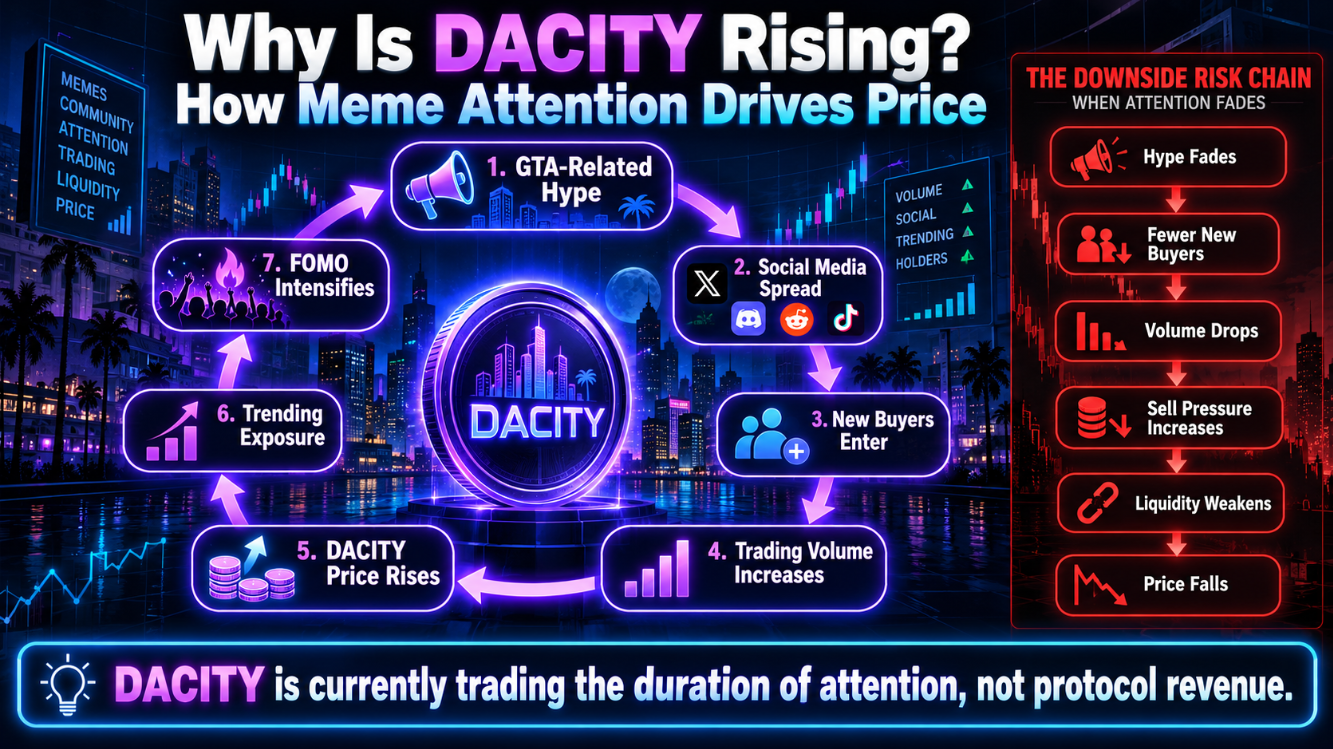
Hot topic emerges → social spread → new buyers → volume rises → price rises → more people notice → FOMO → volume rises further.
This is the “DACITY attention flywheel.”
It starts fast, but it can reverse just as fast. Once GTA-related discussion declines, or a more viral new meme appears on Robinhood Chain, the reverse flywheel can kick in:
Attention falls → new buyers decline → rally stalls → profit-taking begins → liquidity comes under pressure → price falls → more users leave.
For memecoins, the biggest risk is often not “the product failed.” It is that the market suddenly stops talking about it.
What Exactly Is DACITY’s Relationship to GTA VI? Where Do People Misunderstand It Most?
DACITY leverages GTA VI-related cultural narrative, but that does not equal an official partnership.
The project publicly describes itself as a community fan meme token and explicitly states that it is not sponsored, supported, or endorsed by Rockstar Games or Take-Two Interactive. In other words, DACITY can use GTA culture to spread, but it does not thereby gain the GTA brand, game revenue, intellectual property, or an official commercial relationship.
Investors must distinguish four things:
- A name appears in game footage or a trailer;
- The community creates a meme around that name;
- A third party deploys a token with the same name;
- Rockstar or Take-Two officially issues, partners with, or endorses it.
The first three may happen. There is currently no reliable evidence of the fourth.
If you are planning to buy because “DACITY is the official GTA VI coin,” I suggest you stop right there. That investment thesis is fundamentally wrong.
Does DACITY Actually Have a Product? Why You Can’t Value It Like a Project Token
To judge whether a token can be held long term, you cannot just look at website packaging. You need a four-layer value review.
The first layer is product: Does DACITY have a product that solves a real problem, and must users use it?
The second layer is revenue: Are there protocol fees, subscription revenue, business cash flow, or other verifiable revenue?
The third layer is token demand: Does not holding DACITY affect a user’s ability to use some service?
The fourth layer is value capture: Can product growth be passed through to the token via fees, buybacks, staking, or other mechanisms?
As of the data cutoff for this article, public information mainly emphasizes community meme status and GTA-related cultural origins. It has not established a mature product, protocol revenue, or mandatory token demand. Therefore, DACITY is not suitable for valuation using TVL, protocol revenue, P/E ratios, or cash-flow models.
It is better evaluated with a meme-asset framework:
Narrative strength × community spread × new buyers × trading volume × liquidity × holder distribution.
DACITY’s biggest asset right now is not technology. It is attention.
DACITY’s Volume Is Huge—So Why Won’t I Buy Just Because Volume Is High?
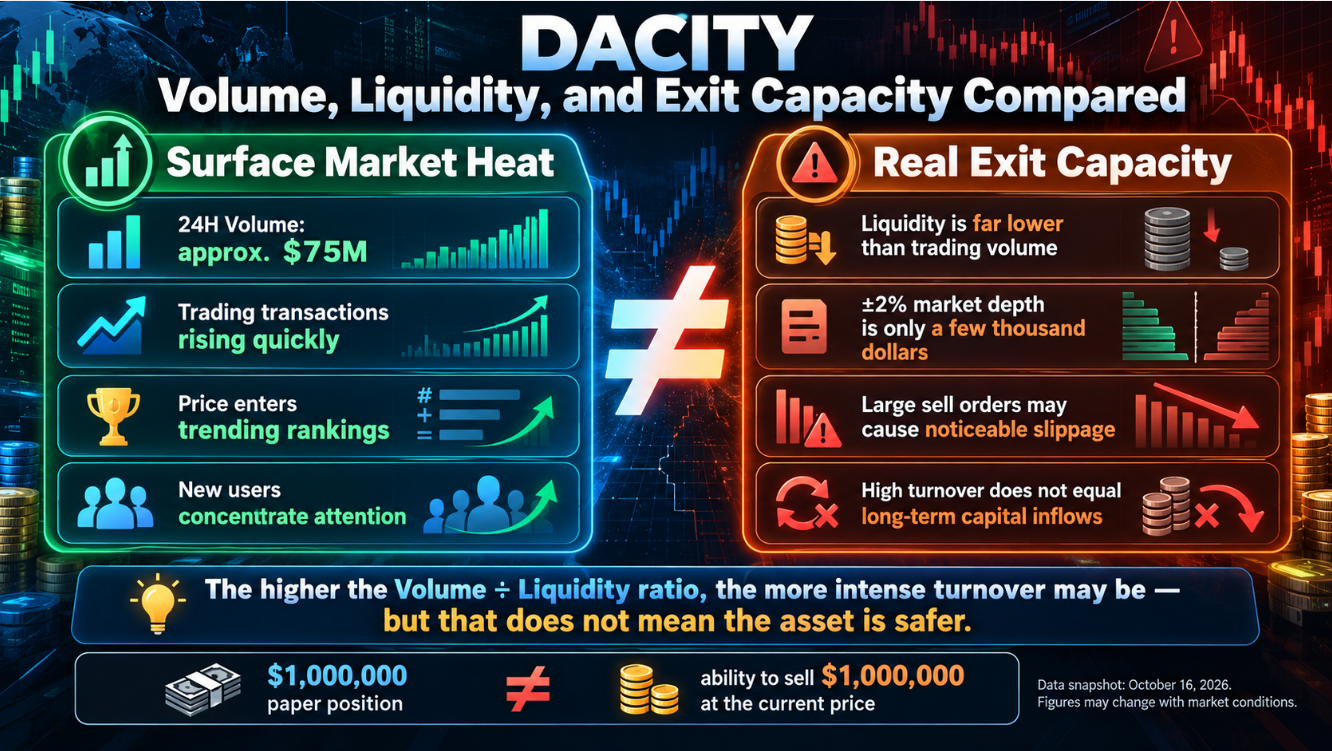
CoinGecko’s October 16, 2026 snapshot showed DACITY’s 24-hour volume at about $75.35 million, with the main active market being the Uniswap v4 DACITY/ETH pair on Robinhood Chain. That number can easily create the illusion of “plenty of capital.”
But the same market page showed only about $4,430 and $4,417 in buy and sell depth within 2% of the price, respectively. Another set of on-chain monitoring data recorded pool liquidity of roughly $200,000 to $400,000 at different times, far below the tens of millions of dollars in volume.
This means three metrics must be understood separately.
Volume Shows Frequent Trading, Not Long-Term Capital Staying
The same capital can be traded back and forth many times in a day. Market making, arbitrage, bot trading, and short-term flipping all inflate volume. $75 million in volume does not mean $75 million in long-term net inflows.
Liquidity Determines Exit Capacity
Pool depth and order impact determine how much slippage a large sell causes. When price rises, the market cap shown on a page can increase quickly. But when you actually exit, the capital available to absorb your sell orders may be far less than the paper valuation.
Volume / Liquidity Reflects Turnover Intensity
When volume is far higher than liquidity, it shows trading is extremely intense and also means capital flows have a large impact on price. A high ratio can be a heat signal and a structural risk signal at the same time.
So the most important thing to study about DACITY now is not “how big is the volume,” but: of that volume, how much is actually liquidity capable of supporting exits?
The Most Dangerous Part of DACITY Right Now: Price, Valuation, and Capital Capacity May Be Completely Mismatched
The four most common illusions in new-token markets are:
- Fast price increases do not mean strong capital capacity;
- An FDV of tens of millions of dollars does not mean the same amount of real capital flowed in;
- High volume does not mean traders intend to hold long term;
- Rapid holder growth does not mean every address is an independent long-term investor.
Addresses are not users. One trader can control multiple wallets. Bots can generate massive numbers of transactions. Liquidity pools and router contracts may also appear in holder counts. When analyzing, you must separate “address count” from “unique users” and “real buyers.”
DACITY Tokenomics: What Does a 1 Billion Token Supply Actually Mean?
Public market data shows the target contract’s total and maximum supply are both 1 billion tokens. At about $0.02, that implies an FDV of nearly $20 million.
But CoinGecko had not reported circulating supply at the time, so investors cannot call FDV the circulating market cap, nor can they claim all tokens are already in market circulation without verifying the distribution structure.
What still needs to be verified:
- How many of the 1 billion tokens went into liquidity pools;
- How much is held by the creator, related wallets, and early addresses;
- Whether multiple addresses are controlled by the same person;
- Whether the contract retains minting, freezing, blacklisting, or fee-modification privileges;
- Whether LPs can withdraw and whether liquidity is locked;
- Whether there are additional token releases or migration plans.
Some monitoring pages at one point showed top 10 balances at roughly 1% to 3%, but until pool addresses, routers, burn addresses, and related wallets are excluded, that figure cannot directly prove genuinely widespread token distribution. Data within hours of a new token’s launch also changes rapidly.
What Matters Most About DACITY Is Not Price but Six On-Chain Metrics
1. Holder Growth
Watch whether new addresses continue to grow, not just the total on day one. If price keeps rising but holder growth stalls, the rally may mainly be existing capital trading with itself.
2. Unique Buyers
Unique buyers matter more than transaction count. One bot can generate thousands of trades while representing only a single capital entity.
3. Liquidity
Is liquidity increasing along with price? If FDV doubles while pool depth stays the same, exit risk actually increases.
4. Volume Sustainability
A genuine second-stage rally requires volume to hold for several days, not just spike for a few hours after launch and then quickly fade to zero.
5. Buy/Sell Ratio
Look at both buy/sell amounts and the number of unique buyers and sellers. If price hits new highs but net selling increases, it often means profit-takers are distributing.
6. Top Holder Concentration
Do not just look at the static top 10 share. Also watch changes in large wallet balances, related transfers, and whether they keep sending tokens to pools or exchanges.
When Is DACITY Worth Buying? My Six Conditions
I would only put DACITY on a high-risk watchlist when most of the following conditions are met at the same time:
- GTA and Dacity-related discussion is still spreading, rather than only the project community talking to itself;
- New holders and unique buyers are growing consistently;
- Volume is not a one-day spike and continues to hold;
- Liquidity and FDV improve together, and slippage on larger orders declines;
- No evidence of concentrated selling into the pool by the creator or whales;
- Price forms a structure after the first emotional release rather than going vertical.
Even if these conditions are met, it only means the short-term structure is relatively healthy. It does not mean DACITY has become a long-term value coin.
When You Should Absolutely Not Buy DACITY
When the following appear, my answer is always “do not chase”:
- Price explodes but holders and unique buyers stop growing;
- Volume surges but liquidity does not improve;
- Community content is nothing but “10X, 100X” and price-target slogans;
- Large numbers of influencers post identical copy in a short period;
- Buying and token distribution become increasingly concentrated in a few addresses;
- The contract, trading pool, or official identity cannot be confirmed;
- You are only FOMOing because you missed the first wave;
- BTC falls rapidly and the broader market enters a risk-off phase.
The easiest time to lose money trading memes is often not when the project is at its worst, but when everyone starts believing it “can’t go down.”
Is DACITY Worth Buying? My Verdict: Tradeable, but Not Worth a Heavy Long-Term Hold

The conclusion is simple:
- Short term: worth watching;
- Swing trading: worth studying, but data must be tracked;
- Long term: insufficient evidence;
- Beginners chasing highs: not recommended;
- Heavy positions: not recommended.
DACITY Investment Strategy: What I Would Do
Don’t Chase the First Explosive Candle
A new token’s first rally usually mixes price discovery, bots, early holders, and FOMO. My approach is to wait for the first emotional release, observe volume, liquidity, and new buyers after the pullback, and then decide whether to participate.
Use Only a Small Position to Test the Thesis
Position size should be based on maximum acceptable loss, not imagined upside multiples. For an asset like DACITY, the reasonable cap is not “how much can I buy,” but “if it goes to near zero, is that still acceptable for my overall account?”
Split Into a Watch Position, Confirmation Position, and Trend Position
The first buy only tests the thesis. The second requires confirmation from holders, liquidity, and volume sustainability. The third is considered only if the trend continues and exit conditions are clear. If the first-stage data deteriorates, do not move to the next stage.
Set Exit Conditions Before Placing an Order
Exits should not rely only on a fixed percentage stop. You can also set thesis-based stops: liquidity drops sharply, unique buyers decline, large holders keep selling, the narrative is replaced, or BTC enters a rapid decline.
Using HIBT as an Example: If You Want to Buy DACITY, What Is the Correct Process?
Step one: confirm the full contract, not just search for “DACITY.”
Step two: confirm that the network shown on the platform, the deposit/withdrawal network, and the on-chain token are consistent.
Step three: check real-time price, volume, bid/ask depth, and spread, and compare them with the main on-chain pool.
Step four: prepare USDT, but use only a small test order the first time.
Step five: prefer limit orders and confirm the actual execution price and slippage.
Step six: write down exit conditions before buying. Do not decide on the fly after price falls.
As of the verification time of this article, it has not been confirmed that HIBT has opened DACITY/USDT spot trading. Therefore, this article cannot state that “HIBT can already buy DACITY.” The more accurate statement is: if HIBT later lists DACITY/USDT, users should still first verify the platform’s mapped contract, network, and trading depth, then trade according to the process above.
How Should You View DACITY Price Predictions? Don’t Let Forecasts Replace Judgment
DACITY’s trading history is too short, lacking daily cycles, complete holder-distribution changes, and multiple market phases. Giving fixed 2027 or 2030 price targets at this point creates a sense of precision far greater than the actual credibility.
A more reasonable approach is to build three conditional scenarios:
Bull Case
DACITY becomes a representative meme on Robinhood Chain, GTA-related culture keeps spreading, holders, unique buyers, and liquidity grow together, and it gains support from more wallets or trading platforms.
Base Case
First-day hype fades, but the community retains some core users, volume normalizes, and price fluctuates repeatedly in a wide range.
Bear Case
GTA discussion cools, a new meme shifts attention away, volume and new buyers decline, pool depth shrinks, and early holders exit in a concentrated way.
You can refer to UPRH price prediction to understand how market expectations for small-cap Robinhood Chain assets are expressed, but UPRH is a different asset, and its prediction cannot be directly applied to DACITY.
Why DACITY Must Be Watched Alongside BTC and ETH
DACITY does not exist in an isolated market.
When BTC real-time quotes stay strong and market risk appetite expands, capital is more willing to flow from core assets into small-cap memes. Conversely, when BTC falls rapidly or the market deleverages, high-beta, low-liquidity memes usually come under pressure first. Investors can use BTC price prediction to gauge the overall risk environment, but BTC rising does not prove DACITY’s fundamentals have improved.
ETH price prediction can help observe on-chain capital and DeFi risk appetite. ETH is not a direct fundamental indicator for DACITY; it is only a market-environment indicator.
What Are the Fundamental Differences Between DACITY, HOOKR, and BORDR?
DACITY, HOOKR, and BORDR may all appear on new-token lists, but their valuation logic is completely different.

What Is HOOKR / Hookr.fun mainly discusses Uniswap v4 Hooks trading infrastructure. What Is BORDR / Bordrless focuses on programmable token standards. At least they can attempt to establish a chain from usage to revenue to token value capture.
DACITY currently lacks the same commercial loop. If your goal is long-term fundamental investing, projects with product logic like HOOKR and BORDR are more worthy of deeper research. If your goal is high-risk meme trading, DACITY is the corresponding target.
DACITY’s Biggest Bull Case and Bear Case
DACITY’s biggest bull case is just one thing: becoming the representative meme of Robinhood Chain.
If Robinhood Chain keeps growing, DACITY forms a stable cultural identity, and its community, liquidity, and trading access continue to expand, the market may give it a higher valuation. But this is still a bull case for an attention asset, not a bull case for business revenue.
DACITY’s biggest bear case is also just one thing: attention disappears.
Once GTA discussion declines and a stronger hot topic appears on Robinhood Chain, new capital will look for the next meme. DACITY’s biggest competitor is not even another Dacity. It is the next hotter story.
DACITY “Buy, Watch, Abandon” Decision Table

FAQ: The Most Common Questions About DACITY
What is DACITY?
DACITY is a community meme token on Robinhood Chain whose value is mainly driven by GTA-related culture, community spread, market attention, and liquidity.
Is DACITY the official GTA VI token?
No. The project publicly describes itself as a fan meme token and states that it is not sponsored, supported, or endorsed by Rockstar Games or Take-Two Interactive.
Is DACITY an official Robinhood project?
There is no evidence that it was issued by Robinhood. Being deployed on Robinhood Chain does not equal official Robinhood endorsement.
What is DACITY’s contract address?
The target Robinhood Chain contract currently identified by CoinGecko is 0x94fc9ed527fc12d3c25229c44922e210f7e9fef0. Same-name tokens exist in the market, so you must re-verify before trading.
Why did DACITY suddenly rise?
The main reasons are GTA VI-related narrative, new-token price discovery, Robinhood Chain hype, social spread, and concentrated short-term capital, not product revenue growth.
What does high DACITY volume mean?
It means trading is active, but it does not equal long-term net capital inflows. It must be judged alongside liquidity, unique buyers, buy/sell structure, and slippage.
How is DACITY’s liquidity?
Data changes quickly. At the time of verification for this article, publicly available liquidity and ±2% market depth were clearly smaller than 24-hour volume, so large entries and exits may face significant slippage.
Is DACITY worth buying?
It is suitable for experienced traders as a high-risk small-position watch, but not for beginners chasing highs or as a long-term core position.
Is DACITY suitable for long-term holding?
Currently, it is not suitable to hold as a long-term value coin because there is no mature product, revenue, or mandatory token demand visible yet.
Could DACITY go to zero?
It is possible. Once attention and liquidity disappear at the same time, a memecoin’s price can suffer an extreme drawdown.
How do you buy DACITY?
First confirm the network, full contract, and trading pool, then choose a platform that supports the asset or a DEX on Robinhood Chain. Do not search only by ticker.
Conclusion: DACITY Has Trading Value but Not Yet Long-Term Investment Value
My view is clear: DACITY currently has trading value, but not enough long-term investment value.
Its biggest strengths are GTA-related hype, virality, and early trading activity, not product, revenue, or mandatory token demand. What the market is really trading right now is “whether DACITY can remain a hot meme on Robinhood Chain.”
I will not take a heavy long-term position just because DACITY’s volume is large, nor will I value it as an official asset or mature project just because it has a narrative link to GTA VI. When volume is far higher than liquidity, the noisier the numbers, the more you need to focus on the exit route.
If hype continues, holders and unique buyers grow, and liquidity improves alongside it, DACITY can be watched as a high-risk meme trading opportunity. If volume declines, new buyers decrease, and liquidity does not keep up, I would prioritize exiting rather than waiting for a so-called “value reversion.”
For crypto newcomers, my advice is: don’t chase highs, don’t take heavy positions, and don’t treat memes as long-term assets.
For experienced traders, the most important question to study about DACITY is not “can it go up 100x,” but: will the next wave of capital keep coming in, and can you exit smoothly before attention disappears?
Data Sources and Update Time
The data in this article was verified on October 16, 2026, with primary references from CoinGecko’s Dacity Coin market page, Robinhood Chain ecosystem pages, DexPaprika pool data, DexBrief on-chain summaries, and the Robinhood Chain block explorer. New-token data changes extremely quickly; price, volume, liquidity, holders, and contract status should all be re-verified before trading.